


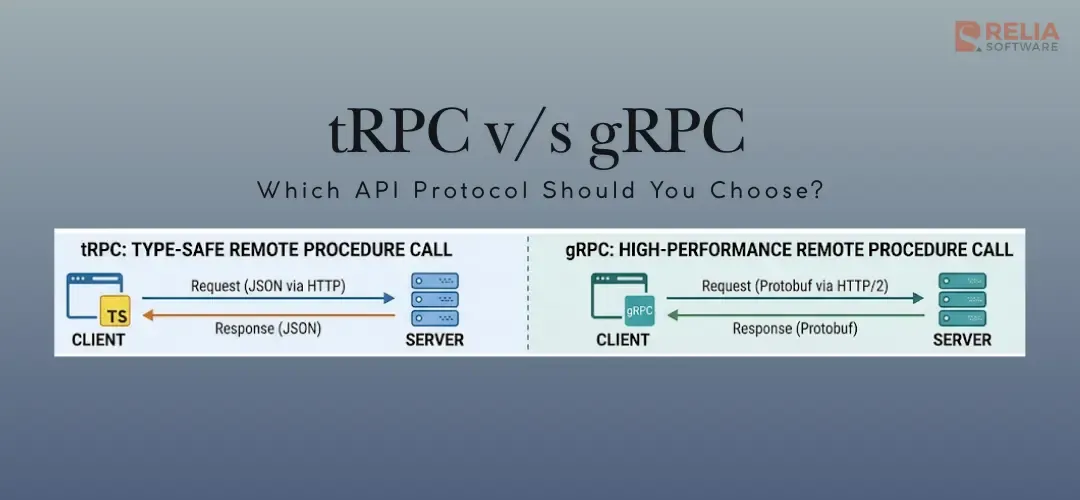
tRPC is a code-first, zero-codegen framework that prioritizes developer experience by inferring types directly from server code for TypeScript-only stacks. Whereas, gRPC is a schema-first, high-performance framework that uses Protocol Buffers and code generation to enable communication across multiple programming languages.
Choosing between tRPC and gRPC can make or break your API architecture. One gives you zero-friction TypeScript type safety, while the other gives you raw performance and polyglot interop across dozens of languages.
This guide breaks down the real differences between tRPC and gRPC with code examples, performance benchmarks, real-world use cases, and a decision framework so you can pick the right one for your project.
What Is tRPC vs gRPC?
tRPC
tRPC (TypeScript Remote Procedure Call) is a framework for building end-to-end type-safe APIs in TypeScript without schemas, code generation, or API specs. Your server code is the contract. TypeScript inference flows from backend to frontend automatically.
// server.ts — define a procedure
import { initTRPC } from '@trpc/server';
import { z } from 'zod';

const t = initTRPC.create();

export const appRouter = t.router({
  getUser: t.procedure
    .input(z.object({ id: z.string() }))
    .query(async ({ input }) => {
      const user = await db.user.findUnique({ where: { id: input.id } });
      return user; // Return type is inferred automatically
    }),

  createUser: t.procedure
    .input(z.object({
      name: z.string().min(1),
      email: z.string().email(),
    }))
    .mutation(async ({ input }) => {
      return db.user.create({ data: input });
    }),
});

export type AppRouter = typeof appRouter;// client.ts — fully typed, zero codegen
import { createTRPCClient, httpBatchLink } from '@trpc/client';
import type { AppRouter } from './server';
const trpc = createTRPCClient<AppRouter>({
links: [httpBatchLink({ url: 'http://localhost:3000/trpc' })],
});
// Auto-complete works. Type errors caught at compile time.
const user = await trpc.getUser.query({ id: '123' });
console.log(user.name); // ✅ Fully typedKey traits: Code-first, JSON over HTTP, no codegen, TypeScript-only, Zod validation built-in.
gRPC
gRPC (Google Remote Procedure Call) is a high-performance RPC framework that uses Protocol Buffers (Protobuf) for serialization and HTTP/2 for transport. It supports 11+ programming languages natively.
You define contracts in .proto files, then generate client and server code:
// user.proto — define the contract
syntax = "proto3";

package user;

service UserService {
  rpc GetUser (GetUserRequest) returns (User);
  rpc CreateUser (CreateUserRequest) returns (User);
  rpc StreamUsers (StreamUsersRequest) returns (stream User);
}

message GetUserRequest {
  string id = 1;
}

message CreateUserRequest {
  string name = 1;
  string email = 2;
}

message User {
  string id = 1;
  string name = 2;
  string email = 3;
}// server.ts — implement the service (Node.js)
import * as grpc from '@grpc/grpc-js';
import * as protoLoader from '@grpc/proto-loader';
const packageDef = protoLoader.loadSync('user.proto');
const proto = grpc.loadPackageDefinition(packageDef) as any;
const server = new grpc.Server();
server.addService(proto.user.UserService.service, {
getUser: async (call, callback) => {
const user = await db.user.findUnique({ where: { id: call.request.id } });
callback(null, user);
},
createUser: async (call, callback) => {
const user = await db.user.create({ data: call.request });
callback(null, user);
},
});
server.bindAsync('0.0.0.0:50051', grpc.ServerCredentials.createInsecure(), () => {
server.start();
});Key traits: Schema-first (.proto IDL), binary Protobuf over HTTP/2, codegen required, polyglot, bidirectional streaming.
tRPC vs gRPC: Side-by-Side Comparison
| Feature | tRPC | gRPC |
| Contract | TypeScript types (code-first) | .proto files (schema-first) |
| Serialization | JSON | Protobuf (binary) |
| Transport | HTTP/1.1 or HTTP/2 | HTTP/2 |
| Language support | TypeScript only | 11+ languages (Go, Java, Python, Rust, C++...) |
| Code generation | None needed | Required (protoc or buf) |
| Type safety | Inferred from source code | Generated from .proto |
| Streaming | SSE subscriptions (v11) | Bidirectional streaming (native) |
| Browser support | Native (JSON/HTTP) | Requires gRPC-Web or ConnectRPC proxy |
| Payload size | Larger (JSON text) | 60-80% smaller (binary) |
| Setup complexity | Minimal (npm install + router) | Higher (proto files, codegen toolchain) |
| Validation | Built-in (Zod) | Schema-level only |
| Middleware | Built-in plugin system | Interceptors |
| Learning curve | Low (if you know TypeScript) | Medium-High (Protobuf + codegen concepts) |
Performance: gRPC Wins
2025 community benchmarks comparing API protocols on Node.js (results vary by hardware, concurrency, and payload shape):
| Metric | gRPC | tRPC | Difference |
| Avg latency | 342ms | 578ms | gRPC ~41% faster |
| Throughput | 4,700 req/s | 3,050 req/s | gRPC ~54% higher |
| Idle memory | 134MB | 172MB | gRPC ~22% lower |
| Payload size | Baseline | ~3-5x larger | Protobuf binary vs JSON |
| Serialization speed | 3-10x faster | Baseline | Protobuf vs JSON.parse |
Through the table, gRPC wins raw performance benchmarks decisively.
But tRPC's performance is more than adequate for most web applications serving <10,000 req/s. The time saved by having instant, zero-codegen type safety often outweighs the need for maximum throughput.
Otherwise, choose gRPC when your system reaches a scale where every millisecond and byte counts. For example:
- High-frequency inter-service communication,
- Real-time data pipelines,
- Mobile clients on constrained networks (smaller payloads),
- Systems processing millions of messages per day.
Type Safety: tRPC's Biggest Advantage
tRPC's killer feature is zero-codegen type safety. Change a server procedure, and your client gets a type error instantly, no build step, no regeneration.
// Change server return type...
getUser: t.procedure
  .input(z.object({ id: z.string() }))
  .query(async ({ input }) => {
    return {
      id: input.id,
      name: 'Alice',
      role: 'admin', // ← Added new field
    };
  }),

// Client auto-completes the new field immediately
const user = await trpc.getUser.query({ id: '1' });
console.log(user.role); // ✅ TypeScript knows about 'role'
With gRPC, you'd need to:
- Update the
.protofile - Run the code generator
- Import the new types
- Rebuild
This friction is minor for large teams with CI pipelines. For a solo dev or small team iterating fast? It's a significant DX (developer experience) tax.
Language Support: gRPC's Biggest Advantage
tRPC is TypeScript-only by design. If any part of your system isn't TypeScript, tRPC can't reach it.
gRPC supports 11+ languages with official client/server libraries, including Go, Java, C++, Python, Ruby, C#, Node.js, Dart, Kotlin, Swift, PHP. If your backend is Go, your ML pipeline is Python, and your mobile app is Kotlin, gRPC gives you one contract (.proto) that generates idiomatic clients for all of them.
// gRPC polyglot architecture
┌──────────┐    .proto    ┌──────────┐
│  Go API  │◄────────────►│ Python ML│
└──────────┘              └──────────┘
      ▲                        ▲
      │       .proto           │
      ▼                        ▼
┌──────────┐              ┌──────────┐
│ Kotlin   │              │ Node.js  │
│ Mobile   │              │ Gateway  │
└──────────┘              └──────────┘
tRPC vs gRPC for Microservices
When tRPC works for microservices: TypeScript-only monorepo microservices where all services share a single language. If your entire backend is Node.js/TypeScript in a Turborepo or Nx workspace, tRPC's zero-codegen DX can be faster to develop with.
// tRPC in a TypeScript monorepo (packages/api)
// Service A calls Service B directly with full type safety
import type { ServiceBRouter } from '@myapp/service-b';

const serviceB = createTRPCClient<ServiceBRouter>({
  links: [httpBatchLink({ url: process.env.SERVICE_B_URL })],
});

const result = await serviceB.processOrder.mutate({ orderId: '123' });
// ✅ Fully typed, zero codegen, instant refactoring
gRPC is the default choice for microservices, especially polyglot ones. Netflix, Uber, LinkedIn (50,000+ endpoints migrated), Square, Spotify, and TikTok all use gRPC for service-to-service communication.
Why gRPC wins here:
- Binary serialization = lower bandwidth between services
- HTTP/2 multiplexing = fewer connections
- Bidirectional streaming = real-time inter-service data flows
- Language-agnostic = each service in its best-fit language
- Established ecosystem for service mesh (Envoy, Istio, Linkerd)
tRPC vs gRPC for TypeScript and Next.js Projects
tRPC was purpose-built for the T3 Stack (Next.js + tRPC + Prisma + Tailwind) and TypeScript monorepos. It's the natural choice when:
- Your frontend and backend share a TypeScript codebase
- You use Next.js App Router or Pages Router
- You want React Query integration out of the box
- You're building a SaaS product with a single-language team
>> Read more: A Full Guide to Migrate from React Router to TanStack Router
// tRPC v11 + Next.js App Router
// app/api/trpc/[trpc]/route.ts
import { fetchRequestHandler } from '@trpc/server/adapters/fetch';
import { appRouter } from '@/server/routers/_app';

const handler = (req: Request) =>
  fetchRequestHandler({
    endpoint: '/api/trpc',
    req,
    router: appRouter,
    createContext: () => ({}),
  });

export { handler as GET, handler as POST };// React component with tRPC + TanStack Query v5
'use client';
import { trpc } from '@/utils/trpc';
export function UserProfile({ userId }: { userId: string }) {
const { data: user, isLoading } = trpc.getUser.useQuery({ id: userId });
if (isLoading) return <div>Loading...</div>;
return <h1>{user?.name}</h1>; // ✅ Fully typed
}gRPC in a Next.js app is possible but awkward. You need gRPC-Web or ConnectRPC as a proxy layer since browsers can't speak native gRPC.
When to Use tRPC?
Choose tRPC when:
- Your entire stack is TypeScript (frontend + backend);
- You're building a monorepo or full-stack app;
- You want the fastest possible development iteration speed;
- You're a solo dev or small team (<10 engineers);
- You use Next.js, Nuxt, or SvelteKit;
- You don't need to communicate with non-TypeScript services;
- Your scale is <10,000 req/s;
- You value DX over raw throughput.
Best for: SaaS products, internal tools, MVPs, T3 Stack apps, TypeScript monorepos.
When to Use gRPC?
Choose gRPC when:
- Your services use multiple programming languages;
- You need high throughput (>10,000 req/s) or low-latency communication;
- You're building microservices that communicate intensively;
- You need bidirectional streaming (real-time data, chat, IoT);
- Your payloads are large and bandwidth matters;
- You have a dedicated platform/infra team to manage tooling;
- You need a language-agnostic API contract;
- You're integrating with mobile clients (smaller payloads = better UX).
Best for: Microservices architectures, real-time systems, polyglot backends, high-throughput data pipelines.
Can We You Use Both tRPC and gRPC as a Hybrid Architecture Pattern?
Yes! Combining tRPC and gRPC as a hybrid approach is the 2026 best practice for many teams. The hybrid pattern uses each protocol where it excels:
┌─────────────────────────────────────────────────┐
│                   Browser / App                  │
└──────────────────────┬──────────────────────────┘
                       │ tRPC (JSON/HTTP)
                       ▼
              ┌─────────────────┐
              │  Next.js BFF    │
              │  (tRPC Router)  │
              └────┬───────┬────┘
          gRPC │           │ gRPC
               ▼           ▼
        ┌──────────┐ ┌──────────┐
        │ Go Auth  │ │ Python   │
        │ Service  │ │ ML Svc   │
        └──────────┘ └──────────┘
How it works:
- Frontend → BFF: tRPC for type-safe, zero-codegen client-server communication.
- BFF → Backend services: gRPC for high-performance, polyglot service-to-service calls.
This gives you tRPC's DX on the frontend and gRPC's performance + language flexibility on the backend.
// BFF layer: tRPC procedure calling a gRPC service
import { initTRPC } from '@trpc/server';
import { authServiceClient } from './grpc-clients/auth';

const t = initTRPC.create();

export const appRouter = t.router({
  login: t.procedure
    .input(z.object({ email: z.string(), password: z.string() }))
    .mutation(async ({ input }) => {
      // Call Go auth service via gRPC
      const result = await authServiceClient.authenticate({
        email: input.email,
        password: input.password,
      });

      return { token: result.token, user: result.user };
      // ✅ Frontend gets tRPC type safety
      // ✅ Backend gets gRPC performance
    }),
});
tRPC and gRPC Best Practices for Production
tRPC Best Practices
- Use Zod for input validation. It's the standard, and tRPC is optimized for it;
- Batch requests with
httpBatchLinkto reduce HTTP round-trips; - Split routers by domain (users, posts, billing) for maintainability;
- Use middleware for auth, logging, and rate limiting;
- Enable SSE subscriptions (v11) for real-time features instead of WebSockets;
- Keep procedures thin, business logic belongs in service layers, not procedures.
// ✅ Good: thin procedure, logic in service layer
getUser: t.procedure
  .input(z.object({ id: z.string() }))
  .use(authMiddleware)
  .query(({ input, ctx }) => userService.getById(input.id, ctx.user)),

// ❌ Bad: fat procedure with inline logic
getUser: t.procedure
  .input(z.object({ id: z.string() }))
  .query(async ({ input }) => {
    const user = await db.user.findUnique({ where: { id: input.id } });
    if (!user) throw new Error('Not found');
    const permissions = await db.permission.findMany({ where: { userId: user.id } });
    return { ...user, permissions };
  }),
gRPC Best Practices
- Use
bufinstead ofprotocfor better DX, linting, breaking-change detection; - Version your proto packages (
package user.v1) for backward compatibility; - Use streaming judiciously, unary calls are simpler; stream only when needed;
- Implement deadlines on every RPC call to prevent hanging requests;
- Use interceptors for cross-cutting concerns (auth, logging, tracing);
- Consider ConnectRPC for browser-facing gRPC services. It supports gRPC, gRPC-Web, and Connect protocols with one codebase.
// ✅ Good: versioned package, clear field documentation
syntax = "proto3";
package user.v1;

// User represents a registered account.
message User {
  string id = 1;
  string name = 2;
  string email = 3;
  google.protobuf.Timestamp created_at = 4;
}
How to Migrate from REST to tRPC vs gRPC?
REST to tRPC:
- Start with one route, wrap existing Express handlers;
- Use tRPC's Express adapter for incremental migration;
- Move validation from manual checks to Zod schemas.
REST to gRPC:
- Use ConnectRPC for a smoother transition (supports JSON and Protobuf);
- Define
.protofiles from your existing API contracts; - Migrate one service at a time behind a gateway.
FAQs
tRPC vs gRPC: Which is better?
Neither is universally better. tRPC is better for TypeScript-only stacks where development speed matters most. gRPC is better for polyglot microservices and high-performance requirements.
Can tRPC replace gRPC?
Only if your entire system is TypeScript. tRPC cannot generate clients for Go, Python, Java, or other languages. For TypeScript monorepos, tRPC can fully replace gRPC. For polyglot systems, it cannot.
Does tRPC work with microservices?
Yes, but only TypeScript microservices. In a TypeScript monorepo (Turborepo/Nx), tRPC provides excellent DX for inter-service calls. For polyglot microservices, use gRPC.
Is gRPC faster than tRPC?
Yes. gRPC is roughly 40-50% faster in latency benchmarks and handles 50%+ more throughput thanks to binary Protobuf serialization and HTTP/2. However, for most web applications, both are fast enough.
Conclusion: tRPC or gRPC for Your Project?
- Use tRPC if you're building a TypeScript full-stack app, SaaS product, or monorepo. The zero-codegen DX is unmatched, and tRPC v11 closes many gaps (streaming, HTTP/2, React Server Components).
- Use gRPC if you're building polyglot microservices, need high throughput, or require bidirectional streaming. The performance advantage is real, and the ecosystem is battle-tested at Netflix/Uber scale.
- Use both if you have a Next.js frontend talking to polyglot backend services. tRPC for the BFF layer, gRPC for internal communication, best of both worlds.
The right choice depends on your team, your scale, and your stack. Start with the one that matches your constraints today, and evolve as your architecture grows.
>>> Follow and Contact Relia Software for more information!

- development
- coding