


Nearshore outsourcing means hiring a software team in a nearby country, while onshore outsourcing means hiring a team in your own country. Both models can support strong software delivery, but they solve different business needs. Nearshore is usually better when you want cost flexibility and wider talent access. Onshore is usually better when you need closer control and local legal clarity.
However, you may worry about communication, contracts, or data handling in nearshore outsourcing. Meanwhile, onshore outsourcing is easier to manage, but the higher cost can be hard to justify, especially when local talent is limited. The final choice often comes down to one question: do you need more cost flexibility, or do you want closer control?
This article will compare nearshore and onshore outsourcing across cost, communication, talent access, control, security, travel, and best-fit use cases. After reading it, you will have a clearer view of which model fits your software project, budget, timeline, and risk level.
|
Key Takeaways:
|
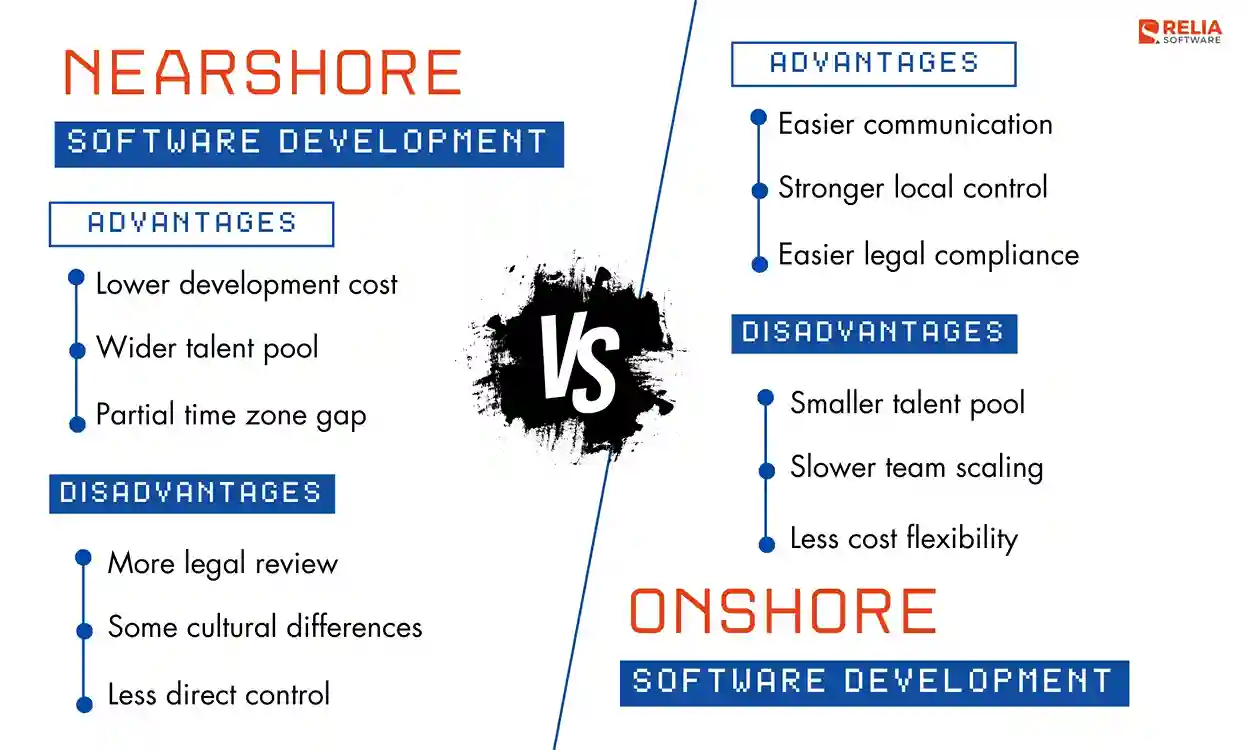
Key Differences Between Nearshore and Onshore Outsourcing
Here is a quick comparison before we go into each point in more detail:
|
Factor |
Onshore Outsourcing | |
|
Location |
A nearby country or the same region |
In your home country |
|
Cost |
Usually lower than onshore |
Usually higher |
|
Time Zone Overlap |
Good overlap, but may not cover the full workday |
Full or near-full workday overlap |
|
Communication |
Easy if the team has a clear process |
Usually the easiest |
|
Control Level |
Structured remote control |
More direct control |
|
Scaling Speed |
Faster |
Can be slower in competitive markets |
|
Talent Access |
Wider regional talent pool |
Limited to your local market |
|
Hiring Speed |
Often faster because you can look beyond one country |
Can be slower in competitive markets |
|
Legal Control |
Needs careful review by the country |
Easier because the vendor follows local laws |
|
Cultural Fit |
Often close, but still needs alignment |
Have the same culture |
|
Long-term Development |
Cost-effective for ongoing work |
More expensive for long-term development |
|
Best For |
Team extension, MVP, product development, QA, DevOps |
Discovery, regulated projects, consulting, sensitive systems |
Location
Nearshore outsourcing means hiring a software team in a nearby country or the same region. Meanwhile, onshore outsourcing means hiring a software team in your own country.
For example, a US company may work with a nearshore team in Mexico, Colombia, Argentina, or Costa Rica. A UK company may work with a nearshore team in Poland, Portugal, Romania, or another nearby European country. In both cases, the development team is outside the client’s country, but still close enough for better communication and support on time.
If your company is based in Hanoi, Vietnam, and you outsource software development to Relia Software in Ho Chi Minh City, that is called onshore outsourcing because both sides are still in Vietnam.
However, location should not be the only factor to make the final decision. A nearby vendor can still be hard to work with if they have weak processes, unclear communication, or limited technical experience. Meanwhile, a same-country vendor can also be a poor fit if their cost is too high for the value they provide. Therefore, other aspects such as experience, working methods, etc, also have to be considered carefully.
Cost
Nearshore outsourcing is often more cost-effective when a company from a high-cost market works with a vendor in a nearby lower-cost market. Because the vendor operates in a nearby country with lower labor and operating costs, you can build a larger team, add more roles, or keep development running longer without putting too much pressure on your budget or even at a lower total cost compared to onshore outsourcing.
Onshore outsourcing usually costs more because the vendor works in the same labor market as the client. If developer salaries and service rates are high in the client country, those costs will appear in the vendor’s pricing. However, onshore can be worth the higher cost when the project needs heavy discovery, legal review, frequent stakeholder meetings, or close in-person work.
Therefore, your choice should depend on how much control your project really needs. If the project needs close review, strong legal control, or frequent stakeholder meetings, onshore may be worth the higher cost. When you mainly need to extend your core team, reduce workload, and control development cost, nearshore is usually the more practical option.
Communication
Nearshore outsourcing usually gives some time zone overlap because the team works in a nearby country or region. However, the main limit is that working hours may not match the client’s full business day, which can cause delays in supporting questions, approvals, or urgent fixes.
For example, a UK company working with a software team in Romania or Bulgaria may have a 2-hour time difference. Both sides can still hold daily meetings and review progress during shared office hours, but late-afternoon feedback from the UK side may reach the nearshore team near the end of their workday. Urgent fixes, quick approvals, or follow-up questions may then move to the next working day.
Meanwhile, onshore outsourcing gives the smoothest communication flow because the client and vendor work in the same country, so they usually follow the same time zone and business hours. Meetings are easier to book, feedback comes on time, and business users can join discussions with fewer scheduling issues. Onshore is a better fit when the project needs frequent calls, quick approvals, close review, or direct work with many internal stakeholders.
Therefore, before choosing a nearshore vendor, you have to check:
- How many working hours that vendor overlaps with your team.
- Whether daily or weekly meetings fit both calendars.
- How urgent issues are handled outside shared hours.
- Which tools are used for tasks, documentation, and reporting.
- How feedback, approvals, and blockers are managed.
Talent Availability
Nearshore outsourcing gives access to a wider regional talent pool. It can be especially useful when you need roles that are hard to hire locally, such as backend developers, mobile developers, QA automation engineers, DevOps engineers, cloud engineers, UI/UX designers, or dedicated product teams. It is also useful when your local market is too expensive, too competitive, or too slow for your hiring needs.
Onshore outsourcing limits your search to vendors and talent inside your own country, which can make hiring harder when dedicated software teams are in high demand. However, onshore can be stronger when the project needs deep local knowledge, such as local healthcare workflows, banking rules, public sector processes, or country-specific user behavior.
Control Level
Control in outsourcing usually means:
- How fast you and your team can review work.
- How often stakeholders can join discussions.
- How clearly the vendor reports progress.
- How quickly business decisions are made.
- How easily you can change priorities.
- How much visibility you have into code quality, testing, and delivery.
Normally, nearshore outsourcing gives you structured control. Your team can still track progress, review deliverables, and approve changes through planned check-ins, written feedback, sprint reviews, and shared working hours. Because the vendor is not in the same country, quick changes or urgent business decisions may take longer when they fall outside the shared working window.
Meanwhile, onshore outsourcing gives your business more direct control. When a vendor is in your own country, it is usually easier to arrange meetings, run workshops, review progress, and bring them in for in-person reviews when needed. Onshore is better when the project needs close supervision, fast approval, frequent review, or direct involvement from business stakeholders.
Legal, Security, and Compliance
Nearshore outsourcing needs more legal and compliance review because the client and vendor operate under different national laws. The client has to check how data moves across borders, where data is stored, who can access systems, how IP ownership is protected, and which law applies if a dispute happens. Legal and security risks can increase when customer data, source code, or internal systems cross national borders without clear terms.
Onshore outsourcing is easier to manage because the vendor works under the same national laws as the client, making contracts, data protection rules, dispute handling, tax matters, and vendor checks more straightforward. The onshore outsourcing model is often safer for healthcare, finance, insurance, government, or any project where data must stay inside the country or legal responsibility must be very clear.
Cultural Fit
Nearshore outsourcing means working with a vendor in a nearby country, but nearby does not always mean the same working culture. For instance, a UK team can expect direct feedback and quick questions, while their Romanian outsourcing team can prefer written confirmation before making changes. Different public holidays, meeting habits, and feedback styles can also affect sprint planning, review dates, and response time.
Onshore outsourcing usually has a stronger cultural and business alignment because both teams work in the same country and share the same business habits, workplace norms, local customer expectations, and communication style. It is easier for clients and vendors to discuss tasks, give feedback, handle deadlines, and make decisions without spending too much time aligning on basic work habits.
When Should You Choose Nearshore Outsourcing?
Choose nearshore outsourcing when your business needs to extend the development team, reduce development costs, and keep regular communication with the vendor. Nearshore is also a good choice when your local hiring market is too slow, too expensive, or too limited. Instead of waiting months to hire developers in your own country, you can work with a nearby software team that already has the skills you need.
Some best-fit projects include:
- SaaS product development;
- Mobile app development;
- Web app development;
- MVP development;
- QA automation;
- DevOps support;
- Long-term team extension;
- Product maintenance, etc.
When Should You Choose Onshore Outsourcing?
Onshore is usually the better option when your project is still unclear at the beginning, needs close control, fast communication, and stronger local legal alignment. If your team needs help shaping the product idea, defining user flows, reviewing business rules, or running workshops with many stakeholders, a same-country vendor can make the process easier.
Some best-fit projects include:
- Compliance-heavy software;
- Early product discovery;
- Sensitive data platforms;
- Public sector projects;
- High-touch consulting, etc.
Common Mistakes to Avoid When Choosing Between Nearshore and Onshore
Choosing only by price
Nearshore often costs less than onshore, but the lowest rate is not always the best deal. A weak vendor can create rework, delays, poor code quality, and extra management work for your internal team.
Choosing onshore only because it feels safer
Onshore gives closer control, but it is usually more expensive, so the higher cost should match a real project need. Onshore makes sense when you need close review, local legal clarity, same-day decisions, sensitive data handling, or in-person work. If your project mainly needs extra development capacity, nearshore can be more practical.
Ignoring real-time zone overlap
Nearshore vendors are in nearby countries, but nearby does not always mean full-day overlap. A small time difference can still affect feedback, approvals, and urgent fixes when the shared working window is short. Before choosing a nearshore team, check the exact working hours, not only the country location.
Skipping legal, IP, and data access review
Legal and security terms should be clear even before the project starts. The contract should state who owns the source code, design files, documentation, and product assets. The client should also check where data is stored, who can access systems, how access is removed, and which law applies if a dispute happens.
Starting without internal ownership
Outsourcing does not remove the need for internal decision-making. Your business still needs someone to answer questions, approve work, give feedback, and guide product direction. Without an internal owner, both nearshore and onshore teams can get stuck waiting for decisions.
How to Choose the Right Nearshore or Onshore Partner?
Before signing a contract, review these points carefully:
- Check relevant project experience: Review whether the vendor has built similar software before. A team with related experience will understand common workflows, risks, and technical decisions faster.
- Review technical skills: Make sure the vendor can support your required tech stack, architecture, integrations, testing needs, and long-term maintenance.
- Ask about team structure: Check who will work on the project, who manages delivery, who reviews code, and who communicates with your team.
- Confirm the communication process: Ask how often meetings happen, which tools they use, how progress is reported, and how blockers are handled.
- Review security practices: Check how the vendor manages code access, cloud access, credentials, production systems, and sensitive data.
- Check IP ownership terms: Make sure the contract clearly states that your business owns the source code, design files, documentation, and other project assets after payment.
- Ask about data handling: Confirm where data is stored, who can access it, how access is removed, and how the vendor protects confidential information.
- Review time zone overlap: For nearshore partners, check the real shared working hours, not only the country location. For onshore partners, confirm their availability for reviews, workshops, and urgent discussions.
Remember that the right partner should make your project easier to run, not harder to manage. For a nearshore vendor, look closely at communication discipline, time zone overlap, legal clarity, and delivery maturity. For an onshore vendor, check whether the higher cost brings real value through close control, local knowledge, faster decisions, or stronger compliance support.
FAQs
1. Is nearshore outsourcing cheaper than onshore outsourcing?
Nearshore outsourcing is often cheaper when the vendor is based in a nearby country with lower labor and operating costs than the client’s country. Onshore outsourcing usually costs more because the vendor works in the same local labor market as the client.
2. Can nearshore and onshore teams work together?
Yes. A business can use an onshore team for discovery, planning, stakeholder workshops, legal review, or high-level consulting, while a nearshore team handles development, QA, DevOps, maintenance, or long-term delivery support. This setup can help balance control and cost.
3. What is the biggest risk of nearshore outsourcing?
The biggest risk is weak alignment across countries. Time zone gaps, different working habits, unclear contracts, or poor data access rules can affect delivery. You can reduce this risk by checking real working hours, legal terms, the communication process, and vendor experience before starting.
4. What is the biggest risk of onshore outsourcing?
The biggest risk is paying a higher cost without getting enough added value. Onshore makes sense when you need close control, legal clarity, sensitive data handling, or frequent in-person work. If your project mainly needs extra development capacity, nearshore may be more cost-effective.
5. Does nearshore outsourcing work for startups?
Yes. Nearshore outsourcing can work well for startups that need to build an MVP, add developers quickly, or reduce development costs. It works best when the startup has clear product priorities and someone who can review work regularly.
>> Read more:
- Onshore vs Offshore Software Development: Which is Better?
- Nearshore vs Offshore: Which One Should You Choose?
Conclusion
Nearshore outsourcing is more flexible and cost-focused, while onshore outsourcing is more control-focused and locally aligned. Nearshore gives businesses access to vendors in nearby countries, which can help reduce costs and expand the talent pool. Onshore keeps the vendor in the same country, which makes communication, legal work, cultural fit, and in-person collaboration easier to manage.
The right choice depends on your project requirements, not only the vendor’s location. In short:
- Choose nearshore when you want to extend your development team, reduce workload, control cost, and still keep regular communication.
- Choose onshore if your project carries a higher legal, security, or business risk and needs closer day-to-day control.
>>> Follow and Contact Relia Software for more information!

- development
- outsourcing