


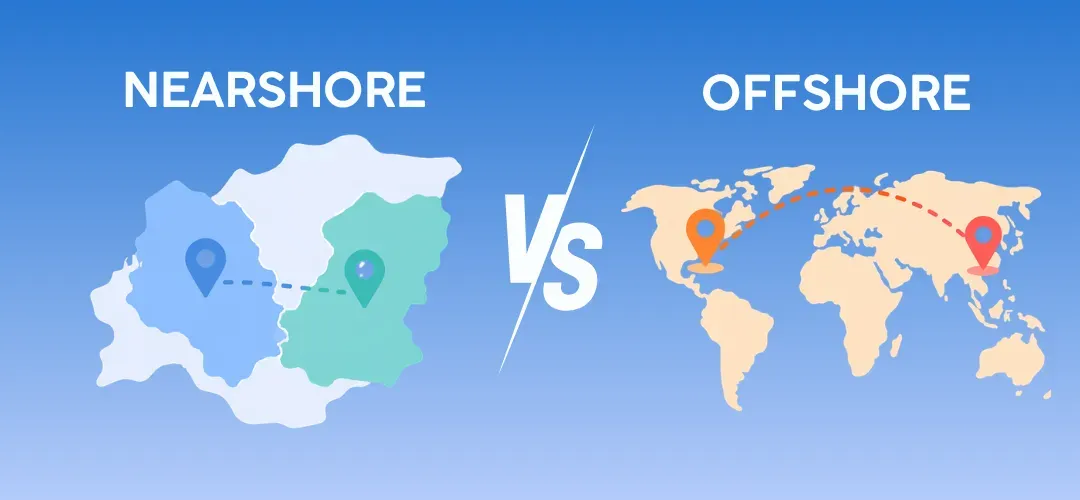
Choosing between nearshore and offshore software development outsourcing changes how a project gets managed day to day. The two models differ in time zone overlap, hourly rates, talent pool size, and how much compliance work a contract needs. Each difference traces back to where the development team is located relative to the buyer.
This blog compares nearshore and offshore across aspects, then walks through a five-step framework for matching the right model to a specific project, not defaulting to whichever option looks cheaper.
What is Nearshore vs. Offshore Development?
Nearshore software development means hiring a development team in a country close to yours, usually within one to four time zones. A smaller gap means more overlapping work hours, which supports real-time meetings, faster feedback, and closer day-to-day collaboration.
Offshore software development means hiring a team in a distant country, usually eight or more time zones away. A larger gap means less overlap, which pushes teams toward asynchronous workflows: detailed documentation, recorded updates, and handoffs instead of live discussion.
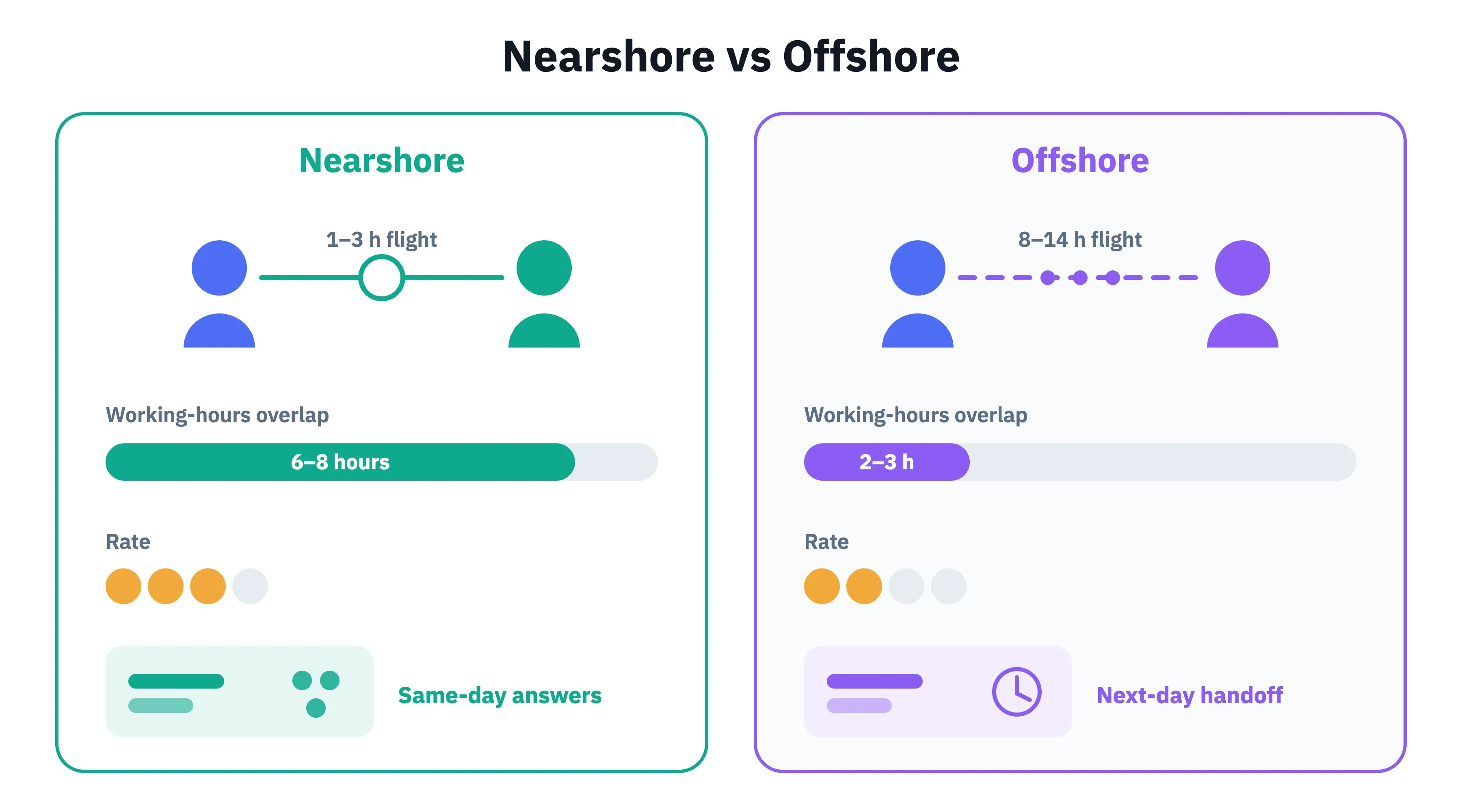
Nearshore vs. Offshore Outsourcing: What’s the Difference?
|
Factor |
Nearshore |
Offshore |
|
Time zone difference |
0 to 4 hours |
8 to 12 hours |
|
Cultural fit |
Often closer, especially with shared language or overlapping business norms |
Wider differences in business practices are more common; needs structured onboarding |
|
Costs |
Higher |
Lower |
|
Collaboration style |
Mostly real-time |
Mostly asynchronous |
|
Travel time for on-site visits |
Same day, often a short flight |
One or more days |
|
Talent pool size |
Smaller, regional |
Larger, global |
|
Compliance complexity |
Lower for same-region regulations (for example, GDPR within the E.U.) |
Higher; requires cross-border legal review |
|
Common engagement models |
Dedicated team, staff augmentation |
Dedicated team, offshore development center, managed services |
|
Key risk |
Smaller pools can limit access to niche specializations |
Communication gaps and rework if documentation and handoffs aren't disciplined |
|
Best fit |
Projects needing frequent, real-time collaboration |
Projects with clear specifications and a cost or scale priority |
Team Location
Nearshore development teams are located in countries close to the client's country. For example, a U.S. company, common nearshore locations are Mexico, Colombia, and Costa Rica.
Offshore development teams are located farther away compared to the client's country. With the same U.S. company, common offshore locations are Vietnam, India, and the Philippines.
Nearshore and offshore are relative terms. The same country can be a nearshore option for one client and an offshore option for another, depending on where the client is based.
For example, Vietnam sits offshore relative to the U.S. and Europe,, but it sits nearshore relative to Singapore, most of Southeast Asia, and much of Australia. A single Vietnam-based team can serve as an offshore partner for a U.S. client and a nearshore partner for an Australian or Singaporean client at the same time.
Time Zone Overlap
Nearshore teams typically overlap with a client's working hours for most or all of the business day. A team in Mexico working 9 a.m. to 6 p.m. local time overlaps with a U.S. East Coast team for six to eight hours.
Besides, nearby countries often share closer business-culture norms and, in some regions, a common language with the client, which can make day-to-day collaboration feel more familiar from the start.
Offshore teams typically overlap with a client's working hours for two hours or less, and sometimes not at all. A team in Vietnam working 9 a.m. to 6 p.m. local time has almost no overlap with U.S. business hours.
Offshore teams more often work from a different business culture and communication style. This isn't a quality issue, offshore outsourcing does mean the client and vendor typically need a more structured onboarding period to align on expectations, feedback style, and decision-making norms.
Project Management
Nearshore projects typically run on the same communication rhythm the client's in-house team already uses. The team can join daily standups, live sprint planning, and ad hoc video calls when a question comes up without scheduling around a time gap. Nearshore engagements have more flexibility to adjust scope mid-sprint since a live conversation is usually available the same day.
Offshore projects typically shift more communication into written form. Requirements become structured tickets with acceptance criteria written in a tool like Jira or Linear, since the offshore pick up the work while the client's team is asleep. Slack and similar tools carry status updates. Video calls still happen, but they're scheduled in advance to land within whatever overlap window exists, rather than started on impulse.
Offshore engagements benefit from disciplined sprint planning and detailed documentation up front, because there's less room to clarify requirements mid-sprint through live conversation.
>> Read more:
- In-depth Guide To Manage a Web Development Project Successfully
- How To Manage Mobile App Development Projects Effectively?
Cost
Nearshore rates are usually higher than offshore rates, but still less than onshore hiring around 20 to 40%. According to DistantJob's 2026 developer rate data, mid-level developers in Mexico charge $40 to $60 per hour and senior developers charge $60 to $85. In Vietnam, an offshore location for the U.S. and E.U. clients, mid-level developers charge $25 to $40 per hour and senior developers charge $40 to $70.
However, nearshore engagements often carry lower coordination costs because real-time collaboration reduces the need for extensive documentation and catches misunderstandings faster.
Offshore engagements often carry lower base rates but require more investment in project management, written specifications, and asynchronous communication tools to get the same result.
A full cost comparison should include both the hourly rates by countries and the coordination overhead each model requires.
Talent Pool
Nearshore recruiting gives access to a smaller, regionally concentrated talent pool. Mexico, Colombia, and Poland all have growing tech sectors, but the pool of senior, specialized developers in any single nearshore country is smaller than the combined offshore talent pool across multiple Asian countries.
Offshore recruiting gives access to a larger global talent pool, since the client isn't limited to countries within a few time zones. Countries like Vietnam, India, and the Philippines each graduate large numbers of computer science and engineering students annually. Besides, their outsourcing industries have built deep specialization in specific technology stacks over decades of serving international clients.
For a project requiring a narrow specialization, such as a specific AI framework or a legacy enterprise system, offshore hiring offers more candidates to choose from. A project requiring broad, general web or mobile development skills usually has enough qualified candidates under either model. Time zone and communication style become the deciding factors instead of talent availability.
Legal, Security, and Compliance
Nearshore engagements within the same regulatory bloc simplify some compliance work. A U.S. company hiring a nearshore team in Mexico still needs a solid contract covering IP assignment and data handling. But, they don't face the layered cross-border data transfer rules that apply when moving E.U. citizen data outside the European Economic Area.
Offshore engagements more often require additional legal review, particularly for regulated industries. A U.S. healthcare company working with an offshore team needs the vendor to demonstrate compliance with HIPAA. A fintech company in any region typically requires SOC 2 compliance, confidentiality, processing integrity, and ISO 27001 certification.
Neither nearshore nor offshore location automatically satisfies these requirements. What matters is whether the specific vendor holds the relevant certifications and has a track record handling the client's type of data.
Engagement Models
Both nearshore and offshore providers typically offer the same engagement models, including staff augmentation, a dedicated development team, and managed services. But each model tends to fit nearshore or offshore work differently.
Nearshore engagements typically use staff augmentation or a dedicated development team. Both models depend on frequent, informal check-ins to stay aligned, and nearshore's time zone overlap is what makes that pace easy to sustain.
Offshore engagements also use staff augmentation or a dedicated development team, plus two that scale better across a bigger time zone gap: an offshore development center (ODC), and a managed services arrangement. Both fit offshore work because they run on a standardized process and clearly defined outcomes instead of the frequent, real-time coordination a nearshore team can rely on.
A company evaluating nearshore or offshore options should decide which engagement model it needs before comparing vendors, since the same vendor may price and structure these models very differently.
Key Risks
Nearshore engagements carry talent and scale risk. Because the nearshore talent pool is smaller and regionally concentrated, a project that needs a narrow specialization can struggle to find enough qualified candidates in a single nearshore country. As a result, hiring can be slow or rates are pushed higher as local demand rises.
Offshore engagements carry more communication and coordination risk. With little or no working-hour overlap, a misunderstood requirement can go unnoticed for a full day before either side catches it. The misunderstanding turns into a sprint's worth of rework if it isn't caught quickly. However, clear documentation and disciplined project management can reduce this risk.
Both models share a risk that has nothing to do with location: vendor instability. High developer turnover, weak retention, or a vendor spread too thin across too many clients undermines a project regardless of whether the team is nearshore or offshore.
Vendor track record and team stability matter at least as much as location when weighing the risk of either model.
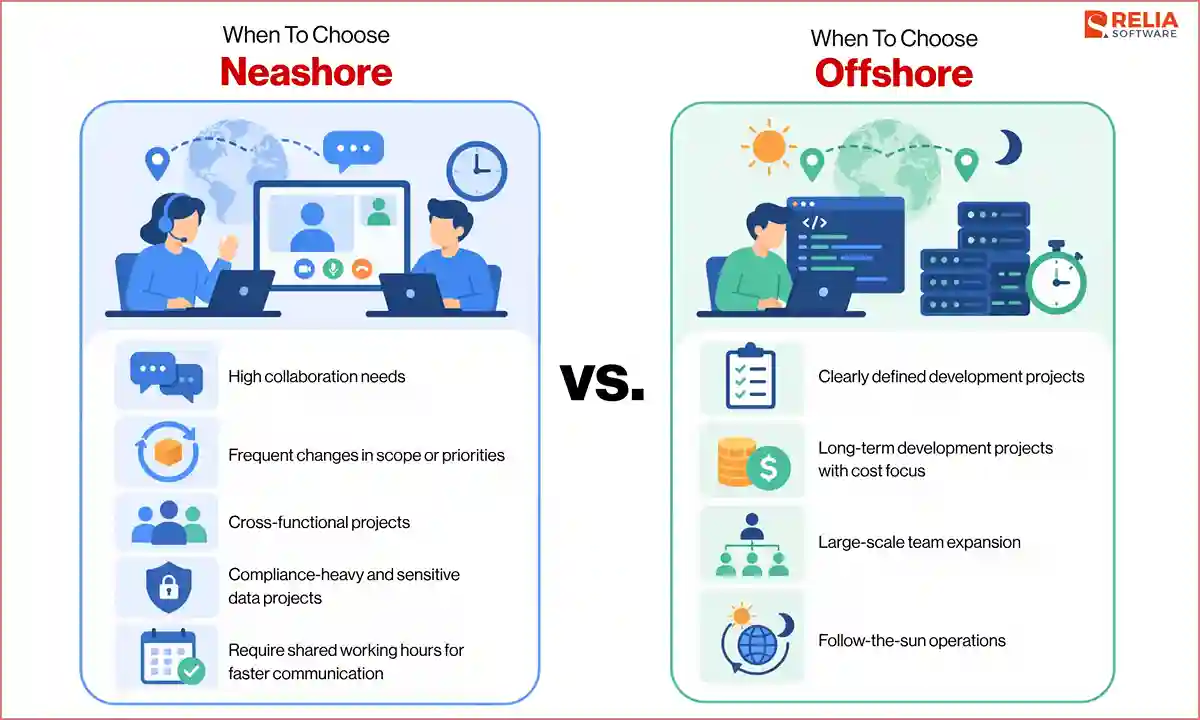
When to Choose Nearshore Software Development?
Nearshore development fits projects that depend on frequent, real-time collaboration. Specific scenarios where nearshore works better include:
- Agile projects with evolving requirements: Frequent scope changes benefit from same-day conversations instead of a 24-hour turnaround on every clarification.
- Early-stage product development: MVP and discovery-phase work often requires rapid iteration based on user feedback, which moves faster with live collaboration.
- Projects requiring frequent stakeholder involvement: When product managers, designers, and engineers need to sync several times a week, time zone overlap keeps that cadence workable.
- Compliance-sensitive projects within the same region: Staying inside one regulatory bloc, such as keeping E.U. data within the E.U., can simplify legal review.
When to Choose Offshore Software Development?
Offshore development fits projects with clear specifications and a priority on cost or scale. Specific scenarios where offshore works better are:
- Well-defined projects with stable requirements: A clear specification reduces the need for live back-and-forth, which suits asynchronous offshore workflows.
- Large-scale team expansion: Offshore locations often have a bigger pool of available developers, which supports scaling a team quickly.
- Long-term, cost-sensitive development: Lower offshore rates compound over a multi-year engagement, which matters more for sustained development than for a short project.
- Follow-the-sun support: A large time gap becomes an advantage for coverage models where work needs to continue around the clock, handed off between time zones.
How to Decide Between Nearshore and Offshore: A 5-Step Framework
- Assess collaboration intensity: Estimate how often the team needs live discussion versus how often written specifications are enough. Frequent live discussion favors nearshore providers; clear, stable requirements favor offshore partners.
- Set the budget range, including management overhead: Compare hourly rates, but also account for the extra project management time offshore engagements typically require.
- Define the minimum acceptable overlap in working hours: Decide how many overlapping hours per day the team actually needs for standups, reviews, and unplanned questions, then filter vendor locations against that number.
- Identify compliance and data-handling requirements: List the certifications (SOC 2, ISO 27001, HIPAA, GDPR alignment) the project needs, then confirm which vendors, in which locations, can demonstrate them.
- Match the required skill set to talent availability: Check whether the specific technology stack or specialization needed is well represented in the nearshore countries under consideration, or whether the offshore talent pool offers meaningfully more depth.
Working through these five factors in order, not just starting with cost, produces a more accurate decision. You can identify the constraints (compliance, overlap hours) that some locations simply can't meet, before rate comparisons become the deciding factor.
- Onshore vs Offshore Software Development: Which is Better?
- Nearshore vs Onshore: Key Differences & When to Choose Each?
How Relia Software Delivers Nearshore and Offshore Teams?
Relia Software is based in Vietnam and works with clients across the U.S., Europe, and the Asia-Pacific region. For the U.S. or E.U. client, a Relia team in Vietnam is an offshore engagement. For a client in Singapore or much of Australia, the same team is a nearshore engagement.
Two Relia engagements show both sides of this:
- Mekari, an HR and accounting software company based in Indonesia, is a nearshore relationship. The partnership began in 2017 with a 3-person team building the UI/UX design and initial mobile app for Mekari's Talenta HR product. By 2020, that team had grown to 7 people supporting a product that scaled from a few thousand users to more than 10 million.
- American Bureau of Shipping (ABS), a U.S.-based maritime classification society, is an offshore relationship built as an ODC. Relia formed a 6-person dedicated offshore development team in Vietnam within two months of signing the contract. Then, the team grew to 18 people to modernize ABS's fleet and vessel management systems.
Both engagements show the same underlying pattern: a dedicated offshore or nearshore team adds capacity as the product or scope grows, rather than requiring the client to rebuild the team from scratch.
Companies evaluating a nearshore or offshore partner for a similar scaling need can review Relia's engagement models and current availability by contacting the team directly.
FAQs
Can a company use both nearshore and offshore teams on the same project?
Yes. Companies sometimes pair a nearshore team for tasks requiring frequent collaboration, such as product design and sprint planning, with an offshore team for well-specified, high-volume work such as QA automation or backend feature development.
Does offshore development mean lower quality?
No. Quality depends on the vendor's processes, team experience, and how clearly the project is specified and managed, not on the vendor's location.
Which model is better for a startup building its first product?
Nearshore development usually fits early-stage startups better, since MVP development often requires fast iteration based on user feedback, and real-time collaboration speeds up that feedback loop. Startups with a well-defined scope and a tighter budget sometimes choose offshore instead, accepting a bit slower iteration cycle in exchange for lower cost.
Conclusion
Nearshore and offshore software development solve the same problem, building and scaling a team, through different tradeoffs in time zone overlap, cost, and talent access. Nearshore fits projects that need frequent, real-time collaboration and a smaller compliance footprint. Offshore fits projects with clear specifications, a larger talent pool, and a stronger cost priority.
The five-step framework above, which starts with collaboration intensity rather than cost, gives a clearer basis for that decision than comparing hourly rates alone.
>>> Follow and Contact Relia Software for more information!

- offshore development
- offshore outsourcing software
- outsourcing