


AI in ERP is being discussed everywhere, but many businesses are still unsure what it truly means. Some vendors present AI as a built-in upgrade, while others position it as a separate layer that sits on top of existing systems. This makes it hard for companies to tell whether they need a new ERP, an AI add-on, or a mix of both.
In this article, we break down what AI in ERP software actually means in practice. We explain the main types of AI used in ERP systems, where they are applied, how companies can adopt them safely, and what real benefits and challenges to expect when AI is added to ERP environments.
What is AI in ERP Software?
AI in ERP software means adding innovative technologies like AI, machine learning, and natural language processing to ERP systems to improve forecasting, reporting, analysis, and decision support. Instead of just storing data, the system can now help analyze it and support decisions.
It can automate repetitive tasks such as invoicing and data entry, predict trends like future demand, and provide useful insights. This helps companies work faster, make better decisions, and improve overall efficiency.
Main Types of AI in ERP Software
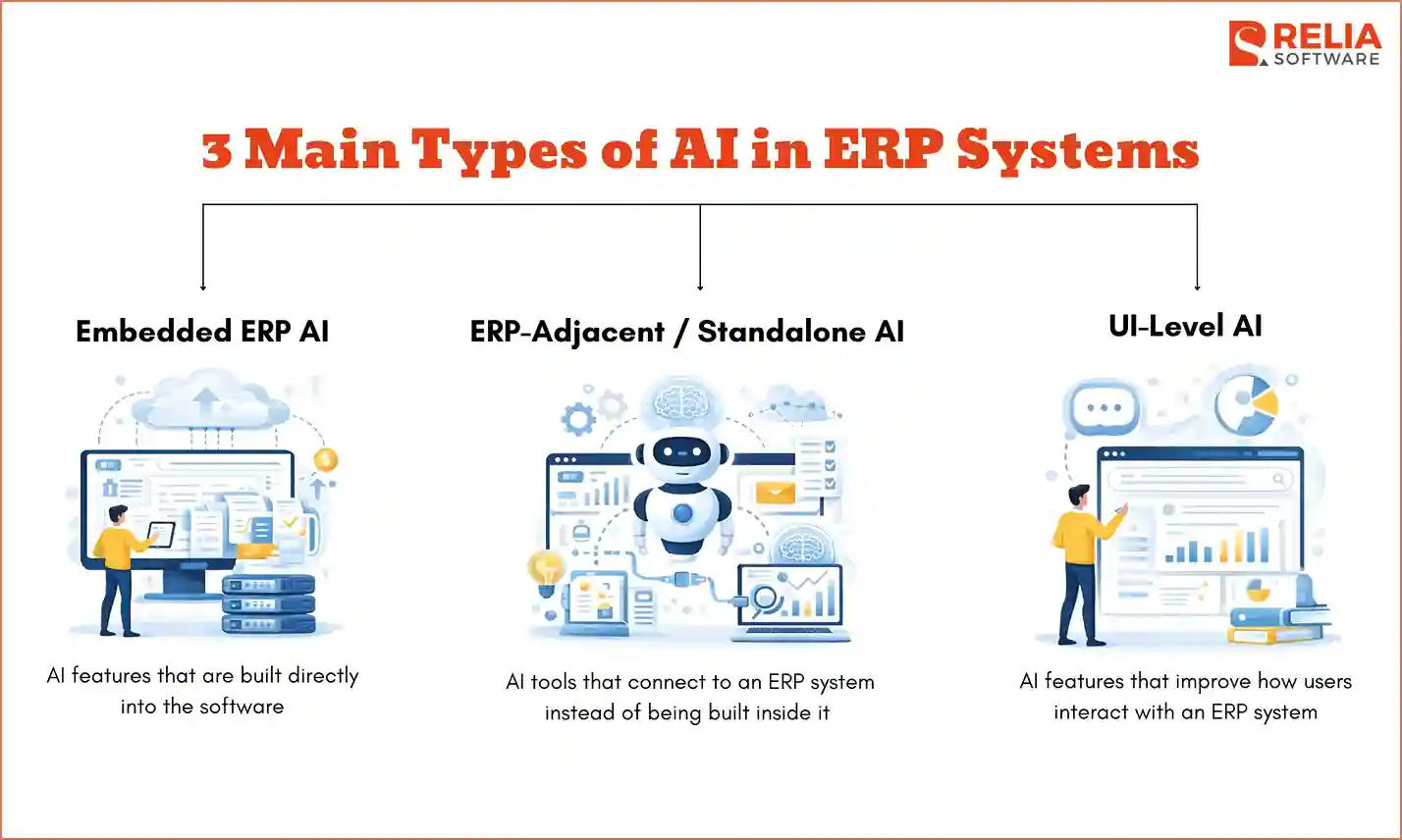
Embedded ERP AI
Embedded AI is about AI features that are built directly into the software. If a company uses a large ERP system, these smart features are already added to the system that people use every day. There is no need to install a separate tool or connect another system, because the AI is already part of the software.
To use embedded AI, your businesses have to move the data to the cloud, because the math needed to run AI requires a lot of computer power that only big cloud data centers have. When the software provider updates the system, you get new smart features automatically. This is the easiest way to get started, but it means you have to follow the path the software maker sets for you.
ERP-Adjacent / Standalone AI
ERP-adjacent or standalone AI refers to tools that connect to an ERP system instead of being built inside it. These tools work alongside the main system and focus on specific tasks, which usually makes them faster and easier to set up.
A key advantage is that these tools are ERP-agnostic. They can connect to both new and older systems, which makes them easier to adopt. Companies do not need to change their core ERP, which lowers risk. If the tool does not deliver value, it can be removed without affecting the main system, giving teams more freedom to test and learn.
UI-Level AI
UI-level AI refers to AI features that improve how users interact with an ERP system. Instead of changing how the ERP works internally, it changes how people access and understand the data. Users can ask questions in natural language and get direct answers right on the user interface.
This approach saves time, reduces reporting effort, and allows non-technical users to get answers without special training. While it does not replace core system logic, it makes daily decision-making easier and more accessible.
Core AI Technologies In ERP Systems
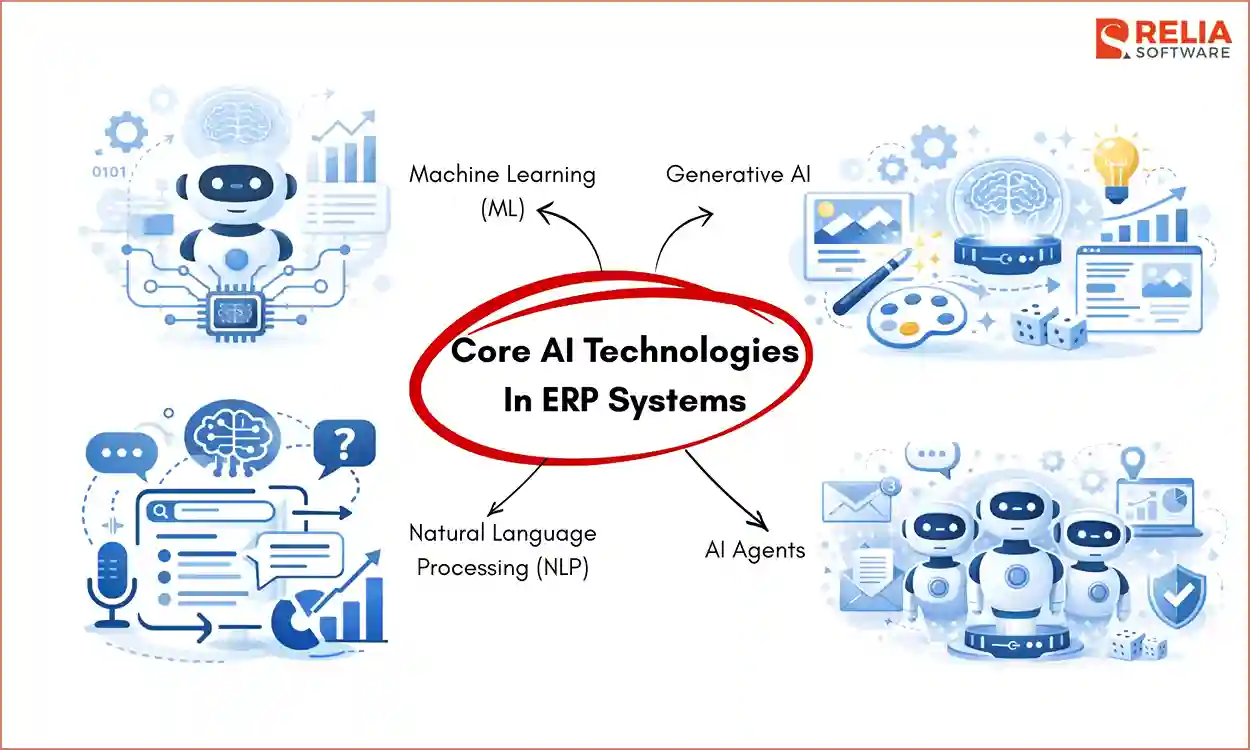
Machine Learning (ML)
Machine learning uses past data to help predict what may happen next. In an ERP system, it is mainly used for forecasting. The system looks at past years of sales data and spots patterns, such as higher sales around certain holidays or during longer warm periods, to support planning.
- Spotting Patterns: The system reviews large volumes of past transactions and finds links that people often miss.
- Cash Flow: Tracks how quickly customers pay their invoices and learns their habits over time. If one customer pays within days and another takes much longer, the system uses this behavior to estimate how much cash will be available in the coming weeks.
- Always Learning: Each new sale, payment, or delivery helps update the model. As long as the data stays reliable, the system becomes more accurate through regular use.
>> Read more:
- Top 9 Machine Learning Platforms for Developers
- Top 7 Machine Learning Solutions For Growing Your Business
Natural Language Processing (NLP)
Natural Language Processing, or NLP, acts as a bridge between everyday language and the structured data stored inside an ERP system, helping computers understand how people talk and write.
In modern ERP software, NLP is used in search bars and chatbots. Users can ask simple questions, then the system reads the question, searches the relevant data, and returns an answer. It can also explain data in plain language, turning rows of numbers into short, clear explanations that are easier to understand.
Generative AI
Generative AI is a newer technology that focuses on creating content rather than just analyzing it. In ERP, it acts like a very fast assistant that can write the first draft of almost anything.
- Drafting Reports: It can review a month of sales data and write a short summary for managers, pointing out what went well and what needs attention.
- Writing Proposals: When a sales team prepares an offer for a customer, the AI can pull prices and product details into a clear and professional document.
- Making Suggestions: It can review a problem, such as a shortage of materials, and suggest a few possible ways to handle it, with simple explanations for each option.
Generative AI is good at writing and explaining, but it should not make final decisions. It can suggest ideas and summaries, but a human still needs to approve payments, contracts, and major changes.
>> Read more:
AI Agents
AI agents are different from regular software because they focus on specific tasks. You can think of them as small digital helpers that sit outside the main ERP system but are allowed to access it when needed. They follow clear rules and still require human approval, but they can move through a workflow without someone guiding every step.
For example, an agent might watch the price of steel. When the price drops below a set level, it checks the ERP to see if there is space in the warehouse. If there is, it prepares a purchase order and sends a message to the manager for approval. These agents help systems work together and keep tasks moving, even when people are busy.
>> Read more:
- Top 6 Open-source AI Agent Frameworks
- Top 12 Best AI Agents in Software Testing For Businesses
- A Practical Guide to AI Agents in Software Testing
- 7 Best Golang AI Agent Frameworks You Should Know
How is AI Used in ERP Software?
Below are common areas where AI is already being used around ERP systems, with very different results depending on data quality and process maturity.
Manufacturing & MRP Planning
AI is used in ERP manufacturing modules to improve production planning and reduce delays. It analyzes current orders, supplier history, and real production data together, so plans can adjust early before problems spread. This helps teams balance materials, worker schedules, and delivery deadlines more accurately.
- Material Planning: It calculates what materials are needed based on real sales and current demand, not just old forecasts.
- Timing Analysis: It tracks how long each step actually takes inside the factory and points out where delays happen.
- Handling Change: When an order suddenly increases or changes, the AI quickly updates the schedule to see if deadlines can still be met without disrupting other work.
>> Read more: What Is Digital Transformation in Manufacturing?
Finance
In the finance industry, AI is used to reduce manual checking and improve accuracy in ERP platforms. It can match bank payments with invoices automatically, a process known as reconciliation. Instead of reviewing records line by line, finance teams only step in when something looks unusual. This saves time, stops any revenue leakage, and lets teams focus more on analysis than on manual verification.
>> Read more: Digital Transformation in Banking and Financial Services
Sales
Sales teams often use AI to move faster and close deals more easily.
- Fast Proposals: AI pulls this information together and creates a draft in minutes. It also looks at what the customer bought before and suggests suitable products.
- Pricing Suggestions: It reviews costs and past deals to suggest a price that keeps margins healthy while staying competitive.
- Visibility: It flags deals that may be risky, such as when customers stop responding or margins are too low.
Supply Chain Management
AI can help companies prepare for disruptions in supply chain systems. It analyzes risks such as shipping delays, cost changes, or supplier issues and tests different scenarios quickly.
By simulating situations like port closures or rising fuel prices, AI helps businesses plan alternatives, adjust routes, or choose backup suppliers early. This allows companies to prepare ahead instead of reacting after problems occur.
>> Read more:
- Top 6 Best Supply Chain Management Software
- 9 Key Logistics Technology Trends for Businesses
- A Comprehensive Guide for Logistics App Development
Benefits of Using AI in ERP Software
Faster Access to Insights
One of the biggest benefits of AI in ERP software is faster access to information. Instead of creating reports, setting filters, or exporting data, users can ask simple questions and get answers right away. This reduces waiting time and lowers dependence on technical users who know how reports work. Teams spend less time searching for data and more time making decisions.
Better Decision-Making at Scale
AI is useful when decisions involve many changing factors. Planning and forecasting often require looking at demand, supply limits, timing, and cost all at once. It is hard for people to keep track of everything, especially when data changes every day. AI can review large amounts of information quickly and point out patterns or risks that might be missed in manual checks, helping teams make more consistent decisions.
Reduced Manual Work
AI reduces manual work that many ERP users still rely heavily on by pulling data directly from the system and handling repeated checks automatically. Tasks like comparing periods, spotting changes, or preparing summaries no longer require manual copying and rework. This frees up time and lowers error risk caused by repeated manual handling.
Improved ERP Usability
ERP systems can use AI to improve usability by making interaction more natural. Users do not need deep system knowledge to get answers or explanations. This lowers training effort, shortens onboarding time, and helps non-technical roles work more confidently with complex data. The system feels more supportive instead of restrictive.
Incremental ROI Without Full ERP Overhaul
Many AI tools connect to legacy systems and improve insight, analysis, and decision support without forcing a full replacement, leading to faster time-to-value and lower risk. In the short term, the biggest benefit is not full automation, but clearer access to information and a better understanding of what is happening inside the business.
Challenges of AI in ERP
Data Quality
ERP systems often store data collected over many years, and that data is not always clean or consistent. Missing fields, duplicate records, and outdated formats can reduce AI accuracy. Since AI depends on reliable input, poor data quality can lead to weak predictions or misleading results.
Integrating Issues
Many companies still run older ERP versions that were not designed to support AI. These systems may lack modern APIs or flexible data access, which makes integration difficult. Adding AI often requires custom connectors, data pipelines, or middleware, which increases setup time and maintenance effort.
Moreover, some ERP systems process data in batches instead of in real time. This can limit AI performance, especially for tasks that need live data, such as forecasting, monitoring risks, or adjusting schedules quickly.
Security Impact
ERP systems hold sensitive business data such as financial records, supplier contracts, and payroll details. Integrating AI requires careful control over which data the model can access and how it is processed. Poor configuration can create security risks or expose information unintentionally.
>> Read more: 6 API Security Vulnerabilities and How to Secure API Servers?
Accuracy and Control
AI outputs must be tested carefully before they are used in core ERP workflows. Small errors can affect planning, finance, or supply decisions. Because ERP systems control core operations, companies must validate AI outputs thoroughly before allowing them to influence processes.
Best Practices to Implement AI in ERP Software
Separate AI from ERP Upgrades
In many cases, you can add AI to your existing ERP data and system without changing the whole ERP. Thinking about it, replacing an ERP can take years, while some AI tools can be set up in weeks. You should not delay small improvements just because a larger system change is being discussed.
Vendors often push upgrades to keep customers in their ecosystem. However, when companies connect AI too quickly to an ERP upgrade, they may adopt features that do not truly support daily work. It is better to focus first on slow or manual tasks and apply AI only where it brings clear improvement.
Begin with Low-Risk Wins
If you want people to accept new technology, you need to show that it works without disrupting their daily routine. A safe place to start is at the UI level, the parts of the system people use every day.
UI-level AI, reporting, and analysis reduce daily effort without changing how transactions work. Instead of creating more reports, users can ask simple questions and get answers right away. This saves time, reduces frustration, and builds trust before AI is used in core processes.
Adopt AI Gradually
AI should start as standalone or ERP-agnostic tools that connect to the system but operate outside of it. Let’s start with one clear use case and a small group of users. If the results are helpful, you can expand gradually. If not, you can adjust or stop without affecting daily operations. This step-by-step approach builds trust and reduces the risk of spending large amounts on a big project that may not succeed.
Focus on Change Management
AI can change how people perceive their roles. Someone who has spent many years becoming an expert at building reports may feel uncomfortable when a system can do it instantly. Therefore, clear communication is important. Teams should understand what the AI can do, what it cannot do, and that final decisions still belong to people.
Businesses should also involve the future users before choosing the tool. When employees help select and test the solution, they are more likely to trust it and use it in their daily work.
Track Adoption, Not Features
Success should be measured by how much people actually use the tool and whether it makes their work easier. Ask simple questions: Are employees using it regularly? Are tasks becoming simpler?, etc. If the AI makes work feel smoother and less stressful, it is working. Advanced features do not matter if they create extra steps. The goal is to reduce effort, not increase it.
>> Read more:
- Integrating AI into Mobile App Development: Why, When, How?
- Pros and Cons of AI in Healthcare with Detailed Explanation
Conclusion
AI in ERP software does not solve all problems, and it does not deliver the same value in every situation. The real benefits come when companies apply AI to clear use cases, introduce it step by step, and focus on making daily work easier rather than chasing features.
The companies that succeed are not the ones that separate AI from hype, manage change carefully, and measure success by real adoption. In the end, AI in ERP is less about automation and more about clarity, access, and better decisions at scale.
>>> Follow and Contact Relia Software for more information!

- automation
- development