


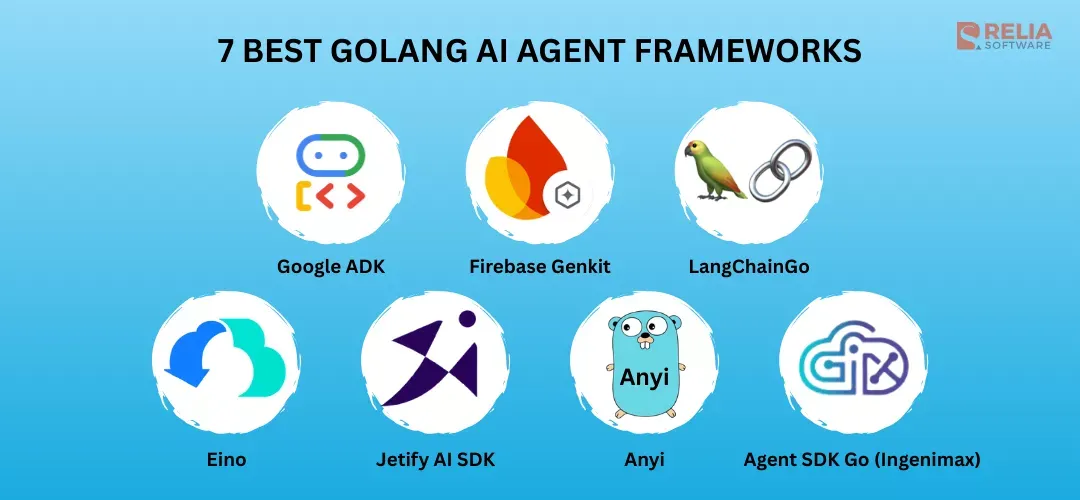
In the era of AI these days, Python usually gets all the attention. But, Golang is far from out of the game. In fact, for developers who care about speed and reliability, Go is still a go-to choice for building AI agents.
Between Google’s own tools and a growing list of open-source AI agent frameworks, the Go ecosystem is finally ready for prime time in the AI space. Whether you're building autonomous agents, LLM-powered applications, or multi-agent systems, Go's native concurrency, strong typing, and REST/RPC support make it ideal for production-grade AI solutions.
In this blog, I will introduce the best Golang AI agent frameworks available in 2026, helping you choose the right tool for your next AI-powered application.
Take a look at quick comparison before going into details:
| Framework | Best For | LLM Support | Multi-Agent | Hosting | Difficulty |
|---|---|---|---|---|---|
| Google ADK | Enterprise multi-agent systems | Google AI models (Gemini) | Native A2A protocol | Google Cloud optimized | Advanced |
| Firebase Genkit | Rapid prototyping & RAG apps | Gemini, Gemma, Multi-provider | Limited | Firebase, GCP | Beginner |
| LangChainGo | LLM app development | 10+ providers (OpenAI, Anthropic, AWS, Ollama, etc.) | Agent chains | Platform agnostic | Intermediate |
| Eino | High-scale production | Multiple providers | ReAct agents | CloudWeGo ecosystem | Intermediate |
| Jetify AI SDK | Multi-provider abstraction | Multiple providers | Limited | Platform agnostic | Beginner |
| Anyi | Workflow automation & RPA | Unified interface | Workflow-based | Platform agnostic | Intermediate |
| Agent SDK Go | Enterprise SaaS platforms | Multiple providers | Full support | Multi-tenant ready | Advanced |
Google Agent Development Kit (ADK)
Google Agent Development Kit (ADK) for Go is an open-source, code-first toolkit for building, testing, and deploying AI agents in Go. This framework is suitable when you need structured, multi-agent workflows that still feel like normal software (clean modules, versioning, and predictable behavior).
While most frameworks focus on simple "prompt-and-response" loops, ADK is built for complex, hierarchical multi-agent systems. It treats agents as modular microservices that can discover and collaborate with one another via the Agent2Agent (A2A) protocol.
Core Features:
- Multi-Agent Orchestration: ADK provides sophisticated agent hierarchy management where parent agents can delegate tasks to specialized child agents. The framework handles coordination, state management, and message routing automatically, enabling complex workflows like escalation chains and parallel task execution.
- MCP Toolbox Integration: Connectivity to 30+ databases including PostgreSQL, MySQL, MongoDB, Redis, BigQuery, and more. Each integration provides type-safe query builders and automatic connection pooling, reducing boilerplate code by up to 80% compared to manual implementations.
- Agent2Agent (A2A) Protocol: Standard-based communication protocol enabling agents to discover, negotiate, and collaborate with other agents in distributed systems. Supports synchronous RPC-style calls and asynchronous message passing with built-in retry logic and circuit breakers.
- Google Cloud Native: Deep integration with Vertex AI for model serving, Cloud Run for serverless deployment, and Cloud Logging for observability. Automatic authentication using Workload Identity and built-in support for VPC Service Controls for enterprise security requirements.
- Production-Grade Concurrency: Leverages Go's goroutines for handling thousands of simultaneous agent interactions with minimal memory overhead. Built-in rate limiting, backpressure handling, and graceful shutdown ensure stability under high load.
Use Cases: ADK's code-first approach is ideal for complex enterprise applications requiring precise orchestration and delegation between specialized agents.
Example: Build a customer support system where multiple specialized agents (billing, technical, sales) collaborate to resolve complex customer inquiries.
Installation & Quick Start:
# Install ADK for Go
go get github.com/google/adk-go

# Initialize a new project
go mod init my-agent-app
// Basic agent setup example
package main
import (
"context"
"github.com/google/adk-go/agent"
"github.com/google/adk-go/tools"
)
func main() {
// Create a new agent
myAgent := agent.New("customer-support-agent",
agent.WithModel("gemini-1.5-pro"),
agent.WithTools(tools.Database(), tools.Email()),
)
// Define agent behavior
myAgent.OnMessage(func(ctx context.Context, msg string) string {
// Agent logic here
return myAgent.Generate(ctx, msg)
})
// Run the agent
myAgent.Start()
}>> Explore further: How to Implement Golang MCP? Code Examples Included
Firebase Genkit
Firebase Genkit is an open-source framework from Firebase that integrates production-ready AI features into applications with minimal setup. Specifically, you can build AI features fast using familiar backend patterns: you define flows (server functions) that call models, tools, and retrieval steps, then run and debug them locally with built-in tooling and tracing.
Genkit combines Go's performance advantages with Google's battle-tested AI infrastructure, providing lightweight, composable abstractions that simplify complex AI workflows. It is the best choice for teams that need to move from a prototype to a scalable backend in days, not months.
Core Features:
- Unified Generation API: Single, consistent interface across all LLM providers. Switch from Gemini to OpenAI or Anthropic by changing one configuration parameter. Handles authentication, retry logic, streaming, and error handling uniformly regardless of the underlying provider.
- Native Vector Database Support: Built-in integrations with popular vector stores (Pinecone, Chroma, Vertex AI Vector Search). Automatic embedding generation, semantic search, and hybrid retrieval combining keyword and vector search. Supports metadata filtering and re-ranking for improved retrieval accuracy.
- Structured Output & Function Calling: Type-safe structured outputs using Go structs with automatic JSON schema generation. Function calling capabilities allow agents to invoke Go functions with validated parameters. Supports complex nested schemas and streaming structured outputs.
- Developer Experience Optimizations: Hot-reload development server, built-in UI for testing flows, automatic tracing and debugging. TypeScript-like developer experience with code generation for flows. Local emulator support for Firebase services during development.
- Production Deployment: One-command deployment to Cloud Run or Firebase Functions. Automatic scaling, global CDN distribution, and built-in monitoring. Environment-based configuration for seamless staging-to-production workflows.
Use Cases: Genkit is ideal for RAG-style assistants (internal docs search, product Q&A, support copilots) and tool-driven automations (summarizing tickets/meetings, extracting structured fields from documents, and triggering actions (DB/API/Slack/email)).
Example: Create a RAG-powered documentation assistant that indexes your knowledge base, retrieves relevant context, and generates answers using Gemini with simple indexing and retrieval APIs.
Installation & Quick Start:
# Install Genkit for Go
go get github.com/firebase/genkit-go
go get github.com/firebase/genkit-go/plugins/googleai

# Install CLI tools (optional)
npm install -g genkit
// Simple RAG application example
package main

import (
    "context"
    "github.com/firebase/genkit-go/ai"
    "github.com/firebase/genkit-go/plugins/googleai"
)

func main() {
    ctx := context.Background()

    // Initialize Genkit with Google AI
    googleai.Init(ctx, nil)

    // Define a flow for document Q&A
    ai.DefineFlow("docQA", func(ctx context.Context, query string) (string, error) {
        // Retrieve relevant documents
        docs := ai.Retrieve(ctx, "docs-index", query)

        // Generate answer with context
        response := ai.Generate(ctx, ai.ModelRequest{
            Model: googleai.Model("gemini-1.5-flash"),
            Prompt: ai.NewPrompt(query, docs),
        })

        return response.Text(), nil
    })

    // Start the development server
    ai.StartServer()
}
LangChainGo
LangChainGo is a community-driven Go port of LangChain with a comprehensive toolset for Go developers to build complex, multi-stage AI applications. It mirrors the philosophy of the original Python LangChain, providing a vast library of modular chains, loaders, and retrievers that can be snapped together like LEGO blocks.
This framework is the best choice if you need to maintain deep flexibility across multiple LLM providers or require advanced document processing capabilities that go beyond simple chat interfaces.
Core Features:
- Universal LLM Provider Support: Most comprehensive provider ecosystem with 10+ integrations: OpenAI (GPT-4, GPT-3.5), Anthropic (Claude), Google (Gemini, PaLM), AWS Bedrock, Cohere, Mistral AI, Ollama for local models, Hugging Face, and more. Each provider implements a common interface for seamless switching.
- Composable Chain Architecture: Build complex workflows by chaining together modular components. Sequential chains for multi-step processes, router chains for conditional logic, map-reduce chains for parallel processing. Chains are type-safe, testable, and easily extended with custom logic.
- Autonomous Agent Framework: Complete agent implementation with ReAct (Reasoning + Acting) pattern. Agents can use tools (APIs, databases, search engines), maintain conversation memory, and make multi-step decisions. Support for self-ask agents, plan-and-execute agents, and custom agent types.
- Vector Store Ecosystem: Integrations with all major vector databases: Pinecone, MongoDB Atlas, Weaviate, Chroma, Qdrant, and more. Unified interface for indexing, similarity search, and hybrid search. Support for metadata filtering and custom embedding models.
- Memory & Context Management: Multiple memory types for maintaining conversation state: buffer memory for recent messages, summary memory for long conversations, entity memory for tracking specific information. Persistent storage backends including Redis, PostgreSQL, and file-based options.
Pro Tip: Jetify’s provider abstraction layer allows you to hedge against provider downtime. You can wrap your clients in a custom wrapper to automatically failover to a secondary model if the primary returns a 5xx error.
Example: Build an intelligent document processing pipeline that extracts information from PDFs, categorizes content, and generates summaries using composable chains and multiple LLM providers.
Installation & Quick Start:
# Install LangChainGo
go get github.com/tmc/langchaingo

# Install specific provider packages
go get github.com/tmc/langchaingo/llms/openai
go get github.com/tmc/langchaingo/llms/anthropic
go get github.com/tmc/langchaingo/llms/ollama
// Document processing chain example
package main
import (
"context"
"github.com/tmc/langchaingo/chains"
"github.com/tmc/langchaingo/llms/openai"
"github.com/tmc/langchaingo/schema"
"github.com/tmc/langchaingo/vectorstores/pinecone"
)
func main() {
ctx := context.Background()
// Initialize LLM
llm, _ := openai.New(
openai.WithModel("gpt-4"),
)
// Create a processing chain
chain := chains.NewLLMChain(llm, schema.PromptTemplate{
Template: "Summarize this document: {document}",
})
// Execute the chain
result, _ := chain.Run(ctx, map[string]any{
"document": "Your document content here...",
})
// Create autonomous agent with tools
agent := agents.NewExecutor(
agents.NewConversationalAgent(llm, tools),
tools,
agents.WithMaxIterations(5),
)
}Eino
Eino is CloudWeGo’s Go-first, full-code framework from ByteDance’s CloudWeGo team. It is built to solve the real challenge of running LLM apps and AI agents at massive scale.
Inspired by LangChain and LlamaIndex, it provides structured building blocks (flows/graphs, agents, components, and extensions) with an optimized orchestration engine and a stable core. Thus, you can embed complex agentic logic into high-concurrency microservice architectures while keeping reliability, predictable behavior, and strong performance.
Core Features:
- Production-Ready ReAct Agents: Complete implementation of the ReAct (Reasoning and Acting) pattern with built-in observation loops, thought chains, and action execution. Agents automatically handle multi-step reasoning, tool selection, and result validation without manual orchestration code.
- Enterprise Reliability Patterns: Built-in circuit breakers prevent cascade failures, exponential backoff for retries, request timeouts, and bulkhead isolation. Dead letter queues for failed requests, comprehensive error categorization (transient vs. permanent), and automatic recovery strategies.
- High-Throughput Architecture: Optimized for processing 10,000+ requests per second with connection pooling, request batching, and efficient memory management. Supports both vertical scaling (more goroutines) and horizontal scaling (distributed deployments) without code changes.
- CloudWeGo Ecosystem Integration: Native integration with Hertz (HTTP framework), Kitex (RPC framework), and Volo for cross-language service communication. Automatic service discovery, load balancing, and distributed tracing through CloudWeGo's observability stack.
- Simplified API Design: Deliberately minimal API surface area focusing on common use cases. Sensible defaults reduce configuration overhead by 60% compared to other frameworks. Clear separation between development/production configurations.
Use Cases: Eino's focus on reliability makes it the framework of choice for mission-critical applications where AI agent failures could impact business operations.
Example: Deploy a high-throughput content moderation system that processes thousands of user submissions per second using Eino's ReAct agents with built-in error handling and retry logic.
Installation & Quick Start:
# Clone and install Eino
git clone github.com/cloudwego/eino
cd eino
go mod download

# Or use as a module
go get github.com/cloudwego/eino
// ReAct Agent with error handling
package main

import (
    "context"
    "github.com/cloudwego/eino/flow"
    "github.com/cloudwego/eino/components/model"
    "github.com/cloudwego/eino/components/tool"
)

func main() {
    ctx := context.Background()

    // Initialize ReAct Agent with built-in patterns
    agent := flow.NewReActAgent(
        flow.WithModel(model.NewChatModel("gpt-4")),
        flow.WithTools(
            tool.NewSearchTool(),
            tool.NewCalculatorTool(),
        ),
        flow.WithMaxIterations(10),
        flow.WithRetryPolicy(flow.ExponentialBackoff),
    )

    // Execute with automatic error handling
    result, err := agent.Execute(ctx, flow.Request{
        Input: "Moderate this content and classify risk level",
        Config: flow.Config{
            Timeout: 30, // seconds
            CircuitBreaker: true,
        },
    })

    if err != nil {
        // Built-in error categorization
        handleEinoError(err)
    }
}
Jetify AI SDK
Jetify AI SDK (Go) is an open-source, Go-first SDK that gives you a single, consistent interface for Go applications. Heavily inspired by the Vercel AI SDK from TypeScript, it provides a single, idiomatic API to interact with multiple LLM providers like OpenAI, Anthropic, and Google Gemini.
It's suitable for developers who want to maintain a model-agnostic codebase, allowing them to switch LLM backends or implement automatic failover with just a few lines of configuration change.
Core Features:
- Unified Provider Interface: Single API contract across all LLM providers. Switch providers by changing configuration, not code. Handles provider-specific quirks (rate limits, token counting, error formats) transparently. Consistent behavior for streaming, function calling, and embeddings regardless of backend.
- Idiomatic Go Design: Built using Go best practices: context-aware APIs, error wrapping with proper semantics, interface-based design for testability. Strong typing eliminates entire classes of runtime errors. Follows standard library conventions for familiar developer experience.
- Automatic Failover & Health Checking: Configurable failover chains with customizable retry policies. Active health monitoring of provider endpoints with circuit breaker pattern. Automatic recovery when failed providers come back online. Latency-based routing to fastest available provider.
- Type-Safe Request/Response: Strongly-typed request builders prevent invalid API calls at compile time. Generic response types with provider-specific metadata preserved. Automatic validation of required fields, token limits, and parameter ranges before API calls.
- Developer Tooling: Built-in request/response logging, token usage tracking, cost estimation per request. Integration with Go's testing frameworks for easy mocking. CLI tool for testing prompts against multiple providers simultaneously.
Use Cases: Use it when you want one Go codebase that can switch between LLM providers (or use a fallback) without rewriting your AI logic.
Example: Create a Golang chatbot that automatically fails over to alternative LLM providers if your primary provider experiences downtime, ensuring 99.9% uptime for customer interactions.
Installation & Quick Start:
# Install Jetify AI SDK
go get github.com/jetify-com/ai

# Install provider plugins
go get github.com/jetify-com/ai/providers/openai
go get github.com/jetify-com/ai/providers/anthropic
// Multi-provider chatbot with automatic failover
package main
import (
"context"
"github.com/jetify-com/ai"
"github.com/jetify-com/ai/providers"
)
func main() {
ctx := context.Background()
// Configure multiple providers with fallback chain
client := ai.NewClient(
ai.WithProviders(
providers.OpenAI("gpt-4"), // Primary
providers.Anthropic("claude-3"), // Fallback 1
providers.Google("gemini-pro"), // Fallback 2
),
ai.WithAutoFailover(true),
ai.WithHealthCheck(30), // seconds
)
// Make requests with automatic failover
response, _ := client.Chat(ctx, ai.ChatRequest{
Messages: []ai.Message{
{Role: "user", Content: "Hello, how can you help?"},
},
Temperature: 0.7,
})
// Type-safe response handling
println(response.Content)
}Anyi
Anyi is an autonomous AI agent framework that can bridge the gap between LLM reasoning and real-world task execution. While other frameworks focus on chat-based interactions, Anyi is architected around declarative workflows. It allows developers to define complex sequences of tasks that include validation checkpoints, conditional branching, and automatic retries.
If you are building digital workers that need to navigate business processes like processing an invoice or managing a DevOps pipeline, Anyi has the structure to do it reliably.
Core Features:
- Workflow-First Architecture: Declarative workflow definitions with visual DAG representation. Sequential, parallel, and conditional step execution. Built-in state management across multi-step workflows. Workflow versioning and rollback capabilities for production safety.
- Business Rules Validation: Comprehensive validation framework supporting field-level, cross-field, and business logic rules. Custom validator plugins for domain-specific requirements. Validation error messages with suggested corrections for AI agent learning. Validation checkpoints at critical workflow stages.
- Enterprise Integration Capabilities: Pre-built connectors for email systems (SMTP, IMAP, Exchange), ERP systems (SAP, Oracle), CRM platforms (Salesforce, HubSpot), and accounting software (QuickBooks, Xero). REST API and webhook support for custom integrations. Data transformation pipelines between systems with different schemas.
- Human-in-the-Loop Workflows: Automatic routing of edge cases and exceptions to human reviewers. Approval gates for high-risk operations. Human feedback incorporation for agent learning. Audit trails showing when AI made decisions vs. human overrides.
- Unified LLM Interface: Provider-agnostic LLM abstraction supporting OpenAI, Anthropic, and open-source models. Consistent prompting patterns across different workflow steps. Automatic prompt optimization based on workflow success rates. Token usage tracking and cost allocation per workflow execution.
Use Cases: Anyi's workflow-first approach makes it ideal for robotic process automation (RPA) scenarios where AI agents need to interact with multiple systems following specific business rules.
Example: Automate invoice processing by creating an agent that extracts data from emails, validates against business rules, enters information into accounting systems, and routes exceptions to human reviewers.
Installation & Quick Start:
# Install Anyi
go get github.com/jieliu2000/anyi

# Install workflow components
go get github.com/jieliu2000/anyi/workflow
go get github.com/jieliu2000/anyi/validators
// Invoice processing workflow automation
package main
import (
"context"
"github.com/jieliu2000/anyi"
"github.com/jieliu2000/anyi/workflow"
"github.com/jieliu2000/anyi/validators"
)
func main() {
ctx := context.Background()
// Define workflow steps
invoiceWorkflow := workflow.New("invoice-processor",
workflow.Step("extract", extractInvoiceData),
workflow.Step("validate", validateBusinessRules),
workflow.Step("enter", enterIntoAccounting),
workflow.Step("notify", notifyRelevantParties),
// Validation and error handling
workflow.WithValidation(validators.Required("invoice_number", "amount")),
workflow.WithErrorHandler(routeToHumanReview),
workflow.WithTimeout(300), // 5 minutes
)
// Create agent with workflow
agent := anyi.NewAgent(
anyi.WithWorkflow(invoiceWorkflow),
anyi.WithLLM("gpt-4"),
anyi.WithTools(emailTool, accountingTool, notificationTool),
)
// Execute workflow
result, _ := agent.Execute(ctx, anyi.Input{
Source: "email",
Data: emailContent,
})
}Agent SDK Go (by Ingenimax)
Agent SDK Go is a high-performance framework built for enterprise-grade AI operations. While other libraries focus on the "intelligence" of the agent, Ingenimax focuses on the governance and infrastructure surrounding it.
It introduces a declarative, YAML-based approach to agent definition, allowing teams to manage agent personas, safety guardrails, and cost limits as code. It is a great choice for SaaS providers building multi-tenant AI platforms.
Core Features:
- Built-in Guardrails System Multi-layered safety controls including content filtering (PII detection, profanity blocking), behavioral guardrails (preventing infinite loops, hallucination detection), cost controls (per-request, daily, monthly limits), and compliance rules (GDPR, HIPAA, SOC2). Guardrails are configurable per tenant with inheritance from global policies.
- Enterprise Observability Full distributed tracing using OpenTelemetry with automatic instrumentation of LLM calls, tool usage, and agent decisions. Prometheus-compatible metrics for request latency, token usage, error rates, and cost tracking. Structured logging with correlation IDs for debugging complex multi-agent interactions. Integration with Grafana, Datadog, and New Relic.
- Multi-Tenancy Architecture Three isolation levels: namespace (logical separation), database (separate data stores), cluster (dedicated infrastructure). Per-tenant configuration overrides, usage quotas, and billing aggregation. Tenant-specific model deployments and custom tool integrations. Cross-tenant analytics with privacy preservation.
- Declarative Configuration YAML-based agent definitions with schema validation. Version control friendly with GitOps workflows. Configuration inheritance and composition for DRY principles. Hot-reload for configuration changes without downtime. Environment-specific overrides (dev, staging, prod).
- Production-Ready Infrastructure Built-in caching layer for repeated queries reducing costs by 40-60%. Automatic request queuing and backpressure management. Health checks, readiness probes, and graceful shutdown for Kubernetes deployments. Zero-downtime rolling updates with version compatibility checks.
Use Cases: The declarative YAML configuration approach makes it easy for non-developers to customize agent behavior, enabling faster iteration with product and business teams.
Example: Deploy a multi-tenant customer service platform where each organization gets isolated agents with custom configurations, usage tracking, and compliance guardrails.
Installation & Quick Start:
# Install Agent SDK Go
go get github.com/Ingenimax/agent-sdk-go

# Install CLI tools
go install github.com/Ingenimax/agent-sdk-go/cmd/agent-cli
agent-config.yaml
# Declarative agent configuration
agent:
  name: customer-service-agent
  version: 1.0.0
  model:
    provider: openai
    name: gpt-4
    temperature: 0.7

  guardrails:
    - type: content-filter
      rules:
        - block-pii
        - block-profanity
    - type: rate-limit
      max_requests: 1000
      window: 1h
    - type: cost-limit
      max_cost_per_day: 100

  tools:
    - name: knowledge-base
      type: vector-search
      config:
        index: customer-kb
    - name: ticketing
      type: api
      endpoint: <https://api.ticketing.com>

  observability:
    tracing: true
    metrics: true
    logging: debug

  tenancy:
    enabled: true
    isolation: namespace
// Multi-tenant agent implementation
package main

import (
    "context"
    "github.com/Ingenimax/agent-sdk-go/agent"
    "github.com/Ingenimax/agent-sdk-go/config"
)

func main() {
    ctx := context.Background()

    // Load declarative configuration
    cfg, _ := config.LoadFromFile("agent-config.yaml")

    // Initialize multi-tenant agent
    svc := agent.NewService(cfg,
        agent.WithTenancy(agent.TenancyConfig{
            IsolationLevel: agent.NamespaceIsolation,
            CustomDomains: true,
        }),
    )

    // Handle requests with automatic tenant isolation
    svc.HandleRequest(ctx, agent.Request{
        TenantID: "org-123",
        Input: "How do I reset my password?",
    })
}
How to Choose a Suitable Framework?
Those frameworks serve different use cases. Here is smy hort recommendations:
- Enterprise multi-agent systems: Choose ADK or Agent SDK Go
- Rapid prototyping: Go with Genkit or LangChainGo
- High-scale production: Select Eino or Jetify AI SDK
- Workflow automation: Pick Anyi
Conclusion
The rise of specialized Golang AI agent frameworks marks a significant shift in how developers build AI-powered applications. With Go's native strengths in concurrency, performance, and cloud-native deployment combining with sophisticated AI capabilities, you can now build production-grade AI agents that scale reliably.
Start with the framework that matches your immediate needs, but don't hesitate to experiment. Most of these frameworks can coexist in the same codebase, allowing you to use the best tool for each component of your AI system.
Ready to build your first Go-powered AI agent? Pick a framework from this list and start coding today.
>>> Follow and Contact Relia Software for more information!

- golang
- coding