


AI agent is a system that can observe what is happening, make decisions, and take actions on its own instead of following fixed instructions. Because of this, AI agents work well in software testing, where applications change often and need flexible, adaptive testing. They help developers and businesses test faster, cover more real user scenarios, and reduce the time spent writing and maintaining test scripts.
In this article, you’ll learn how AI agents in software testing work, the roles they play in modern QA, and best practices for using them effectively. Reading this guide will help you understand when AI agents make sense for your software testing process and how they can improve software quality and delivery speed.
>> Read more:
- Top 6 Open-source AI Agent Frameworks
- 7 Best Golang AI Agent Frameworks You Should Know
What are AI Agents in Software Testing?
AI agents in software testing are systems that can automatically determine what to test and execute those tests within an application or software without fixed testing scripts. They act as real testers who analyze the app, create and run test cases, and improve their actions based on past results. They often use Natural Language Processing (NLP) and generative AI to understand text, user flows, and create new test scenarios.
Traditional automation testing tools depend on fixed scripts that often break when the app changes, such as when a button moves or a field name is updated. Meanwhile, AI agents use patterns, text, and visual clues to understand what they are testing, so they can still continue their work if the layout changes. This helps QA teams test faster, discover new issues, and keep up with apps that change frequently.
>> Read more: What is Automation Testing in Software Testing?
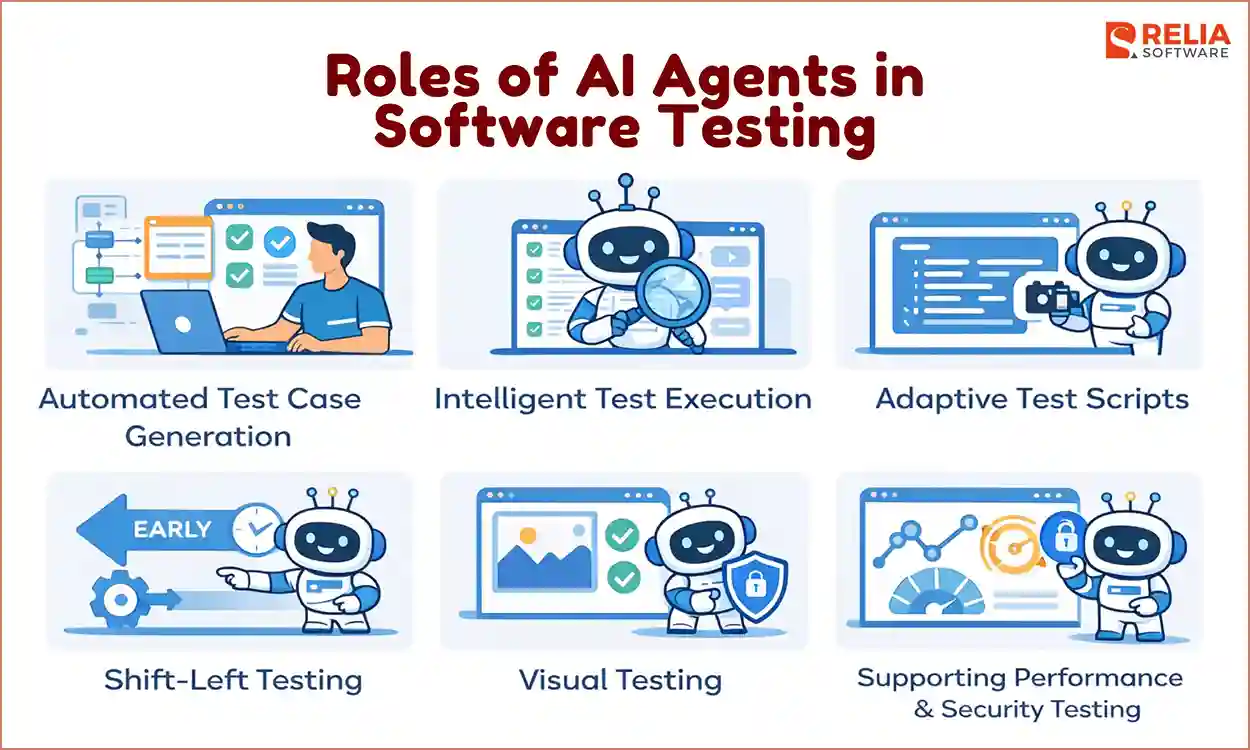
Roles of AI Agent in Software Testing
Automated Test Case Generation
AI agents can create test cases by using the app like a real user. They click through screens, fill in forms, and try different actions to see how the system works, then turn those actions into test cases. This helps QA teams cover more user flows and edge cases without writing every test manually, and also keeps tests easier to update when the app changes.
Intelligent Test Execution
AI agents execute tests more smartly and efficiently than traditional automation tools. They can run tests 24/7, in parallel, and at any time without manual triggers. Based on recent code changes, past failures, or risk levels, the agent can decide which tests should run first to ensure critical areas are validated early.
This approach helps QA teams shorten test cycles and get faster feedback from each build. Instead of running every test blindly, AI agents focus execution on the most important scenarios, improving reliability while saving time and resources.
Adaptive Test Scripts
Adaptive test scripts, also known as self-healing test scripts, allow AI agents to keep tests working even when the application changes. When a button moves, a field is renamed, or the UI structure is updated, the agent can detect these changes using visual and text clues and automatically adjust the test to match the new structure.
Unlike traditional scripts that break easily, self-healing scripts reduce maintenance effort in fast-moving, agile environments. This helps QA teams spend less time fixing broken tests and more time focusing on improving overall software quality.
>> Read more: How to Write A Powerful Test Plan in Software Testing?
Shift-Left Testing
Shift-left testing is a testing approach where quality checks are done earlier in the software development process instead of waiting until the end. By getting involved from the start, AI agents can review APIs, requirements, or early builds to create and run tests before the full user interface is ready. This helps teams find problems sooner, reduce rework, and keep the product more stable as it grows.
>> Read more:
- What is Unit Testing? Definition, Benefits & Process
- What is Integration Testing? Example, Approaches, Process
- Mastering Functional Testing for Delivering Bug-Free Software
Visual Testing
Visual testing checks how an application looks on the screen to make sure the layout, text, and buttons appear correctly. Instead of comparing pixels, AI agents review the screen in a more human way, allowing them to spot issues such as missing content or broken layouts even when small design changes occur.
AI agents can also compare screenshots across different devices, screen sizes, and resolutions to ensure a consistent user experience. This helps QA teams quickly detect UI differences and visual problems without being distracted by minor or expected design updates.
Self-Learning and Predictive Analysis
AI agents improve as they run more tests and collect more results. They learn which parts of the app tend to break and which ones usually work fine, then use that knowledge to decide what to test next. Based on past results, they can focus on risky areas, remove redundant tests, and spot problems earlier before they affect users.
Supporting Performance & Security Testing
AI agents can support performance and security testing by running tests under heavy load and risky conditions. They generate different types of traffic, try unusual inputs, and monitor how the application responds. This helps teams find performance issues and security weaknesses that normal tests might not catch.
>> Read more:
- Top 7 Web App Security Testing Tools For Developers
- 7 Leading Performance Testing Tools for Developers
Types of AI Agents in Software Testing
Simple Reflex Agents
Simple reflex agents act based on fixed rules by checking what is happening on the screen and responding with a set action, such as confirming a button is visible or an error message appears. These agents are useful for basic checks, but they do not remember past actions or learn from experience.
Model-Based Reflex Agents
Model-based reflex agents keep track of both current inputs and past experiences, allowing them to handle more complex scenarios. They use this information to understand how pages and actions are connected, which helps them test complete user journeys such as moving from login to checkout.
Goal-Based Agents
Goal-based agents work toward a specific target, such as completing a signup, placing an order, or reaching a certain page. They choose actions based on what will move them closer to that goal, which makes them useful for testing full user flows and making sure important tasks in the app work from start to finish.
This approach is also widely used in multi-step workflows like AI appointment setting, where an AI agent can qualify a lead, check available time slots, schedule the meeting, and send follow-up reminders without requiring a human to manage each step.
Utility-Based Agents
Utility-based agents choose actions based on how useful each option is. They compare different paths in the application and pick the one that gives the best result, such as higher test coverage or lower risk. This helps them focus on the most valuable areas to test instead of just following one fixed route.
Learning Agents
Learning agents are AI agents that improve by learning from past tests. They track what fails and what stays stable, then adjust how they test based on that experience. Over time, this helps them make better testing decisions and work more effectively.

Advantages Of AI Agents in Software Testing
- Faster release cycles: AI agents automate and adapt test execution, helping teams shorten testing phases and deliver software more quickly.
- Broader coverage: It can explore a wider range of scenarios and edge cases that human testers might miss.
- Improved accuracy: Consistently follow testing rules and analyze results carefully, helping reduce human errors and false test failures.
- Lower costs: Automating repetitive tasks and finding bugs earlier in the process leads to significant cost savings.
- Better use of QA resources: AI agents allow QA teams avoid wasted time and effort on repetitive work and fixing tests, and more time on quality planning and confident releases.
Best Practices for Implementing AI Agents in Software Testing
Start Small First
You should start by using AI agents on a small set of tests or in test environments instead of applying them to the whole app at once. This helps teams see how the agents work, manage risks, and avoid issues in production. Once the results are reliable, the agents can be expanded to more parts of the application.
Prioritize Data Quality
AI agents depend on data to work, so data quality is very important. Teams should ensure to use clean, realistic test data that reflects real user behavior and common scenariosto train the agents effectively from day one. Good data helps AI agents make better testing decisions, find real issues, and produce more reliable results from the start.
Set Clear Boundaries and Rules
Teams should clearly specify which parts of the application the AI agent can access, what actions it is allowed to perform, and when it should stop testing. These boundaries help keep testing safe and aligned with business goals.
Monitor Agent Behavior
It is important for teams to monitor both test results and how the AI agent behaves during testing, including its actions and decisions. Regular review and adjustment help ensure the agent stays focused on high-risk areas and continues to deliver reliable value as the application changes.
Combine AI Agents with Human Oversight
AI agents are effective at running and exploring tests, but human review is still essential. QA teams should review critical test flows and important findings to ensure results make sense and meet quality expectations.
Choose the Right Tools
Consider using platforms with pre-built AI agents, such as those available from LambdaTest or ACCELQ, rather than building from scratch. These tools help teams get started faster, reduce setup effort, and fit more easily into existing testing workflows, allowing QA teams to focus on improving test quality instead of building and maintaining AI systems.
Challenges of AI Agents in Software Testing
- Dependence on data quality: Inaccurate or insufficient data can limit the effectiveness of AI-driven testing decisions.
- Reduced predictability: Non-deterministic behavior may make test outcomes harder to reproduce and audit.
- Limited transparency: Understanding how an AI agent reached a decision can be challenging, which may affect trust and compliance.
- Governance and security concerns: Enterprises must ensure proper controls to prevent unintended actions, data leakage, or compliance issues.
FAQs
1. Can AI agents replace human QA testers?
No. AI agents help QA teams but do not replace people. They handle repetitive and large-scale testing, while humans are still needed for test planning, business logic checks, and decision-making.
>> Read more: Will AI Replace Software Engineers Altogether?
2. How do teams check if AI agent results are reliable?
Teams review test logs, compare results across different runs, and manually check important test flows. Clear rules and human review are often used for critical areas.
3. Do AI agents work with CI/CD pipelines?
Yes. AI agents can be added to CI/CD pipelines to run tests on new builds, focus on risky changes, and give faster feedback during development.
4. Are AI agents safe to use in enterprise or regulated environments?
They can be, if proper controls are in place. Many enterprises use clear rules, audit logs, and human oversight to meet security and compliance needs.
5. What is the difference between using AI to help testing and testing an AI agent?
Using AI to help with testing means using AI features to test a normal application. Testing an AI agent means checking how the agent itself makes decisions, learns, and reacts to different situations over time.
6. What is the difference between AI in software testing and AI agents in software testing?
AI in software testing means using AI to assist certain testing tasks while people still control the overall process. AI agents in software testing go a step further by acting like testers themselves, deciding what to test, taking actions on their own, and learning from past test runs.
Conclusion
AI agents in software testing are becoming an important part of modern QA as applications grow more complex and change more quickly. They help development teams conduct tests more efficiently, reduce maintenance effort, and improve overall test coverage.
Using AI agents in software testing is not about replacing human testers, but about supporting developers and businesses with smarter and more flexible testing approaches. When applied with clear rules, oversight, and best practices, AI agents can significantly improve software quality and help teams deliver reliable products faster.
>>> Follow and Contact Relia Software for more information!

- testing
- development