


Each application needs a strong back-end system for execution. In each system, the back-end guarantees the smooth functioning, data management, and security of an application. While the users interact with the front end, the back-end processes the request, communicates with the database, and ensures that things work efficiently. To help the back-end run effectively, we need suitable technologies.
This blog will give you in-depth details about the popular back-end technologies and trends in 2026 that you can apply in real-world applications.
Top Backend Programming Languages
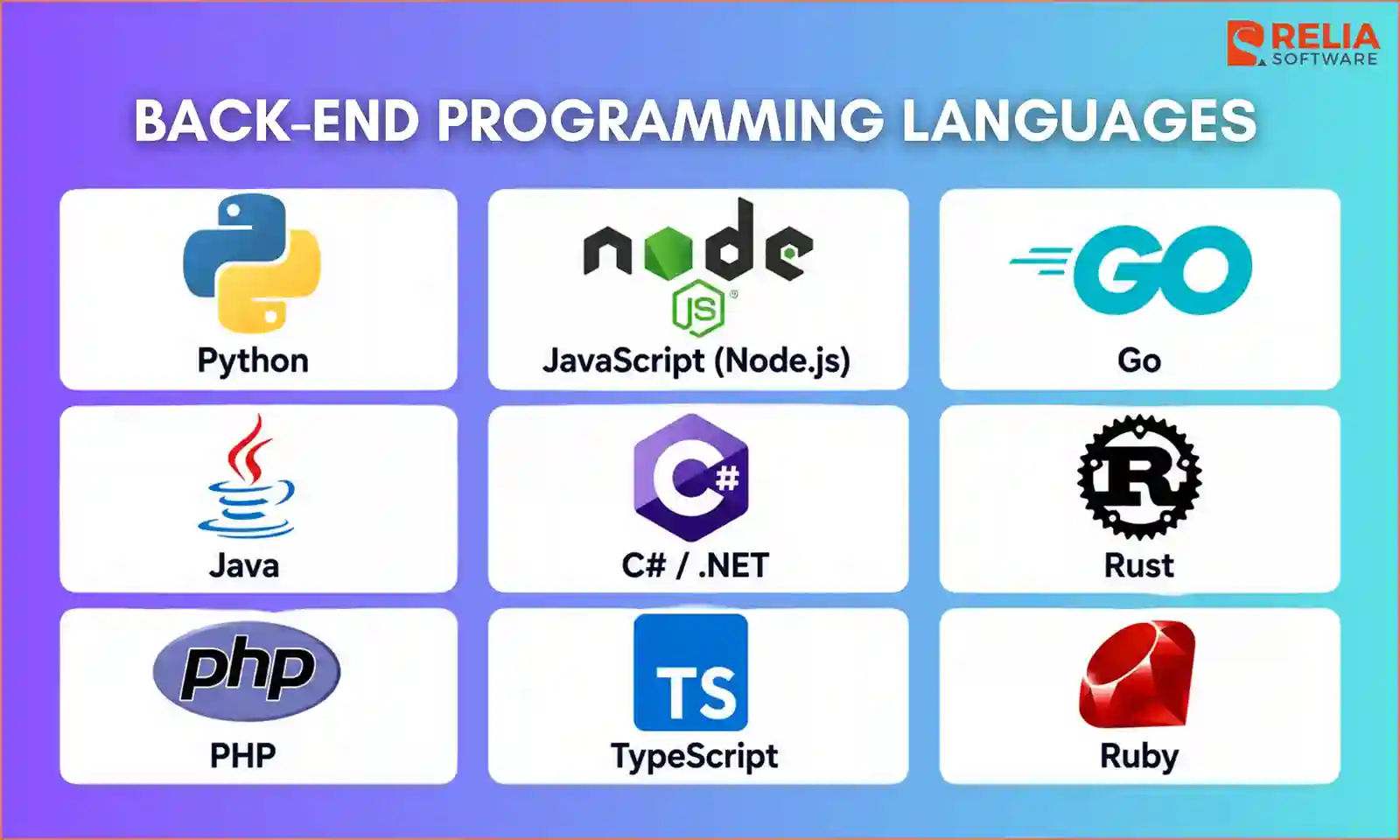
Python
Python remains one of the world’s most widely used backend languages and regularly ranks near the top of the TIOBE Index and Stack Overflow Developer Survey. According to the 2025 Stack Overflow Developer Survey, 54.8% of professional developers use Python. Its simple syntax and large library ecosystem make it a strong choice for AI products, data-heavy platforms, automation, and APIs that need to be developed quickly.
JavaScript (Node.js)
JavaScript has been the most commonly used programming language for over a decade and has become a backend language through Node.js, a runtime built for event-driven, non-blocking applications. Node.js runs on Google's V8 engine and uses an event-driven, non-blocking I/O model, which makes it excellent for real-time applications, streaming, and APIs that handle many simultaneous connections.
>> Read more: What Can You Do With JavaScript? 8 Popular JavaScript Usages
Golang (Go)
Created by Google, Go is a compiled language built for speed and scale. It compiles directly to machine code, so it runs faster than interpreted languages, and Go’s built-in concurrency model also makes it a natural fit for microservices and cloud-native systems. Although its smaller framework ecosystem can require more manual decisions than Java or Node.js, Go was still used by 17.4% of professional developers (2025 Stack Overflow Developer Survey).
>> Read more:
- The Ultimate Guide to Golang Structs with Code Example
- Instruction For Using Golang Generics With Code Examples
- Top 10 Best Golang Web Frameworks
Java
Java has a mature ecosystem, JVM performance, strong tooling, and frameworks such as Spring Boot that support complex backend development. It remains a safe choice for enterprise systems, banking platforms, high-traffic services, and long-term applications. Spotify, for example, uses Java across major backend systems and has built internal tools to manage Java runtime upgrades across thousands of software components.
>> Read more: Python vs Java: Which Language Fits Your Project Best?
C# / .NET
C#, running on the cross-platform .NET runtime, is the go-to choice in Microsoft and Azure ecosystems. This is a strong backend stack for enterprise applications, financial systems, cloud services, and Microsoft products. ASP.NET Core also supports API development, authentication, dependency injection, and cross-platform deployment. Beyond enterprise web apps, C# is also widely used for game backends via Unity.
>> Read more: C# vs Java: Which One Should You Use?
Rust
Rust fits performance-sensitive backend services, infrastructure tools, networking systems, and workloads where performance and memory safety are non-negotiable. It provides low-level control without a garbage collector and prevents many memory and concurrency errors during compilation. It's a steeper learning curve than most languages here, so it's typically chosen for infrastructure-level and performance-critical services rather than everyday CRUD apps.
>> Read more: Rust vs Go Comparison: Performance, Popularity, & More
PHP
PHP remains a practical backend language for content platforms, e-commerce sites, business portals, and applications built with WordPress, Laravel, or Symfony. This language is mature, easy to deploy, and supported by massive documentation and community resources. Modern PHP and the Laravel framework have also made it considerably faster and more pleasant to work with than its older versions suggest.
>> Read more: PHP vs JavaScript: Which Language Should You Choose?
TypeScript
TypeScript adds static types to JavaScript. On the backend, it brings type safety to Node.js codebases, catching a whole category of errors before runtime, which becomes increasingly valuable as a project and team grow. It works especially well with NestJS, Express, and Fastify for APIs, real-time applications, and full-stack software development. For instance, Slack, Airbnb, and Asana use TypeScript to keep large JavaScript backends maintainable.
>> Read more: TypeScript vs JavaScript: Which Is Better For Your Project?
Ruby
Ruby is mainly used for backend development through Ruby on Rails, which favors clear conventions and fast product delivery. It remains useful for SaaS products, marketplaces, internal systems, and startups that need to release features quickly. Shopify, as an example, uses Ruby on Rails across major backend systems and has shown that Rails can scale when supported by strong engineering and infrastructure.
>> Read more:
- Top 10 Ruby on Rails IDEs for Web Development Projects
- Top 10 Most Popular Ruby Frameworks For Programmers
Top Backend Frameworks
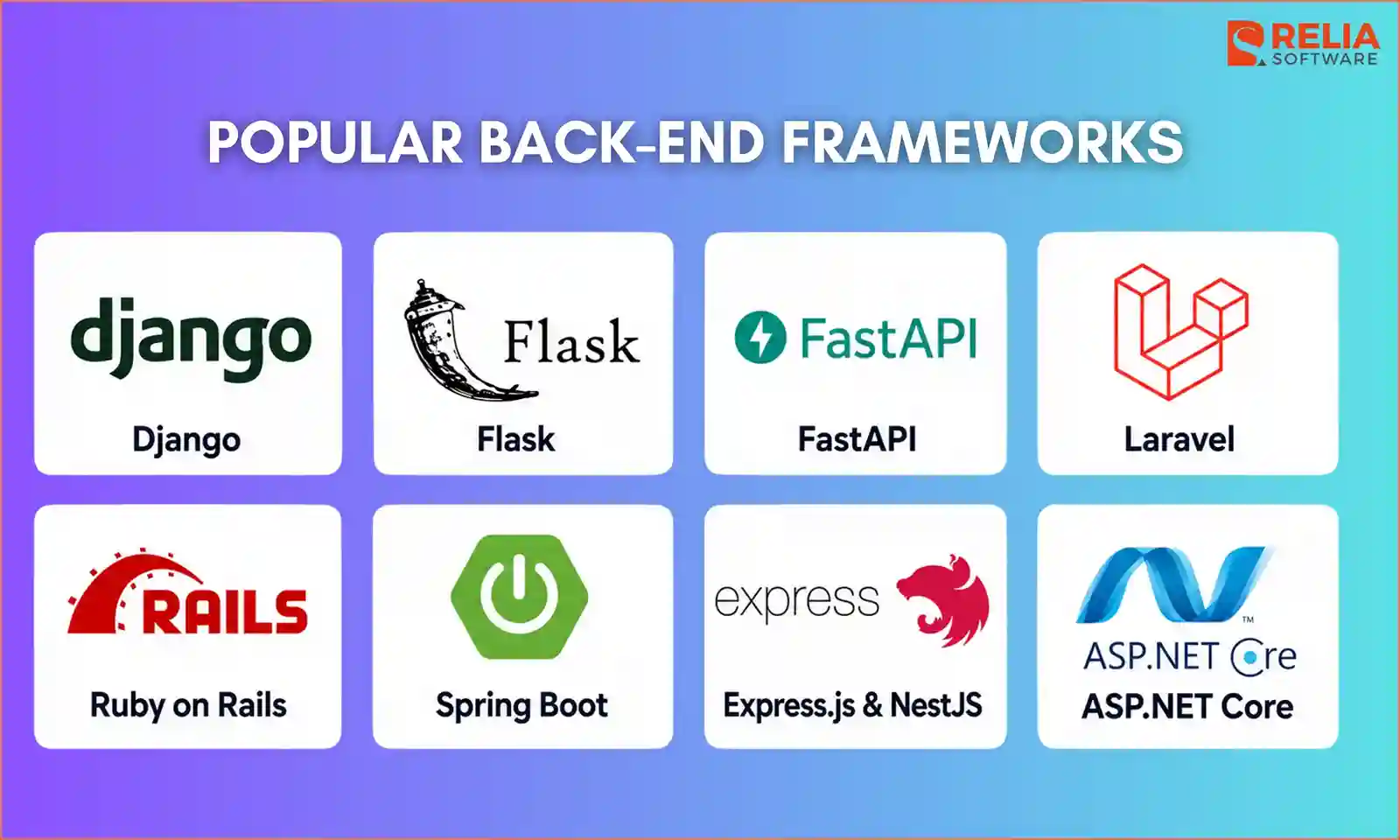
Django
Django is a full-featured Python framework built for fast and structured web development. It includes an ORM, authentication, URL routing, form handling, security controls, and a ready-to-use admin panel. These built-in tools make Django suitable for SaaS platforms, content management systems, marketplaces, and data-heavy applications.
However, Django’s fixed structure can be excessive for a small API or microservice. Django is usually the better choice when a project needs many standard web features from the beginning.
Flask
Flask, opposite to Django, is a lightweight Python framework that provides routing, request handling, and templating without forcing developers to follow a large application structure. That flexibility makes it excellent for small services, microservices, and prototypes where Django's full stack would be overkill. For startups and teams building focused, single-purpose services, Flask is a better fit than Django.
>> Read more: Django vs. Flask: A Comprehensive Comparison Across 10 Aspects
FastAPI
FastAPI is another modern Python framework focused on building fast and reliable APIs. It uses async support and Python type hints to validate data, generate API documentation, and catch errors earlier in development. This combination has made it the default choice for serving machine learning models and building the API layer of AI-driven applications, which is a major advantage heading into the near future.
Laravel
Laravel provides an elegant, developer-friendly toolkit, including an expressive ORM (Eloquent), clean routing, middleware, and strong support for RESTful services, for building modern web application backends quickly. This PHP framework is used for business applications, content platforms, e-commerce systems, and REST APIs, and for companies already using PHP or WordPress-based systems.
Ruby on Rails
Ruby on Rails is a full-stack backend framework that follows clear conventions to reduce setup and repeated code. It includes database migrations, routing, validation, authentication support, testing tools, and an ORM called Active Record.
By making sensible default decisions for developers, Ruby on Rails lets small teams build and launch full-featured applications quickly, which makes it a popular choice for startups and MVP development. Its mature MVC architecture, built-in database migrations, and strong testing culture also help teams build structured, maintainable backends that work well with almost any frontend.
Spring Boot (Java)
Spring Boot helps developers build Java applications without manually configuring every part of the Spring ecosystem. It removes much of the boilerplate that used to make Java feel heavy by providing auto-configuration, embedded servers, and production-ready tools out of the box.
Spring Boot is widely used for banking platforms, enterprise software, high-volume APIs, and systems that must remain stable for many years. With the large Spring ecosystem, strong community support, and a deep Java talent pool, Spring Boot remains a dependable option for complex and long-lived systems
Express.js & Nest.js
Express.js and NestJS are two major frameworks in the JavaScript and TypeScript backend ecosystem. Express is minimal and flexible, making it suitable for small APIs and real-time services. Meanwhile, NestJS adds more structure on top of Node.js with a TypeScript-first approach, dependency injection, and modular architecture, which is a better fit for large and maintainable backend systems.
Together, Express.js and NestJS are widely used in JavaScript backend development, including by major companies with large-scale web systems. However, they cover different backend needs: Express.js is a good fit for lean APIs, while NestJS is better for larger, structured, enterprise-grade applications.
ASP.NET Core
ASP.NET Core is Microsoft’s modern, cross-platform framework for C#, and it's one of the highest-performing options in this entire list by raw throughput. It runs on Windows, Linux, and macOS, integrates well with Azure, and provides a full enterprise toolkit for building web apps and high-performance APIs.
The framework is a natural fit for enterprise systems, financial software, internal business platforms, and companies already using the Microsoft ecosystem or other .NET technologies. Its structured approach supports large teams, although smaller projects may not need its full set of tools and conventions.
Backend Databases List
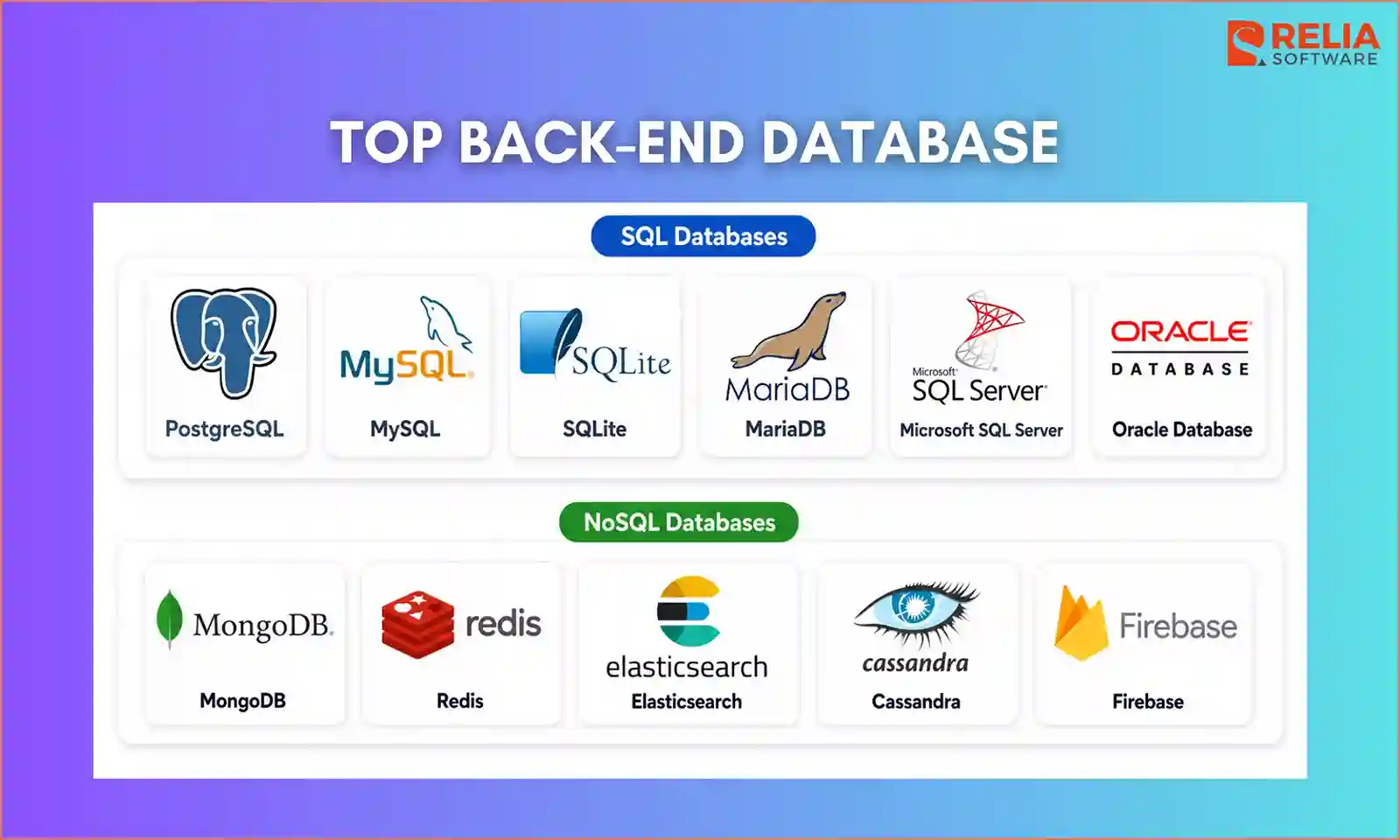
There are two core types of databases: relational (SQL) databases and non-relational (NoSQL) databases. Based on the requirements of the project, most real systems can use both. Here are the options:
SQL (Relational) Databases
Relational databases (SQL databases) organize data into tables of rows and columns with defined relationships between them, and they use SQL as a common query language.
>> Read more: Clustered vs Non-Clustered Index: Key Differences with Examples
PostgreSQL
PostgreSQL is the gold standard for open-source relational databases, and consistently the most-used database overall in the Stack Overflow Developer Survey. It goes well beyond simple storage, supporting custom data types, advanced indexing, JSON documents, and even vector search for AI workloads. If you're starting a new project and unsure which relational database to pick, PostgreSQL is the safe and capable default.
MySQL
MySQL is the other dominant open-source relational database and one of the most widely deployed in the world, powering the majority of CMS and e-commerce sites. It's fast, reliable, well-documented, and easy to find talent for. In practice, MySQL and PostgreSQL are very similar, but MySQL remains an excellent and battle-tested choice. Some popular platforms such as Facebook, GitHub, and Netflix all use MySQL.
SQLite
SQLite is a lightweight, serverless database contained in a single file, which makes it the most widely deployed database inside mobile apps, browsers, and countless embedded systems. It's easy to set up and perfect for local storage, small applications, and development. However, its simplicity means it isn't built for high-concurrency, multi-user production loads. Apple, Adobe, and Android all use SQLite extensively.
MariaDB
MariaDB is a fully open-source fork of MySQL, created when Oracle acquired MySQL, and it's maintained under a more permissive license. It stays largely compatible with MySQL while adding performance improvements and additional storage engines, making it a drop-in alternative for teams that want to avoid Oracle's licensing entirely. Samsung, DigiCert, and Bandwidth use MariaDB in production.
Microsoft SQL Server (MSSQL)
MSSQL is Microsoft's enterprise relational database, tightly integrated with the .NET ecosystem and Windows environments. It's a commercial, licensed product known for strong security, robust tooling, and reliability at enterprise scale. Microsoft, Accenture, and Costco also rely on Microsoft SQL Server.
Oracle Database
Oracle Database is built for very large, mission-critical systems that demand high scalability, concurrency, and security. It's expensive and less flexible than open-source options, so it's typically found only in large enterprises with the scale and budget to justify it. Netflix, LinkedIn, and eBay use Oracle for their largest workloads.
NoSQL (Non-Relational) Databases
NoSQL databases excel at storing unstructured or semi-structured data and tend to scale horizontally across many servers, making them well-suited to high-traffic, rapidly evolving applications.
MongoDB
MongoDB is the most popular document database, storing data as flexible, JSON-like documents rather than rigid tables. That schema flexibility makes it ideal for applications whose data structures change frequently or don't fit neatly into rows and columns, and its sharding support lets it scale horizontally across servers to handle heavy traffic.
Redis
Redis is an in-memory key-value store, making it extraordinarily fast and capable of millions of operations per second. It's rarely a system's primary database; instead it sits alongside one, handling caching, session storage, rate limiting, and real-time data. Pairing PostgreSQL for durable storage with Redis for caching is one of the most common patterns in modern backends.
Elasticsearch
Elasticsearch is a search and analytics engine built for fast full-text search, logging, and log analysis. It's commonly deployed as part of the ELK stack (Elasticsearch, Logstash, Kibana) to power search features and monitor infrastructure at scale. When your application needs sophisticated search or real-time log analytics, Elasticsearch is the specialist tool.
Cassandra
Cassandra is a distributed, wide-column database designed for extreme write-heavy workloads and massive scale. Its peer-to-peer architecture has no single point of failure, so it stays available even when nodes go down. That’s the reason why it's chosen for the highest-volume systems. In real cases, Discord uses it to store billions of messages; Netflix and Spotify use it for scale and personalization.
Firebase
Firebase, specifically Cloud Firestore, is Google's cloud-hosted NoSQL database and a cornerstone of its Backend-as-a-Service offering. It syncs data between clients in real time and lets mobile apps talk directly to the database without you running your own servers, which makes it a fast path to launch for mobile-first and serverless applications. Lyft, Instacart, and The New York Times use Firebase.
>> Read more: Top 10 Popular NoSQL Databases for Developers
Backend Infrastructure & DevOps Tools
Docker (Containerization)
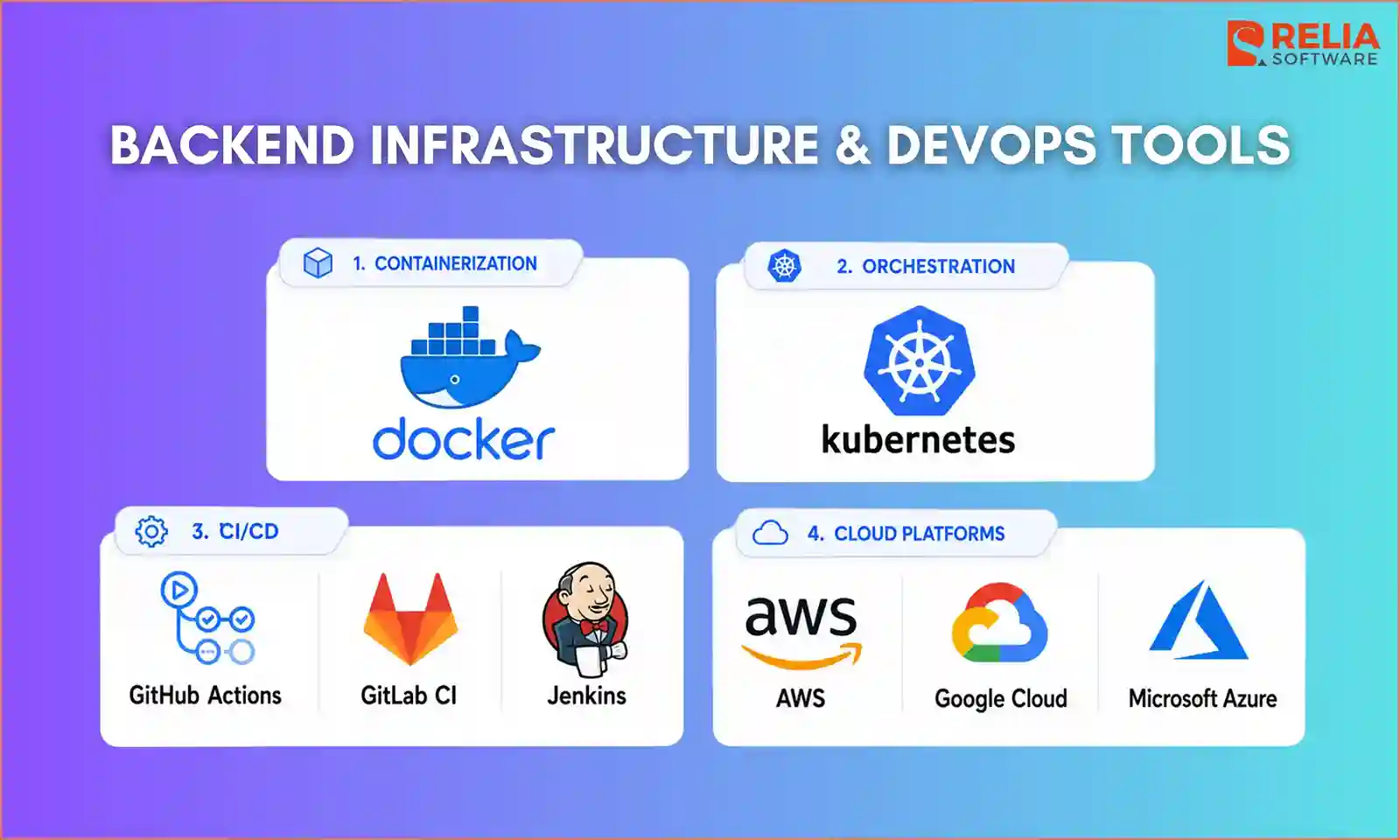
Docker packages an application and all the files, libraries, and tools it needs into a lightweight, self-contained container. The container runs the same on a developer’s computer, a test server, and a production server, preventing common problems where software works in one environment but fails in another. Docker also makes deployments more consistent, faster, and easier to repeat. It's effectively a baseline skill for backend and DevOps work today.
Kubernetes (Orchestration)
When a system runs hundreds or thousands of containers across many servers, managing them manually becomes difficult. Kubernetes automates tasks such as deploying containers, scaling them, restarting failed containers, and managing network connections. It can be complex and is unnecessary for small projects, but it is the industry standard for large systems that need to run reliably at scale.
CI/CD Pipelines
Continuous Integration and Continuous Deployment (CI/CD) automate the process of testing, building, and deploying software whenever developers update the code. Its features help teams find bugs earlier, reduce manual work, and release changes more quickly and safely. Common CI/CD tools include GitHub Actions, GitLab CI, and Jenkins. A reliable CI/CD pipeline is an important part of running production software.
>> Read more:
- 5 Best Practices for Enhancing CI/CD Pipeline Security
- 10 Popular CI/CD Pipeline Security Tools For Developers
Cloud Platforms
Most backend systems today run on cloud platforms instead of physical servers managed by the company. AWS offers the widest range of services, Google Cloud is strong in data, analytics, and Kubernetes, while Microsoft Azure works well with .NET and other Microsoft tools.
These providers also offer managed databases, storage, networking, and serverless functions, so teams do not need to build and maintain everything themselves. The cloud provider a company chooses often affects the rest of its technology stack because teams usually select databases, queues, and other services from the same platform.
Message Queues and Event Streaming
A message queue lets one service send a task for another to process later, so users do not have to wait for background work like emails. It also helps systems scale by reducing delays, retrying failed tasks, spreading work across services, and handling traffic spikes without overwhelming the application.
Apache Kafka
Kafka is the dominant choice for high-volume event streaming. Technically, it stores messages in a durable log, allowing multiple services to read the same data and replay past events when needed. That design makes Kafka ideal for real-time data pipelines, analytics, and any system ingesting massive streams of events.
RabbitMQ
RabbitMQ is a lightweight open-source message broker that routes and delivers messages between services. It supports multiple protocols, works on-premises or in the cloud, and is a reliable choice for asynchronous tasks and message delivery. Unlike Kafka, which focuses on large event streams, RabbitMQ is better suited for flexible, dependable task processing.
Cloud-Native Options: AWS SQS and Google Pub/Sub
If you're already committed to a cloud provider, such as AWS or Google Cloud, the provider’s managed queue is often the simplest option.
- AWS SQS (Simple Queue Service) is Amazon's fully managed message queue that scales automatically and requires no infrastructure maintenance, though it only runs within AWS.
- Google Pub/Sub is Google Cloud's equivalent, conceptually similar to Kafka but fully managed with no configuration or upkeep.
Both scale automatically and require little maintenance, but they only work within their own cloud platforms. This characteristic limits portability, but it can be a good trade-off for teams that want reliable messaging without managing the infrastructure themselves.
Backend Development Trends in 2026
AI-Native Backends
In 2026, AI is becoming a core part of backend architecture rather than an added feature. Systems are increasingly built to serve machine learning models, call large language model APIs, and run AI-driven logic as a first-class concern.
Therefore, backends now have to handle things like semantic search, recommendation engines, fraud detection, and AI agents as standard workloads, which has increased the use of Python, FastAPI, and vector databases. If you're architecting a new system this year, teams should plan for AI integration from the beginning.
Microservices & Monolith & Serverless
Microservices architectures are still useful for large systems because teams can develop, deploy, and scale services independently. However, many new products now start with a modular monolith to avoid the complexity, network delays, and data issues caused by using microservices too early. The goal is not to avoid microservices, but to use them only when the system is large enough to need them.
Meanwhile, serverless platforms such as AWS Lambda and Google Cloud Functions automatically manage infrastructure and scaling, while teams pay only for what they use. They work well for APIs, real-time processing, and event-driven tasks. Platforms like Firebase and AWS Amplify also provide ready-made authentication, databases, and APIs, helping small teams launch faster with less backend setup.
Event-Driven Architecture
As systems use more services, many teams are moving from direct service-to-service calls to event-driven communication. Instead of one service waiting on another, services publish events that others react to, coordinated through message queues and streaming platforms like Kafka and RabbitMQ. This decoupling reduces dependencies, improves reliability and scalability, and makes it easier to add new features without changing existing services. It's the architectural backbone behind most large real-time and distributed systems in 2026.
Edge Computing & WebAssembly
Backends are moving physically closer to users. Edge computing runs backend logic on servers distributed around the world rather than in one central data center, cutting latency for globally distributed users. WebAssembly (Wasm) is accelerating this trend by letting code written in languages like Rust and Go run safely and near-instantly at the edge. Together, they help teams build fast, lightweight backend services for users around the world.
GraphQL APIs
GraphQL is a popular alternative to REST for complex data requests. Rather than calling multiple endpoints, clients specify exactly the data they need in a single query, which reduces over-fetching and network overhead. It doesn't replace REST, but for complex, client-driven data needs, GraphQL has become a well-established standard rather than an experimental one.
Blockchain for Data Integrity
Blockchain technology is used in backend systems that need secure, transparent, and tamper-resistant records. It stores transactions across a distributed network instead of one central database. While it is not a common choice for most applications, it can be useful in finance, supply chain, and healthcare when data integrity and verification are essential.
>> Read more: Top Frontend Technologies and Development Trends
Conclusion
Back-end technologies provide a basis for both scalability and efficiency in applications. Making the right choice of combination in programming languages, frameworks, and database technologies ensures better performance, security, and adaptability. In the growth of back-end development, businesses have to update to recent technologies and best practices that are crucial in creating high-performance applications.
>>> Follow and Contact Relia Software for more information!

- development