


Loyalty app development is the process of building an app that rewards customers for repeat purchases. Businesses invest in these apps because keeping a customer coming back costs far less than winning a new one. The demand is real: 84% of consumers say loyalty programs affect whether they buy again (Capital One Shopping, 2025), and loyalty customers spend 12–18% more per year than new ones (Antavo, 2025).
This guide covers the main types of loyalty programs, core features, the loyalty app development process, tech stack, integrations, security, and realistic development costs and timelines. We also review some loyalty app development companies in Vietnam for you to choose the right partner.
What Is a Loyalty App?
A loyalty app is a mobile application that rewards customers for purchases with common rewards such as points, discounts, cashback, free products, etc. For the business, the app is a direct channel to reach and keep most engaged customers and records data about customer’s buying behavior.
Loyalty apps work in a simple loop: a customer signs up, earns points or stamps on each qualifying purchase, tracks the balance in the app, and redeems rewards for benefits once they have enough. Some examples of loyalty apps are:
- Starbucks Rewards: Gives Stars for each purchase that customers redeem for free drinks and food.
- Sephora Beauty Insider: Awards points on beauty purchases that convert into products, samples, and perks.
- McDonald's: Runs a standalone app with rewards points, mobile ordering, and member-only deals.
- Walmart: Builds offers and cashback into its main shopping app rather than a separate program.
A loyalty app and loyalty program software sound similar but are not the same thing. A loyalty app is the full product a business builds, with a customer side for earning and redeeming rewards and an admin side for running the program. Loyalty program software is the ready-made engine you can buy instead of building that backend yourself. The table below shows the difference.
|
Aspect |
Loyalty app |
Loyalty program software |
|
Definition |
A complete product with a customer app and an admin dashboard |
A ready-made engine that powers a loyalty program |
|
Main job |
Lets customers earn and redeem rewards, and lets the business run the program |
Stores members, applies the rules, and processes transactions for a software |
|
Who uses it |
Customers and the business team |
Mainly the business team, in the background |
|
Delivery |
Custom-built for one business | |
|
Connection |
Runs on its own backend or connects to third-party software through an API |
Often ships with a ready-made app or app template |
Benefits of Loyalty Apps For Businesses
- Higher retention: The app gives customers a reason to come back, which keeps more of them active and lowers churn.
- More repeat purchases: Rewards nudge members to buy again and more often, which raises purchase frequency.
- Understanding customer behavior: The app records who buys what and when, giving first-party data to personalize offers and forecast demand.
- Lower marketing costs: Push notifications and in-app offers reach customers directly, so the business relies less on paid ads and new-customer acquisition.
- Long-term revenue growth: Higher retention and repeat spend compound over time, raising customer lifetime value and steady revenue.
Types of Loyalty Apps You Can Build
Points-Based Programs
Points-based programs give customers points for purchases or actions, which they redeem for rewards. A customer might earn one point per dollar and trade 100 points for a discount. This model fits businesses with frequent, repeat purchases, such as coffee shops, grocery stores, and retail. Starbucks Rewards is a well-known example of this loyalty program type.
Tiered Reward Programs
Tiered programs sort customers into levels, such as silver, gold, and platinum, based on how much they spend or how often they engage over a set period, usually a year. Each level unlocks better rewards, so customers spend more to reach the next tier and to keep the status they already have.
This model works best for businesses with high-value or frequent purchases, such as airlines, hotels, credit cards, and beauty retailers, where customers will spend more to reach a higher tier and keep its perks. Delta SkyMiles, the loyalty program in Delta Air Lines' app, allows customers to move from Silver to Diamond Medallion based on yearly spend, adding upgrades and lounge access at each tier.
Cashback Programs
Cashback programs return a share of each purchase as cash or account credit for customers. For example, a customer who spends $100 at a 5% cashback rate can get $5 back. This model suits retail, fintech, and food delivery apps, where quick, clear savings keep customers coming back. However, cashback comes straight off margin, so the earn rate needs careful modeling to stay profitable.
Paid or Subscription Programs
Paid programs charge a recurring fee in exchange for ongoing benefits such as free delivery, member pricing, cashback, or exclusive access. For example, a grocery app might sell a $99-a-year membership that gives free delivery and member-only prices. Customers pay these amounts upfront to save them more than the fee over time, and the business gains predictable revenue plus a group of committed, high-spending members.
Referral Programs
Referral programs reward existing customers for bringing in new ones, usually giving both people a credit or discount after the new user's first purchase. For example, a fitness app might give a member $20 in credit and the friend $20 off their first month. This program turns happy customers into a low-cost acquisition channel, since a personal recommendation converts better than a paid ad.
Digital Loyalty Card Apps
A digital loyalty card app replaces the plastic punch card with a mobile version. Customers collect stamps or points by scanning a QR code or barcode at checkout, and the app stores every card in one place. Many of these apps also add the card to Apple Wallet or Google Wallet, so customers can redeem without opening the app.
Core Features of a Loyalty App
A loyalty app needs features for both customers and businesses. Weak features on either side reduce engagement or make the program hard to manage. Below are core features of a loyalty app:
Customer-Facing Features
- Registration and login: Lets users sign up with email, phone, or a social account in a few steps.
- Rewards dashboard: Shows points earned, tier status, and rewards available to redeem.
- Earning and redemption: Records qualifying activity and applies rewards at checkout or in the app.
- Push notifications: Alerts users about offers, expiring points, and personalized deals.
- QR or barcode scanning: Lets customers earn and redeem in a physical store.
- Gamification: Adds progress bars, challenges, or streaks to keep users returning.
- Referrals: Gives users a link or code to invite friends for a reward.
- Personalized offers: Tailors promotions to each user's purchase history.
Admin and Business Features
- Program rules engine: Defines how customers earn, redeem, and move between tiers.
- Customer segmentation: Groups members by behavior for targeted campaigns.
- Campaign management: Creates and schedules offers, promotions, and notifications.
- Analytics and reporting: Tracks enrollment, engagement, redemption, and revenue.
- Fraud controls: Flags abnormal earning or redemption patterns.
- Integrations management: Connects the app to POS, e-commerce, and CRM systems.
How To Build a Loyalty App Step by Step?
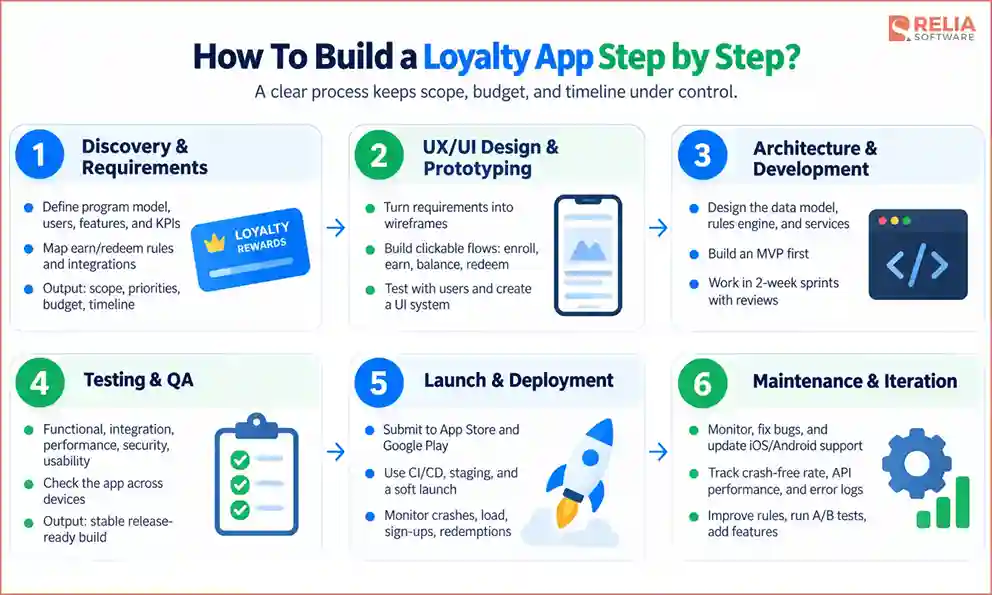
Loyalty app development follows the same core stages as any custom mobile product, with extra attention on the rules engine and integrations. A clear process keeps scope, budget, and timeline under control.
Step 1: Discovery & Requirements
Discovery defines the program model, target users, core features, and success metrics. In this step, the team maps how customers earn and redeem rewards, which program rules apply, and which systems the app must connect to, such as POS, e-commerce, or CRM.
This step is also where you choose the program type, since that decision shapes the rules engine and the feature list. The stage produces a project scope, a prioritized feature list, and a first budget and timeline, and skipping it is the most common cause of rework later.
Step 2: UX/UI Design & Prototyping
In this stage, app designers will turn the requirements into wireframes. Then, they will build a clickable prototype that shows the main flows, such as enrollment, earning points, checking a balance, and redeeming a reward.
After the prototype is ready, test it with real users to catch confusing flows early, when changes cost little. Alongside the flows, designers set the visual style so the app matches the brand, and the stage wraps up with a set of wireframes, a tested prototype, and a reusable UI design system.
Step 3: Architecture & Development
Engineers first design the architecture, including the data model, the rules engine, and how services communicate. They then build a minimum viable product (MVP) on that foundation.
Starting with an MVP is usually the smart approach, because a first version with only the core features lets you launch sooner and test the program with real users before adding tiers, gamification, or deeper integrations. This stage’s work usually runs in two-week sprints with a review at the end of each, so priorities can shift between sprints.
Step 4: Testing & QA
Quality assurance checks that the app works across devices, screen sizes, and both iOS and Android before release. A loyalty app needs several types of testing:
- Functional testing: Confirms that points calculate correctly, rewards redeem as expected, and every flow works end to end.
- Integration testing: Checks that third-party connections stay in sync and pass data accurately.
- Performance testing: Makes sure the app stays fast and stable under heavy load, such as a promotion or holiday rush.
- Security testing: Verifies authentication, data encryption, and payment handling against common vulnerabilities.
- Usability testing: Confirms the app is clear and easy to use on real devices.
Fixing bugs here is far cheaper than patching them in production, and the stage ends with a stable build ready for release.
>> Read more:
- 7 Leading Performance Testing Tools for Developers
- Top 15 Best Usability Testing Tools For Businesses
Step 5: Launch & Deployment
The team now prepares the app for release, submits it to the Apple App Store and Google Play, and sets up the production environment. Good practice is to automate the release with a CI/CD pipeline, so each build is tested and deployed the same way, and to keep staging and production separate to avoid surprises.
A soft launch to a small group, or a staged rollout on Google Play, helps identify issues before a wider release. App store review can take several days and can also reject the app, so the schedule needs room for at least one resubmission. After going live, the team watches crash reports, server load, and key metrics such as sign-ups and redemptions to catch problems early. The output is a live app running in a monitored, scalable production environment.
Step 6: Maintenance & Iteration
After launch, the app needs monitoring, bug fixes, and regular updates to stay compatible with new iOS and Android versions and to patch security issues. The team tracks crash-free rate, API performance, and error logs, and keeps dependencies and libraries up to date so the app does not fall behind.
Beyond upkeep, this stage is where the program improves when teams use real usage data to refine reward rules, fix drop-off points in the sign-up or redemption flow, run A/B tests on offers, and add features such as new tiers or integrations. Planning maintenance as an ongoing service, with an ongoing cost, a set monthly capacity, and a support agreement, keeps the app reliable as the user base grows.
Loyalty App Metrics & KPIs to Track
User Engagement Metrics
The app should track engagement from day one. Build in event tracking for daily active users (DAU) and monthly active users (MAU) to see how many people use the app and how often, and log average session length to show how much they do once inside.
Redemption rate, the share of earned rewards that customers actually claim, is a loyalty-specific signal the rules engine should record, since low redemption usually means the rewards are not worth chasing.
Retention Metrics
Retention is what makes or breaks a loyalty program, so the app and backend need to record it. Retention rate measures the share of customers who keep buying over a set period, and churn rate measures the share who stop, which shows where you lose people.
Repeat purchase rate, calculated from transaction history in the backend, is the clearest sign the program changes behavior. A 5% increase in retention can raise profits by 25% to 95%, based on research from Bain & Company.
Revenue Metrics
Revenue metrics tie the program back to the business, so the app should calculate them from order and member data. Average order value (AOV) compares how much members spend per order against non-members, and customer lifetime value (CLV) estimates the total revenue a member brings over time. Set against the build and running costs, these two metrics show the program's return on investment (ROI).
Tech Stack for Developing a Loyalty App
A loyalty app's tech stack breaks into a mobile frontend, a backend with a rules engine, a database, and supporting services for payments, notifications, and data. The table below maps each layer or task to the tools teams commonly use.
|
App Layers |
Common Tools |
What it handles |
|
Mobile frontend |
React Native, Flutter, Swift, Kotlin |
The app customers use on iOS and Android |
|
Backend and API |
Node.js (NestJS), Go, Python (Django) |
Rules engine, business logic, and earn or redeem processing |
|
Database |
PostgreSQL, MySQL |
Members, balances, and transaction history |
|
Caching and real-time |
Redis |
Fast balance lookups and instant updates |
|
Cloud and hosting |
AWS, Google Cloud, Azure |
Hosting, scaling, and security |
|
Authentication |
Firebase Auth, Auth0, AWS Cognito |
Sign-in, accounts, and session security |
>> Read more:
- 12 Frontend Technologies and 8 Development Trends
- Backend Technologies: Languages, Frameworks & Databases
- Top 10 Best Cloud Computing Platforms For Businesses
Loyalty App Integrations: POS, E-commerce, and CRM
A loyalty app earns its value by connecting to the systems where purchases and customer data already live. Weak integrations lead to delayed points, missing data, and frustrated customers.
Each integration adds development and testing time, so the list of connected systems is a major driver of both cost and timeline.
|
System |
Tools |
Why integrate it |
|
POS system |
Square, Toast, Lightspeed, Clover |
Posts in-store purchases as points at checkout with no manual entry, keeping in-store and app data in sync. |
|
Shopify, Magento, WooCommerce |
Tracks online orders, updates the loyalty balance automatically, and can enroll customers at checkout. | |
|
CDP or CRM systems |
Salesforce, HubSpot, Segment |
Unifies customer profiles and purchase history so you can segment members and personalize offers. |
|
Stripe, Braintree, PayPal |
Handles paid memberships, cashback payouts, and in-app purchases securely. | |
|
Email & SMS marketing |
Klaviyo, Braze, Mailchimp, Twilio |
Sends automated points reminders, tier updates, and targeted offers across channels. |
|
Push notifications |
Firebase Cloud Messaging, APNs, OneSignal |
Delivers offer alerts and expiring-point reminders that bring users back to the app. |
|
Analytics |
Google Analytics, Mixpanel, Amplitude |
Measures engagement, redemption rates, and how the program affects revenue. |
|
Digital wallet |
Apple Wallet, Google Wallet |
Lets customers store the loyalty card or pass in their phone wallet for one-tap access. |
|
Customer support |
Zendesk, Intercom |
Lets agents see a member's points and history to resolve reward issues quickly. |
Loyalty App Security & Compliance Requirements
A loyalty app stores personal data, purchase history, and often payment details, which makes it a target for attackers. A breach can mean regulatory fines, fraud losses, and lost customer trust that is hard to win back. Under the GDPR, fines can reach €20 million or 4% of global annual revenue, so the measures below are requirements, not optional extras. Apply them from the start:
- PCI DSS compliance: Follow the Payment Card Industry Data Security Standard whenever the app stores or processes card data. A certified payment gateway keeps most card data out of your own systems and lowers the compliance burden.
- Data privacy law: Meet the GDPR or CCPA when serving users in the EU or California, with clear consent, data access, and deletion rights built in.
- Strong authentication: Protect accounts and reward balances with secure sign-in and multi-factor authentication.
- Encryption: Encrypt customer and transaction data both in transit and at rest.
- Fraud monitoring: Watch for abnormal earning or redemption patterns to catch account takeovers and reward abuse.
- Access control: Limit which staff and systems can view or change member data and program rules.
How Much Does Loyalty App Development Cost?
Cost by App Complexity
|
App complexity |
Typical cost range |
Timeline |
|
Basic app (points, profiles, basic rewards) |
$20,000 – $50,000 |
2-4 months |
|
Mid-range app (tiers, push, gamification, a few integrations) |
$50,000 – $100,000 |
4-6 months |
|
Advanced app (personalization, multiple integrations, custom backend) |
$100,000+ |
6-9+ months |
Cost by Region
|
Region |
Typical hourly rate per developer |
|
North America (US, Canada) |
$75 – $150 |
|
Western Europe |
$70 – $120 |
|
Eastern Europe |
$35 – $75 |
|
Latin America |
$30 – $65 |
|
South & Southeast Asia (including Vietnam) |
$20 – $50 |
>> Read more: How Much Does It Cost to Design an App?
FAQs
1. Do I need to launch on both iOS and Android at once?
Not always. You can launch on one platform first, usually the one most of your customers use, to save costs and reach the market sooner, then add the other later. Building with a cross-platform framework lets you cover both at once for less than two separate native apps.
2. Does a loyalty app make sense for a small business?
Yes. A small business can run a simple digital stamp or points program, often through a point-of-sale system, while larger brands invest in custom apps with tiers and integrations. The approach should scale with the budget and goals.
3. Can a loyalty app work without an internet connection at checkout?
Usually a connection is needed to update balances in real time. Some apps support offline scanning that syncs once the connection returns, but reliable offline support adds development work, so confirm the need before the build.
Conclusion
In short, loyalty app development is the process of building a mobile app to increase retention, repeat spend, and customer lifetime value. The quality of the app depends on choosing the right app type, building a focused MVP for early feedback and resolution, planning clean integrations, and protecting customer data from the start.
A capable development partner is worth the cost by getting the rules engine, integrations, and security right the first time from their experience, and an experienced offshore team can deliver that quality while keeping the build affordable. Start by defining your program rules, then choose a partner whose portfolio matches the app you want to build.
>>> Follow and Contact Relia Software for more information!

- development
- mobile app
- mobile applications
- Web application Development