


Building software is not only about development, but also needs to catch security issues early, control open-source risks, protect cloud infrastructure, and keep secrets safe throughout the delivery process. DevSecOps tools can help bring security into coding, testing, deployment, and operations for developers instead of leaving it as a final check at the end.
In this article, we look at some of the most useful open-source DevSecOps tools across key security areas such as SAST, SCA, container security, DAST, IaC compliance, etc. If you are building a practical DevSecOps workflow, this list will help you understand what each tool does, where it fits, and how it can support a safer software delivery process.
>> Read more: 10 Popular CI/CD Pipeline Security Tools For Developers
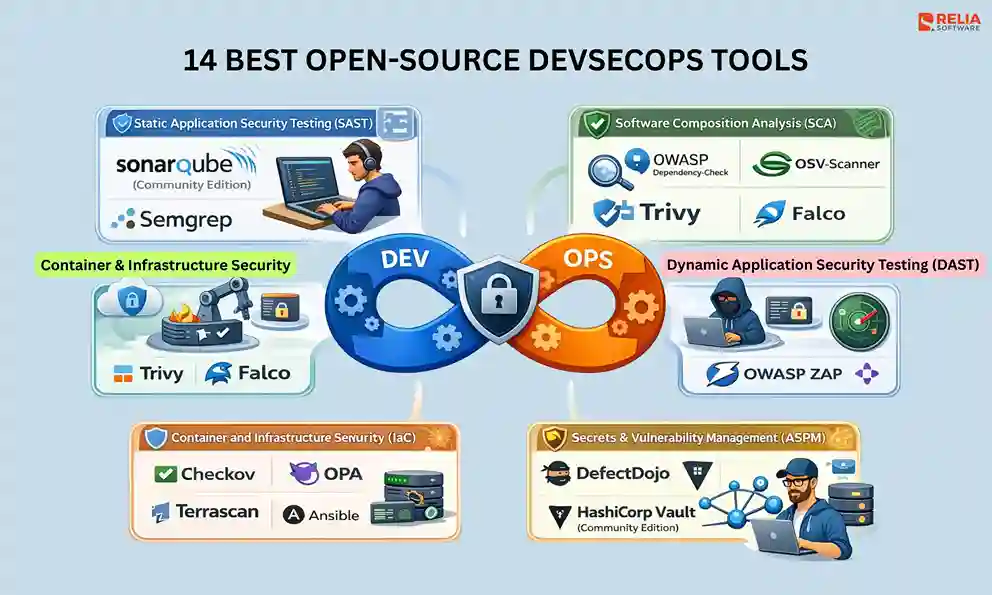
Static Application Security Testing
Static analysis scans your raw source code, looking for logical flaws, insecure coding patterns, and potential bugs before the application is even compiled or deployed. It provides developers with immediate feedback within their IDE or during the pull request process.
SonarQube (Community Edition)
SonarQube Community Edition is a free, self-managed code analysis tool that reviews source code for bugs, security issues, and maintainability problems across more than 30 different programming languages.
This tool helps developers keep code clean by finding code smells, bugs, and security issues in the main branch. It also provides a centralized dashboard that tracks the code health over time, making it easier for teams to visualize their technical debt and security posture.
Key Features:
- Static Analysis: Automatically detects bugs and vulnerabilities in source code without executing the program.
- Quality Gates: Sets specific pass/fail criteria for builds based on security and reliability metrics.
- Multi-language Support: Analyzes languages including Java, C#, JavaScript, Python, and C++.
- Centralized Dashboard: Provides a visual overview of project health, history, and hotspots.
Our Application Example:
We often integrate SonarQube directly into our GitHub Actions or GitLab CI runners. Each time a developer opens a pull request, SonarQube runs a scan automatically. If the code does not meet required security grade, the build is blocked. The developer then gets notified and must fix the issue before the code moves to human review.
Semgrep
Semgrep is a fast, lightweight, and highly customizable static analysis tool that looks at the code structure rather than a simple string of text. This allows it to understand the context of code blocks, making it much more accurate than simple text-based searches. Because the rules also look similar to real code, developers can write their own checks more easily and stop the same security mistakes from showing up again in future projects.
Key Features:
- Pattern Matching: Searches for vulnerabilities using code-like syntax instead of complex regex.
- Fast Scanning: Runs quickly in CI/CD pipelines without requiring a full build environment.
- Custom Rule Support: Allows teams to write and share specific security rules tailored to their own tech stack.
- Registry Integration: Accesses thousands of community-written rules for various frameworks and languages.
Our Application Example:
Semgrep is often used as a pre-commit check and as an early CI scan in our development process, which helps us enforce internal coding rules, such as making sure all API endpoints use the right authorization middleware. This lets us catch simple but risky mistakes, like an exposed sensitive route, just seconds after the code is written.
Software Composition Analysis (SCA)
Modern applications often rely on thousands of third-party libraries to build. SCA tools can look at these dependencies to ensure you aren't using packages with known security vulnerabilities or restrictive legal licenses.
OWASP Dependency-Check
OWASP Dependency-Check is a software composition analysis tool trying to find vulnerabilities in project dependencies. It works by collecting information from the project, such as JAR files or package manifests, and comparing that with data from the National Vulnerability Database. Many teams use it because it is reliable and can create detailed reports in formats like HTML, XML, and JSON.
Key Features:
- NVD Integration: Synchronizes with the National Vulnerability Database to stay updated on the latest threats.
- Broad Ecosystem Support: Works with Java, .NET, Ruby, PHP, and Node.js environments.
- Jenkins Plugin: Integrates directly into build servers to fail builds containing high-risk libraries.
- False Positive Management: Provides mechanisms to suppress findings that are determined to be non-risky.
Our Application Example:
We have successfully integrated OWASP Dependency-Check into the Jenkins pipelines of our enterprise clients who require strict compliance with security standards. If it finds a critical vulnerability in a library we use, it alerts our maintenance team right away. This helps us fix the issue early by updating the library and redeploying before the vulnerability can be used against a live system.
OSV-Scanner
OSV-Scanner is a specialized tool developed by Google that provides an interface to the Open Source Vulnerability (OSV) database. Unlike some scanners that rely on manual entries, OSV-Scanner links vulnerabilities to specific package versions and even source code commits. This results in improved accuracy and reduced false positives, because it can identify more clearly which parts of the code are actually affected.
Key Features:
- Commit-level Precision: Maps vulnerabilities to specific code changes for better accuracy.
- Vulnerability Database Access: Queries the massive OSV.dev database for the latest security data.
- Fast Execution: Designed to run quickly across large monorepos with many languages.
- SBOM Support: Can scan Software Bill of Materials files to verify the security of pre-built packages.
Container and Infrastructure Security
As applications move toward containerization and cloud-native architectures, securing the wrapper around the code is just as important as securing the code itself.
Trivy
Trivy is an open-source security scanner that checks container images, repositories, file systems, binary files, and Kubernetes environments for vulnerabilities and misconfigurations.
Many teams use Trivy because it is easy to run and covers several security checks in one tool. It can find OS package vulnerabilities, language-specific library flaws, and even misconfigured Infrastructure-as-Code (IaC) files. It also works well in different environments, from a developer on their local laptop to an automated process in a cloud environment.
Key Features:
- Comprehensive Scanning: Finds vulnerabilities in OS packages, application dependencies, and IaC files.
- Speedy Analysis: Completes scans in seconds, making it ideal for high-frequency CI/CD.
- Misconfiguration Detection: Checks Dockerfiles and Kubernetes manifests for security best practices.
- Vulnerability Database: Automatically updates its internal data to catch the newest threats.
Our Application Example:
We use Trivy as a required step in our container build process. After the code is packaged into a Docker image, Trivy scans it before the image is pushed to our private registry. If the base image has a high-risk vulnerability, the build stops right away. This helps us make sure every container we deploy to our clients’ cloud environments is more secure from the start.
Falco
Falco is a cloud-native runtime security tool for hosts, containers, Kubernetes, and cloud environments. While other tools look at code or images before they run, Falco monitors what is happening right now. It uses system calls to detect suspicious activity, such as a shell being opened inside a container, unexpected file changes, or unauthorized network connections, and sends out alerts in real-time.
Key Features:
- Runtime Monitoring: Watches system calls in real-time to detect anomalous behavior.
- Flexible Rule Engine: Allows users to create custom security policies for specific workloads.
- Kubernetes Integration: Understands K8s metadata to tell you exactly which pod is acting up.
- Alerting System: Sends notifications to Slack, PagerDuty, or Webhooks when a rule is triggered.
Our Application Example:
We can deploy Falco on the production servers of our Managed Services clients to give our DevOps team real-time visibility into suspicious activity.
For example, if a process tries to open a shell inside a running web container, which can be a sign of an attack, Falco sends an alert to Slack right away. This helps us quickly isolate the container and respond before the issue spreads.
Dynamic Application Security Testing (DAST)
DAST tools test your application while it is running by attacking it from the outside, much like a hacker would. This identifies vulnerabilities that only appear when the full system, including the database, web server, and application, is working together.
OWASP ZAP
OWASP ZAP is a popular open-source DAST tool that sits between the browser and the web application. It lets teams see every request and response, which makes it easier to spot issues like XSS or SQL injection. This tool also includes an automated spider to crawl the site and find pages, along with an active scanner that tests the application in a controlled way to detect security weaknesses.
Key Features:
- Automated Scanning: Crawls and attacks web applications to find common security flaws.
- Interception Proxy: Allows developers to manually inspect and modify web traffic for testing.
- REST API: Enables full automation of security tests within a CI/CD pipeline.
- Add-on Marketplace: Provides a huge library of community-built tools to extend functionality.
Our Application Example:
We run OWASP ZAP during the staging or UAT phase before a major release. It scans the live staging environment so we can find security issues that only appear when the frontend, backend, and database are working together. This helps us catch problems such as session handling issues before the product goes live.
Nuclei
Nuclei is an open-source vulnerability scanner from ProjectDiscovery that uses simple YAML templates to check targets for vulnerabilities, misconfigurations, and exposed services.
This tool is known for being very fast and focused. Instead of sending broad, random attacks, Nuclei uses templates to look for specific security issues, unsafe settings, or exposed files. It also has a large community template library that is updated often as new vulnerabilities are found in popular tools such as WordPress, Jenkins, and Jira.
Key Features:
- Template-based Engine: Uses simple YAML files to define exactly what to scan for.
- High Performance: Designed to scan thousands of hosts simultaneously with very low overhead.
- Community Templates: Leverages a massive library of pre-written checks for the latest CVEs.
- Extensible Logic: Allows security teams to write complex multi-step exploits for testing.
Compliance and Infrastructure as Code (IaC)
As we define our servers, networks, and databases using code (like Terraform or Ansible), we need tools to ensure those configurations are secure and follow industry compliance standards before they are deployed to the cloud.
>> Read more: 19 Popular Infrastructure as Code (IaC) Tools For Businesses
Checkov
Checkov is a static code analysis tool specifically designed for Infrastructure as Code (IaC). It scans files written in Terraform, CloudFormation, Kubernetes, and more to find security and compliance misconfigurations. It comes with many built-in policies for major cloud platforms such as AWS, Azure, and Google Cloud. This helps teams catch unsafe settings early, such as a public S3 bucket or a database that is deployed without encryption.
Key Features:
- IaC Scanning: Analyzes Terraform, Kubernetes, Helm, and Serverless files for errors.
- Policy-as-Code: Enforces security rules automatically during the development phase.
- Compliance Mapping: Checks code against frameworks like CIS Benchmarks and HIPAA.
- Fix Suggestions: Provides clear instructions and code snippets on how to fix identified issues.
Open Policy Agent (OPA)
Open Policy Agent (OPA) is an open-source policy engine that separates policy decisions from the systems that enforce them. Instead of setting different rules for APIs, Kubernetes clusters, and CI/CD pipelines, teams can write policies in Rego and let OPA decide whether an action should be allowed. This makes security rules easier to manage and keep consistent at scale.
Key Features:
- Unified Policy Engine: Provides a single language to manage security across different systems.
- Rego Language: A powerful, declarative language designed specifically for writing policies.
- Decoupled Logic: Separates your security rules from your application code for better management.
- Wide Integration: Works with Kubernetes, Terraform, Envoy, and many other cloud-native tools.
Terrascan
Terrascan is an open-source IaC scanner from Tenable that detects compliance and security violations before infrastructure is deployed. It is built on top of the Open Policy Agent (OPA) engine, specifically targets Terraform, but also supports Kubernetes, Dockerfiles, and ArgoCD. It also includes many built-in policies that help teams check whether their cloud infrastructure follows secure setup practices.
Key Features:
- OPA-Powered: Uses the industry-standard OPA engine for deep and flexible policy checks.
- Extensive Policy Library: Includes hundreds of rules covering security, and reliability.
- Drift Detection: Can be used to find differences between your code and your actual cloud state.
- CI/CD Ready: Easily integrates into pipelines to prevent insecure infrastructure from being built.
Ansible
Ansible is an open-source automation tool used for configuration management, provisioning, software deployment, and workflow orchestration. It lets teams define secure server settings in simple YAML files called playbooks, then apply those settings automatically across many machines. This helps keep servers patched, hardened, and set up in the same way, while reducing human mistakes that can lead to security problems.
Key Features:
- Configuration Management: Automates the setup and hardening of servers to a known secure state.
- Agentless Architecture: Works over SSH, meaning you don't have to install extra software on your servers.
- Idempotency: Ensures that running a script multiple times results in the same secure state.
- Security Patching: Automates the process of updating software across an entire data center.
Our Application Example:
We frequently use Ansible to manage the infrastructure of our long-term managed services clients. Whenever a new server is launched, our Ansible scripts configure it in minutes, ensuring it is secure from the very first second it comes online.
Secrets & Vulnerability Management (ASPM)
As security findings pile up from various tools, you need a way to manage them. Additionally, you must have a way to handle "secrets" (like API keys and passwords) so they never end up in your source code, where they could be stolen.
DefectDojo
DefectDojo is an open-source vulnerability management platform that collects security findings from different tools in one place. It can import results from many security tools, including SonarQube, ZAP, and Trivy, and helps security teams remove duplicate findings, track fix progress, and create reports more easily, making it much easier to run a coordinated security program.
Key Features:
- Vulnerability Aggregation: Imports and centralizes findings from many different security tools.
- Deduplication: Automatically merges identical findings from different tools into a single ticket.
- Metrics and Reporting: Provides clear graphs and data on security trends over time.
- Jira Integration: Pushes security vulnerabilities directly into developer workflows as Jira tasks.
Our Application Example:
DefectDojo is used during our project management stage to review security findings from our automated tools. Our security leads use it to prioritize issues, then sync them to Jira as tasks for developers. This helps us treat security work as part of the normal sprint process, not as a separate workflow.
HashiCorp Vault (Community Edition)
HashiCorp Vault Community Edition is the open, self-managed version of Vault for secrets management. This tool is widely used to store sensitive data such as passwords, API keys, and certificates in a safer place. Instead of putting these secrets directly in code or config files, applications can request them from Vault when needed. It can also create dynamic secrets that expire after a short time, which helps reduce risk if a key is exposed.
Key Features:
- Secret Storage: Securely stores and tightly controls access to tokens, passwords, and certificates.
- Dynamic Secrets: Generates temporary credentials on-the-fly that automatically expire.
- Data Encryption: Provides APIs for developers to encrypt data without handling the keys themselves.
- Lease and Revocation: Allows security teams to instantly revoke access to any secret at any time.
>> Read more:
- Top 9 Best DevOps Deployment Tools for Businesses
- Top 22 Best DevOps Automation Tools You Should Know
Conclusion
Strong security often comes from using the right DevSecOps tools across the full pipeline. The best way is to choose tools that fit your tech stack, team size, and development process.
Start with the areas that matter most to your project, then build a workflow your developers and DevOps team can manage easily. With the right set of tools, teams can release software faster, lower avoidable risks, and build a safer foundation over time.
>>> Follow and Contact Relia Software for more information!

- development