


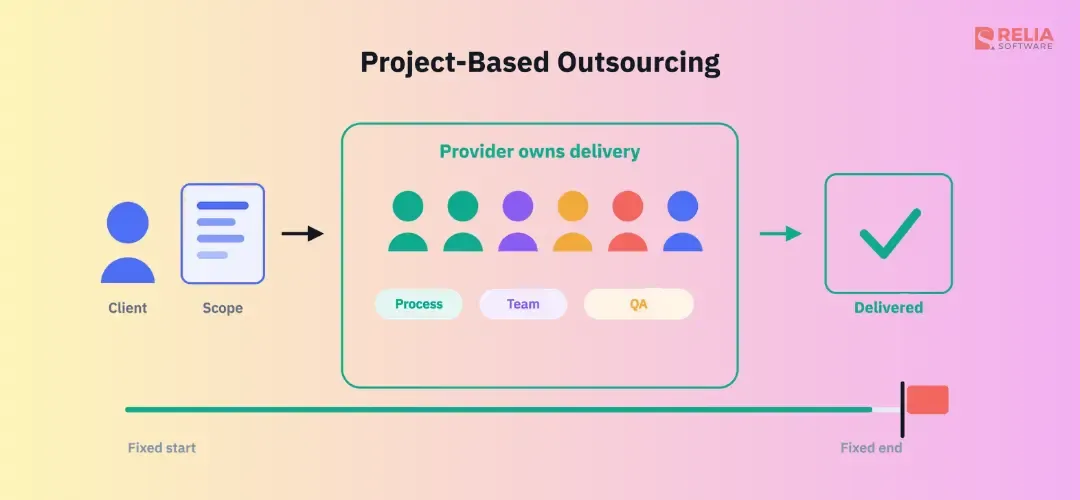
A company that needs a software product built, such as an MVP, a customer portal, or a platform migration, usually faces a choice: build it with an internal team, or hand the work to an external provider. Project-based outsourcing is built for that second option when the deliverable is well defined and has a clear end date.
This guide covers what the model involves, how it's priced, when it fits better than the alternatives, and what to confirm before signing a contract.
What is Project-Based Outsourcing?
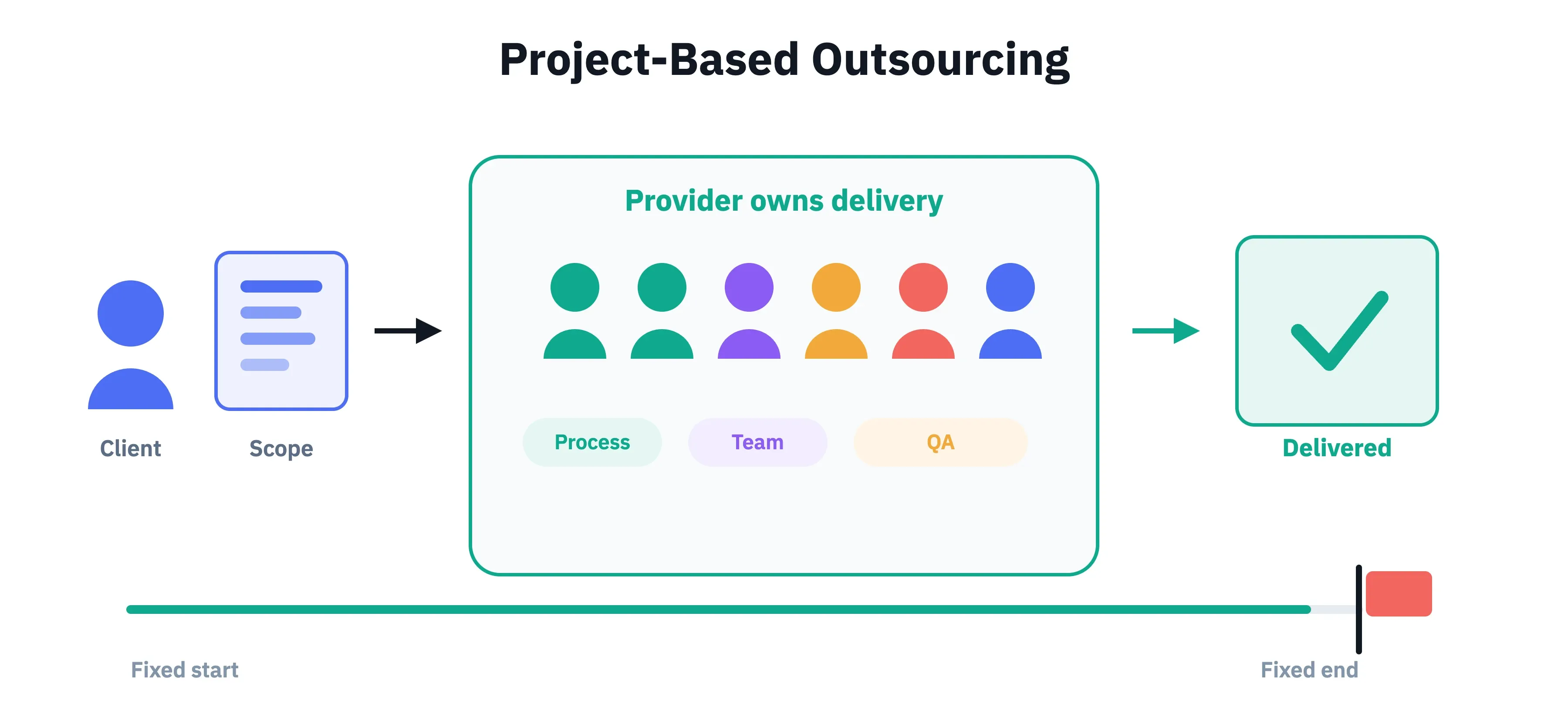
Project-based outsourcing is an engagement model where a company hands a defined software project, from requirements to delivery, to an external provider that manages its own team, process, and quality control.
The client sets the scope, budget, and success criteria. The provider owns how the work gets done, including who's assigned, how progress is tracked, and how quality gets checked before delivery.
A few characteristics define the project-based outsourcing model and set it apart from other ways of outsourcing software work:
- Fixed scope and deadline: The project has an agreed deliverable and a finish line, not an open-ended roadmap.
- Provider-owned delivery: The provider manages its own team, process, and quality control; the client doesn't direct day-to-day work.
- Single point of accountability: One provider is responsible for the outcome, not a mix of individual contractors or in-house staff.
Staff Augmentation, Managed Services, and Dedicated Team Model vs Project-Based Outsourcing
|
Model |
Staff augmentation |
Managed services |
Dedicated team |
Project-based outsourcing |
|
Who manages delivery |
Client |
Provider |
Provider, coordinated with client |
Provider |
|
Team integration |
Joins the client's existing team |
Provider's own team, ongoing |
Standalone unit, ongoing |
Provider's own team, assembled for the project |
|
Typical duration |
Flexible |
Ongoing, SLA-based |
Ongoing, no fixed end date |
Fixed, tied to project length |
|
Common billing |
Time and materials |
Retainer or SLA-based fee |
Fixed price or milestone-based | |
|
Best fit |
A skill or capacity gap inside an existing team |
An entire function, not a single project |
Long-term, ongoing product ownership |
A well-scoped deliverable with a clear end point |
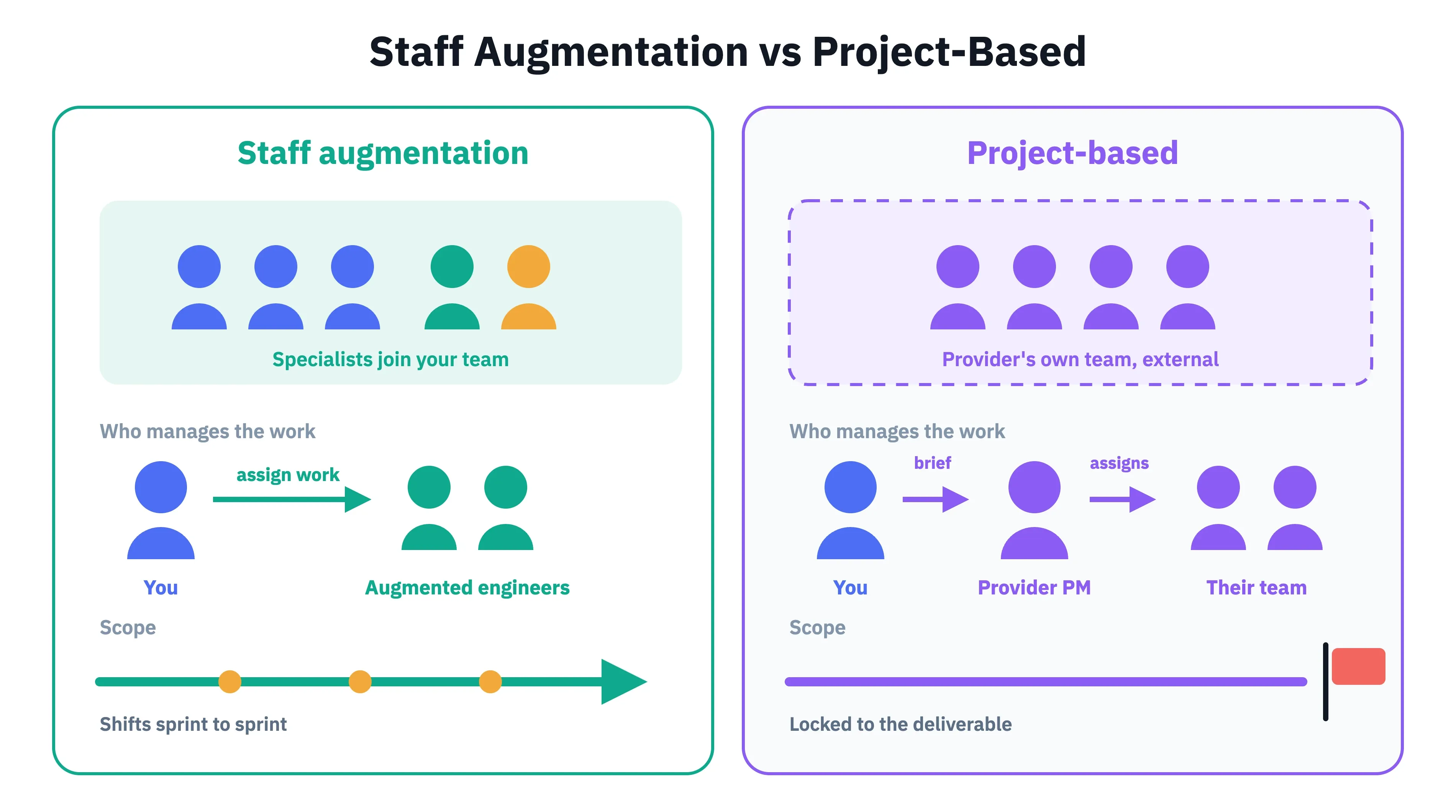
Vs. staff augmentation: Staff augmentation fits when a company already has its own technical leadership and project management, and just needs more hands, such as adding a front-end developer for a busy sprint. Project-based outsourcing fits the opposite situation: a company that needs the entire project managed, not just staffed.
Vs. managed services: Managed services covers an entire function, such as ongoing application support or infrastructure monitoring, measured against service-level agreements. A company outsourcing its help desk or DevOps monitoring needs managed services since there's no single deliverable to define as "done."
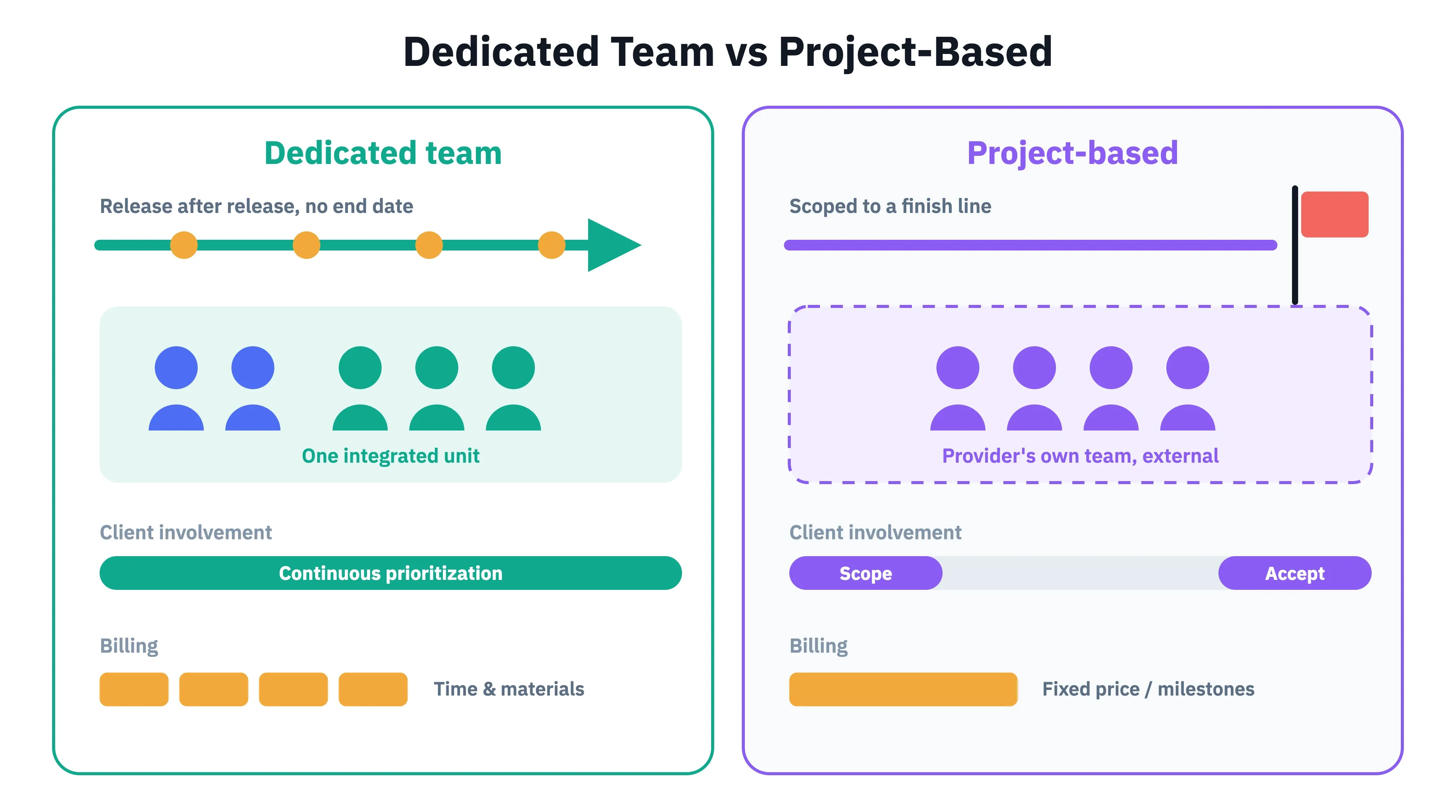
Vs. dedicated team: A dedicated team looks similar to project-based outsourcing on the surface, since both involve a provider-managed team working on the client's behalf, but they differ in duration and scope. A dedicated team is built for a product that keeps evolving indefinitely, with no fixed deliverable to close out. A project-based engagement is built to end, once the agreed deliverable ships, and the contract is scoped around that finish line.
>> Read more:
How Project-Based Outsourcing Works?
A project-based engagement moves through four stages:
|
Stage |
Client's role |
Provider's role |
Output |
|
Define business goals, constraints, and must-have requirements |
Assess feasibility, estimate effort, flag technical risks |
Scope document, timeline, and cost estimate |
|
Approve scope, budget, and milestones |
Build the technical plan: architecture, tech stack, team composition |
Signed contract and project roadmap |
|
Review progress at agreed checkpoints, answer clarifying questions |
Build, test, and manage the team's day-to-day work |
Working software at each milestone |
|
Accept the final deliverable against agreed criteria |
Deploy, document, and transfer ownership (code, credentials, IP) |
Delivered product and documentation |
In a project-based engagement, the provider runs its own internal process and reports progress against the milestones set during planning. So, a clear, specific scope document at the discovery stage matters more here than in any other engagement model. A vague brief produces a vague estimate, and a vague estimate is where fixed-price disputes usually start.
When to Choose Project-Based Outsourcing?
Project-based outsourcing fits best when most of the following are true:
- The scope is defined and stable: Requirements are documented well enough that a provider can estimate effort and cost without guessing.
- There's a clear deadline or milestone: The project has a defined finish line, such as a product launch date or a contractual delivery date.
- The internal team lacks capacity to manage delivery: The company doesn't have a technical lead available to run daily oversight of an outsourced team.
- Single-point accountability matters: The company wants one provider responsible for the outcome, rather than coordinating multiple contractors or in-house staff.
- The work doesn't need daily client-side iteration: Requirements won't shift week to week based on live user feedback.
Contract and Pricing Models for Project-Based Outsourcing
Project-based engagements typically bill under one of three structures, and the right choice depends on how confident both sides are in the scope before work starts.
Fixed price
Fixed price sets the total project cost upfront against a locked scope. This works best for smaller, well-defined projects where requirements are unlikely to change.
The provider absorbs the risk of underestimating effort, which is part of why fixed-price quotes usually include a margin for uncertainty. A mid-scope change after signing typically requires a formal, and often costly, contract amendment.
Milestone-based
Milestone-based pricing breaks the total cost into payments tied to defined deliverables, such as design sign-off, a working MVP, or final delivery. This fits larger projects where the client wants payment tied to demonstrated progress rather than a single lump sum at the end.
Milestone-based also gives both sides a natural checkpoint to catch scope drift early, before it compounds across the whole project.
Time and materials
Time and materials with a capped budget bills actual hours against an agreed rate, with an upper budget ceiling the provider commits not to exceed without client approval. This sits between the other two: it allows some flexibility if requirements shift slightly during development, without the open-ended risk of uncapped time and materials billing.
Cost itself depends mainly on the provider's region and the seniority of the team involved. A defined project's total cost is a function of scope, team composition, and rate, not the billing model chosen. The billing model just changes who carries the risk of a scope miss, not the underlying cost of the work.
Benefits of Project-Based Outsourcing
- Predictable cost: Fixed-price and milestone billing let a client budget the full project cost before work starts, instead of committing to an open-ended hourly spend.
- Lower management overhead: The client doesn't run daily standups or manage individual engineers directly, which matters most for companies without an in-house technical lead available to do that.
- Access to a complete team: A project-based engagement typically includes a project manager, QA, and design alongside development, without the client hiring or coordinating each function separately.
- Faster start: Because the deliverable and timeline are agreed upfront, a vetted provider can begin work within one to three weeks of a finalized scope, without the ramp-up time of building an internal team from scratch.
Risks and Limitations of Project-Based Outsourcing
Higher cost of mid-contract scope changes: Changing a signed fixed-price or milestone contract usually requires formal renegotiation of both price and timeline. You can consider a staff augmentation or time-and-materials engagement if you have changing requirements, since there's no locked scope to renegotiate.
Lower day-to-day visibility: The client doesn't manage the provider's engineers directly, so project status depends on the provider's own reporting cadence. Confirm the reporting schedule, whether that's weekly status calls, a shared project board, or milestone demos, as part of the contract.
IP and security terms need to be explicit: Before signing, confirm a signed NDA, an explicit work-for-hire or IP assignment clause. Also ask the provider directly what security certifications or practices they maintain. A provider's answer to that question, and whether they can back it up with documentation, tells you more about their actual security posture than a general assurance of "we take security seriously."
Greater weight on provider selection: Because the provider owns the full delivery process, choosing the wrong partner is harder to fix later. Replacing the provider often means restructuring the entire engagement, unlike staff augmentation, where individual team members are easier to change.
How to Choose a Project-Based Outsourcing Partner?
Notice to the following factors when choosing an outsourced partner:
Technical vetting process: Ask how the provider screens its engineers, through technical interviews, take-home tests, or peer review. You have to get a specific answer rather than a general assurance of quality.
Domain and technology experience: A provider with prior work in the client's industry and technology stack gets up to speed faster and asks more helpful questions in the discovery phase of the project than one starting cold.
Change-request process: Ask specifically how the provider handles a scope change once the contract is signed. This is the one process detail unique to a fixed-scope engagement.
Contract terms: Confirm IP assignment, data security commitments, and the process for resolving disputes or replacing team members mid-engagement, in writing.
Track record: Ask for a reference from a comparable past project, and check independent review platforms such as Clutch.
Communication process: Confirm how the provider runs status updates and escalation, and whether working hours overlap enough for the client's actual review needs.
Conclusion
Project-based outsourcing fits a defined deliverable with a clear end point: a scoped feature build, an MVP, or a full product launch with a fixed deadline.
A need that's expected to keep shifting or run indefinitely fits staff augmentation or a dedicated team better, since both models flex with changing requirements more easily than a fixed-price or milestone contract built around a locked scope.
The right choice depends on how well-defined the work is today, not on which model sounds more comprehensive.
>>> Follow and Contact Relia Software for more information!

- Mobile App Development
- Web application Development
- development