



IT staff augmentation is a hiring model where a company adds external developers, QA engineers, or other technical specialists to its existing in-house team for a defined period. The augmented staff work inside the client's own workflows, tools, and management structure, reporting to the client's team lead rather than to the provider.
This guide explains how the staff augmentation model works, when it fits, what it costs, and the legal risks to manage before signing a contract.
What is IT Staff Augmentation?
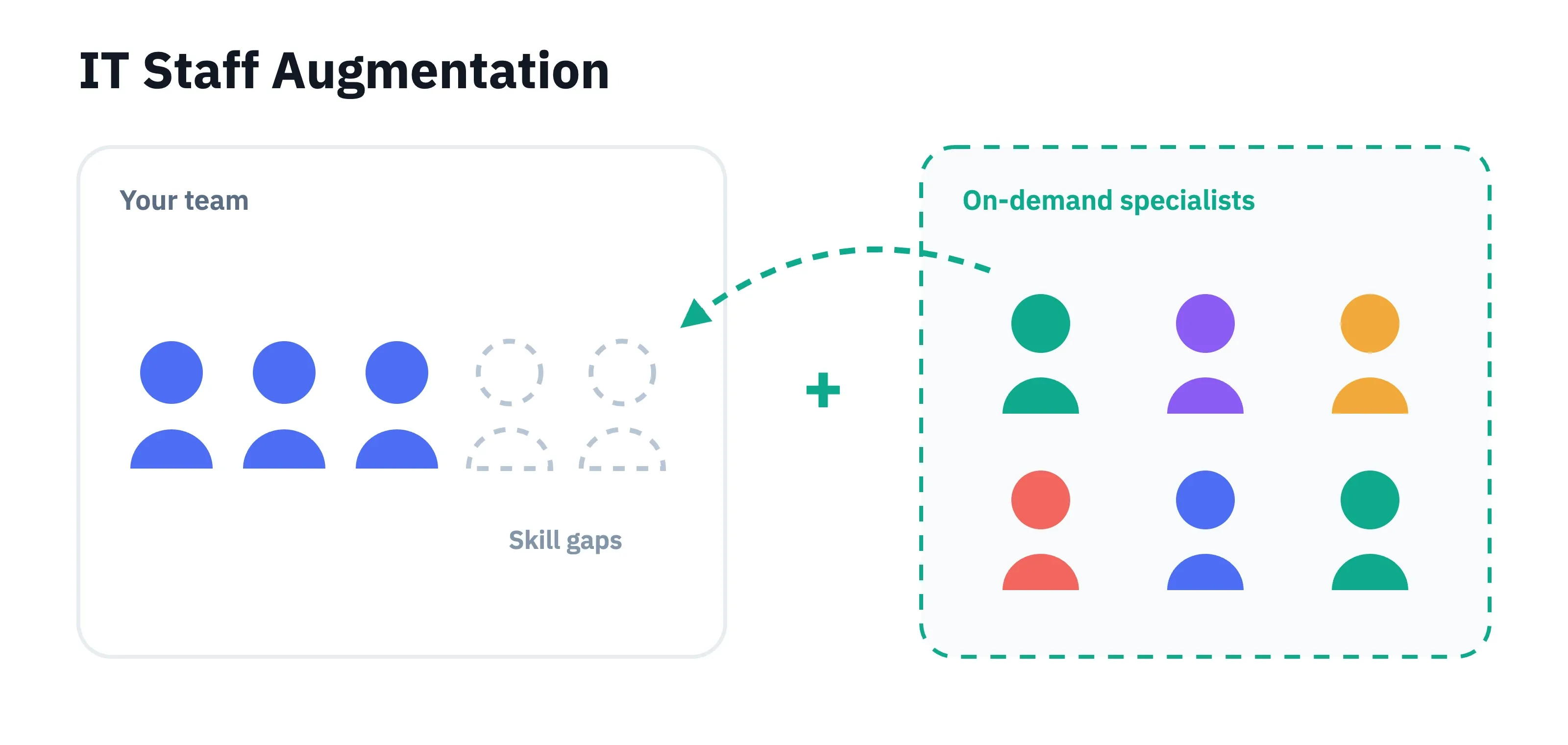
IT staff augmentation is a flexible staffing model that lets a business add external technical talent to its existing development team in a short-term period without hiring full-time employees.
A company using staff augmentation identifies a skill gap, engineering capacity, a specific technology, or a role it doesn't have time to hire for internally, and brings in one or more specialists from a staffing or software development partner to fill it. A company can augment a single role or several roles at once, depending on where the internal team has a gap.
The augmented staff join the client's existing team structure. They use the client's project management tools, follow the client's sprint cadence, and take direction from the client's technical lead, not from the staffing provider. This makes staff augmentation different from other outsourcing models: the client keeps full operational control, and the provider's role is limited to sourcing, vetting, and administering the augmented staff member's contract.
How Does IT Staff Augmentation Work?
Process
A staff augmentation engagement follows a consistent sequence regardless of provider:
- The client defines the role and skill requirements,
- The provider shortlists candidates,
- The client interviews and selects with the provider’s recommendations. Or the provider mainly handles the interview and choice with the client’s approval.
- The chosen engineer joins the client's team under an agreed contract.
Communication and reporting stay with the client. The augmented engineer joins the client's daily standups, uses the client's Slack or Jira instance, and gets evaluated against the client's own performance criteria.
The provider's ongoing role is usually limited to administrative support (payroll, benefits, local employment compliance, replacement if the engineer leaves, and periodic check-ins), not technical oversight of the work itself.
Contract Structures
Employer-of-record and independent contractor are the 2 contract structures that cover most engagements.
- Under an employer-of-record or agency model, the provider remains the augmented staff member's legal employer and bills the client an hourly or monthly rate.
- Under an independent contractor model, the augmented staff member (or a small firm) contracts directly with the client.
Most staff augmentation providers, including agencies that supply engineers to multiple clients at once, use the employer-of-record structure because it shifts local labor compliance onto the provider.
Common Types of IT Staff Augmentation Engagements
Staff augmentation engagements vary mainly by location and duration, not by the underlying contract structure. Understanding these variations helps a company match the model to its actual need instead of defaulting to whichever type a vendor pitches first.
On-site augmentation: The augmented engineer works from the client's own office, alongside the in-house team. This suits roles that need close, in-person collaboration or access to on-site systems that can't be reached remotely.
Remote augmentation: The augmented engineer works from the provider's location, joining the client's team through video calls, chat, and shared tools. This is the most common form of IT staff augmentation today with nearshore and offshore staff augmentation:
- Nearshore staff augmentation: The provider's engineers work from a country in a similar time zone (often two to four hours off), such as Latin America for U.S. clients or Eastern Europe for Western European ones, which keeps daily standups close to real time.
- Offshore staff augmentation: The provider's engineers work from a country with a larger time zone gap, often eight hours or more, which widens the cost advantage but narrows the window for live collaboration. Vietnam and other Southeast Asian markets are common offshore sourcing locations for U.S. and European clients.
Team-based augmentation: The client adds a small group of specialists, for example two backend engineers and a QA engineer, who work as a sub-team inside the client's larger engineering organization. This suits a defined feature or product line that needs dedicated, ongoing capacity.
Project-based augmentation: The engagement is scoped to a single deliverable, such as a migration or an integration, and ends when that deliverable ships. This differs from open-ended team-based augmentation because the end date is fixed in advance.
When You Need IT Staff Augmentation?
Staff augmentation works best when a company already has the technical leadership and processes in place and only needs more hands, or a specific skill, to execute. It fits four situations most reliably.
- Local hiring is too slow: Recruiting a permanent engineer commonly takes 20 to 50 days depending on the role and market. Staff augmentation providers can typically place a vetted candidate in one to three weeks because the sourcing and vetting work is already done.
- Internal team lacks a skill: A company migrating to Kubernetes, for example, may need a DevOps engineer with specific platform experience for six months rather than a permanent hire.
- The project's scale is not stable: A product team ramping up before a launch, then scaling back afterward, can add and release augmented staff without the cost of layoffs.
- A permanent hire is still in progress: Staff augmentation can bridge a gap of a few months without leaving a critical role empty.
Benefits of IT Staff Augmentation
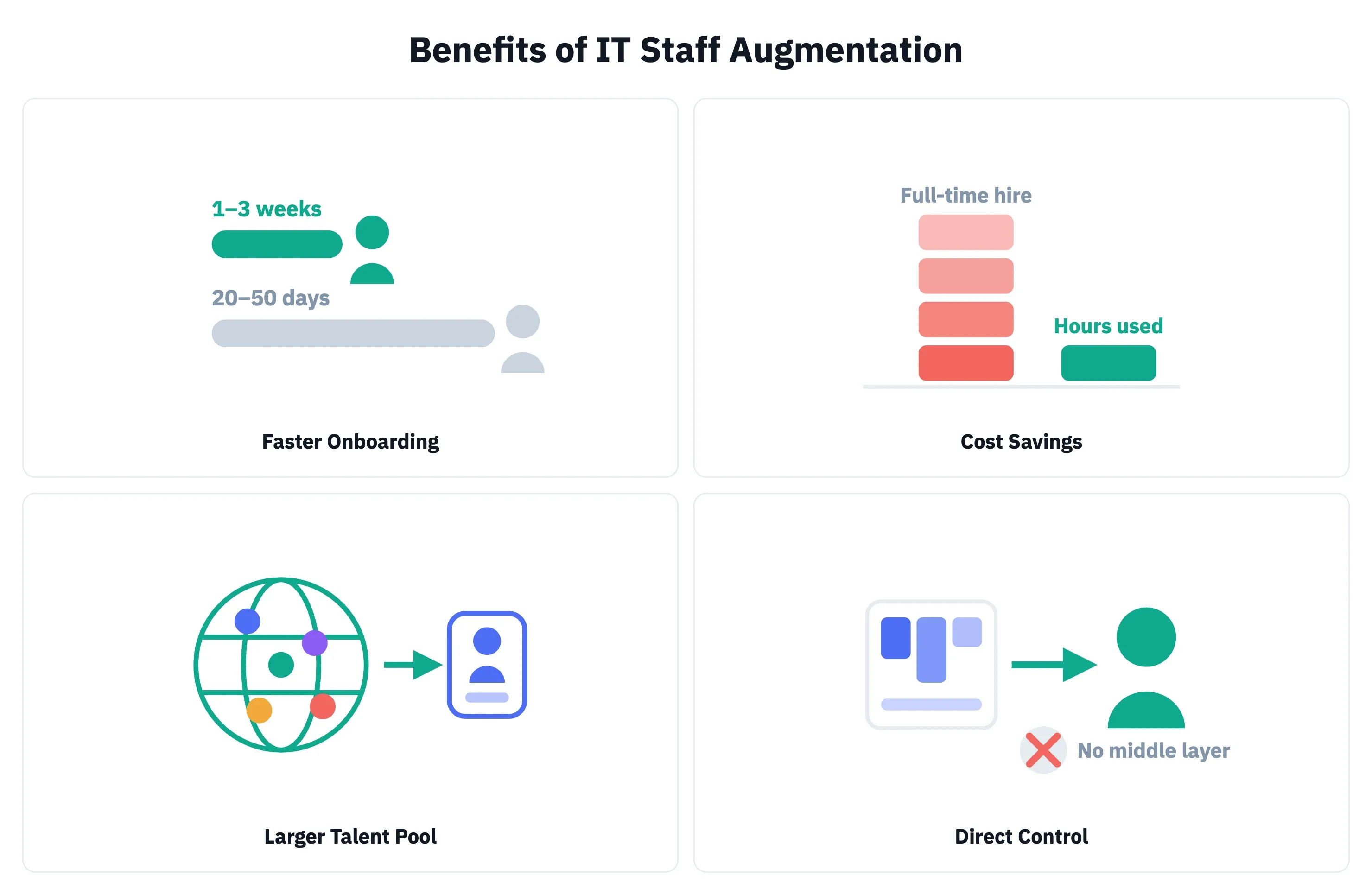
Faster Onboarding: A company can add a qualified engineer to its team in one to three weeks instead of the 20 to 50 days a typical direct hire takes, without the sourcing, screening, and negotiation work that hiring usually requires.
Cost Savings: Staff augmentation avoids the fixed costs of a full-time hire, including benefits, payroll taxes, equipment, and office space, and lets a company pay only for the engineering hours it needs. Also, the cost is even lower when you choose staff augmentation services from Vietnam or similar lower-cost labor markets.
Larger Talent Pool: Staff augmentation gives a company access to skills its local market may not have in sufficient supply, such as a specific framework, a niche cloud certification, or AI/ML experience, without relocating anyone or opening a new office.
Direct control: The client directs the augmented engineer's day-to-day priorities, running them through the same sprint planning, code review, and reporting as any in-house hire. With staff augmentation, there's no intermediary layer to interpret requirements or slow down a change in direction.
IT Staff Augmentation Costs
Most staff augmentation engagements bill on:
- A time and materials basis: the client pays an agreed hourly or monthly rate for each augmented staff member, and the total cost scales with how long the engagement runs. This structure fits staff augmentation because the work itself, ongoing feature development inside an existing team, doesn't have a fixed end point the way a single project does.
- Fixed-price billing (less common in staff augmentation): applies mainly to project-based engagements with a clearly scoped deliverable, such as a defined migration. A fixed-price contract sets the total cost upfront regardless of hours worked, which shifts schedule risk onto the provider but requires requirements to be locked in before work starts.
>> Read more: Time and Materials vs Fixed Price: What's the Difference?
Actual rates vary by seniority level and by the augmented engineer's location more than by anything else. DistantJob's 2026 offshore rate guide breaks general developer rates down as follows:
|
Region |
Junior |
Mid-level |
Senior |
|
United States (onshore) |
$30–$60/hr |
$80–$150/hr |
$150–$250+/hr |
|
Eastern Europe (nearshore for EU clients) |
$30–$45/hr |
$45–$70/hr |
$70–$95/hr |
|
Latin America (nearshore for U.S. clients) |
$25–$40/hr |
$40–$60/hr |
$60–$85/hr |
|
Asia-Pacific, including Southeast Asia (offshore) |
$15–$30/hr |
$30–$50/hr |
$50–$80/hr |
Rates also shift by technology and specialization, independent of region. DistantJob puts AI/ML and data science roles at roughly 15 to 30% above standard developer rates, DevOps engineers at 20 to 35% higher, and blockchain developers at 20 to 40% higher.
IT Staff Augmentation vs. Dedicated Teams, Managed Services, and Outsourcing
The four models differ mainly in who manages the work day to day and how much control the client keeps.
|
Model |
Who manages daily work |
Who owns delivery outcomes |
Best fit |
|
Staff augmentation |
Client |
Client |
Filling a specific skill or capacity gap inside an existing team |
|
Client, with provider-side team lead |
Shared |
Building a defined product with a stable, long-term team | |
|
Provider |
Provider |
Ongoing operational function (e.g., help desk, infrastructure monitoring) the client wants off its plate entirely | |
|
Traditional outsourcing |
Provider |
Provider |
A scoped project with clear requirements and a fixed deliverable |
>> Read more:
- Managed Services vs Outsourcing: What's the Difference?
- The Comparison of Staff Augmentation VS Managed Services
Risks in IT Staff Augmentation and How to Manage Them
Co-employment and worker misclassification: A client that directs an augmented worker's hours, reviews, and pay too closely risks being treated as a joint employer, with added tax and benefits liability. Using a provider that legally employs the augmented staff, rather than contracting the worker directly, is the standard way to avoid this.
IP ownership: The contract should state explicitly, in a written work-for-hire or IP assignment clause, that code and other work belongs to the client, not the provider or the engineer. Never assume IP ownership, confirm it's in writing.
Data security and confidentiality: Augmented staff often need access to production systems or client data. An NDA plus standard access controls (role-based permissions, VPN access, offboarding at engagement end) manage this risk. Regulated clients should also confirm the provider's data residency and compliance practices, such as HIPAA or GDPR.
Communication and quality: Time zone gaps and unfamiliarity with the client's codebase can slow an augmented engineer down early on. A defined onboarding process, documented codebase, and a few hours of daily overlap with the client's team address most of this.
How to Choose an IT Staff Augmentation Provider?
The right provider fits four criteria: verified technical capability, relevant domain experience, contract terms that protect the client's IP and reduce co-employment risk, and a track record with checkable references.
- Technical vetting process: Ask how the provider screens candidates, through technical interviews, take-home assessments, or peer review, and how many candidates they reject before presenting a shortlist.
- Domain and technology fit: A provider with prior experience in the client's industry (healthcare, fintech, logistics) and technology stack ramps up an augmented engineer faster than one starting from zero.
- Contract terms: Confirm IP assignment language, the employer-of-record structure (who is the augmented staff member's legal employer), notice periods, and what happens if an engineer needs to be replaced mid-engagement.
- Track record: Ask for a reference from a client with a similar engagement, not just a portfolio link, and check third-party review platforms like Clutch for independently verified feedback.
- Talent pool depth: A provider with a larger bench of pre-vetted engineers can typically replace or add staff faster than one sourcing each hire from scratch.
Conclusion
IT staff augmentation gives a company a direct way to add tested technical talent to an existing team, without the delay of a full hiring cycle or the reduced control that comes with handing a project to an outside team.
Businesses that need to fill a specific technical role quickly, without committing to a full-time hire, can talk with Relia Software's staff augmentation services about the role, timeline, and budget.
>>> Follow and Contact Relia Software for more information!

- Top Developer
- outsourcing