


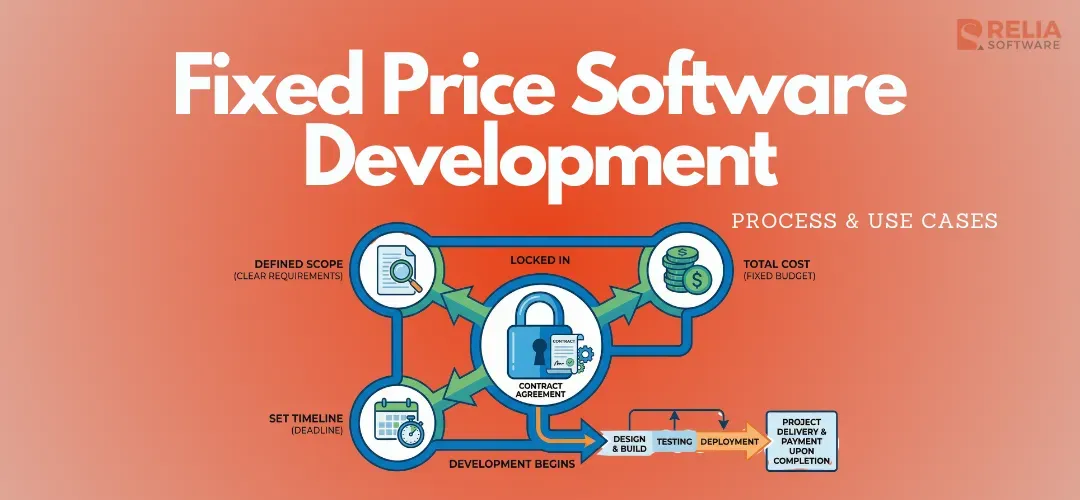
Many businesses choose fixed price software development because they need cost certainty. When a project requires upfront budget plans, open-ended contracts can feel risky, even if they allow more flexibility in this situation. Fixed price becomes attractive because it offers clear cost control and predictable spending from the start.
But that promise only holds when the model is used in the right way. Fixed price software development works well for some projects and fails badly for others. This article will provide its definition, how a fixed price really works, the essentials in a fixed price contract, and how to decide if it fits your project or not. Let’s take a look!
What Is Fixed Price Software Development?
Fixed price software development is a contract model where you and your development partner agree on the project’s scope, total cost, and timeline before the work starts. This model is often chosen when requirements are clear, and the budget must stay under control. Payments are usually linked to milestones instead of time spent.
The main disadvantage of this model is limited flexibility. Any new ideas or requirements that are not written in the agreed document must be reviewed and approved by the provider before development begins. For example, if the document says “user can log in” but does not mention “reset password,” the provider does not have to build the reset password feature unless it is added as a change.
>> Read more:
- In-depth Guide To Software Development Pricing Models
- 8 Popular Types of Engagement Models in Software Development
Pros & Cons of Fixed Price Software Development
Pros
- Clear budget from the start: You know the total cost before work begins, which makes budgeting and approval easier.
- Predictable delivery plan: Scope, timeline, and milestones are agreed up front, so everyone knows what to expect.
- Less budget discussion during development: Since the price is fixed, there is no need to track hours or adjust costs as work progresses.
- Good fit for well-defined projects: When requirements are stable, a fixed price helps the project move forward smoothly.
Cons
- Limited flexibility: Changes or new ideas require approval and often increase cost or timeline.
- Risk of outdated features: User needs may change during development, but the scope stays fixed.
- Higher upfront price: Providers include a buffer to cover unknowns, which can raise the initial quote.
- Quality depends on requirement clarity: If requirements are unclear, the product may meet the contract but not the real needs.
How Fixed-Price Projects Work?
A fixed-price project usually follows a clear path from idea to release. Skipping even one phase often causes problems later. Below is how these projects normally run in real life, step by step.
Phase 1: Discovery
This is where both sides need to agree on what the product actually is. Both client and provider teams will walk through user flows, business rules, edge cases, and basic technical choices. The more honest and detailed this phase is, the safer the fixed price software development will be.
Phase 2: Scope Definition
After discovery, everything discussed is written down. The documents will include a scope list, assumptions, and constraints.
- The scope lists what will be built.
- Assumptions explain what the provider expects from the client (e.g., timely feedback, how to access systems, etc.)
- Constraints define limits, like supported devices, browsers, or environments.
This phase turns ideas into a shared reference point that both sides can rely on.
Phase 3: Cost & Timeline Estimation
Here, the software development service provider translates the scope into effort, cost, and an estimated delivery timeline. Teams break features into smaller pieces, think through technical risks, and account for testing and reviews.
Based on this breakdown, the team also estimates how long each part will take and how these parts fit into the overall project schedule. The final price will be affected by many things: feature depth, integrations, data complexity, performance needs, how clear the requirements are, and development time.
Phase 4: Milestones & Payment Schedule
The project is then divided into milestones. Each milestone group relates features and ends with a review or acceptance point. Milestone completion triggers payment, not the number of hours worked. This helps both sides track progress and reduces disputes, because payment depends on delivered results.
Phase 5: Development
Development happens in planned cycles. Features are built, tested internally, and then shared for user acceptance testing. Bugs are fixed based on agreed-upon rules, such as severity levels. Once acceptance criteria are met, the product is released to the agreed environment. This phase feels active and fast, but it relies heavily on the clarity created earlier.
>> Read more: 8 Common Software Development Life Cycle (SDLC) Methodologies
Phase 6: The Change Request (CR) Loop
Change still happens even when the price is fixed within agreed-upon scopes. When new ideas or missing requirements appear during the development process, the client needs to enter the change request loop.
The development provider will have to review the request, explain the impact on cost and timeline, and wait for approval. Nothing changes until both sides agree. This loop protects the fixed price while still allowing controlled change.
Phase 7: Maintenance & Support
After release, there is usually a warranty period. During this time, the provider fixes bugs related to the delivered scope at no extra cost. Support terms define what happens next, such as ongoing maintenance or a new contract. This phase closes the project cleanly and gives the client confidence that issues will be handled properly.

Above is the process of 7 steps in a fixed price software development. Remember, fixed-price projects can succeed when this flow is respected, not rushed, and not skipped.
SOW (Statement of Work) Essentials For Fixed-Price Project
In a fixed-price project, the SOW is the most important document. It explains what will be built, where the work stops, and how both sides know the project is finished. If the SOW is unclear, fixed price quickly turns into confusion and disagreement.
Deliverables
This part is the most essential because it defines what the provider will deliver throughout the development process. This clearly lists the features, screens, systems, and files that will be handed over. The out-of-scope list is also important. This shows what is not included, so there are no assumptions later. Clear boundaries here help keep the price fixed.
Assumptions List
In this part, the provider will explain what they expect from the client, including fast feedback, access to systems, test data, or having one person who can make decisions. If these assumptions are not met, the plan can break. Writing them down clearly helps both sides understand their responsibilities.
Acceptance Criteria
Acceptance criteria describe how work is reviewed and approved. They explain what needs to work and what level of quality is acceptable. This removes arguments about whether something is finished and replaces opinions with clear checks.
For example:
- “User can log in with valid credentials.”
- “Password reset email is sent and works.”
- “No critical bugs at release”
- “Features match approved design.”
Non-functional requirements
These requirements describe how the system should behave. Simple points like basic speed, security rules, and data handling are enough. If they are not written, the provider will deliver the simplest version that meets the scope.
Below is the template of an SOW; consider it for your project.
SOW mini-template | |
Project overview | What is being built and why |
In-scope deliverables | What will be delivered |
Out-of-scope items | What is not included |
Assumptions | What the client must provide |
Timeline & milestones | Key dates and review points |
Acceptance criteria | How approval works |
Non-functional requirements | Basic performance and security rules |
Change request process | How changes are handled |
Maintenance & support | Bug-fix period after delivery |
IP & ownership | Who owns the final work |
Risk Management in Fixed Price Software Development
In fixed-price software development, both the client and the provider face different types of risk, and each side must manage its own part.
Client-side Risks
For clients, their main risk is that when the project is finished, the software may match the agreement, but no longer fit what users actually need because the product is fixed. User needs, market conditions, and business goals often change over time, but the contract does not change with them.
Changing or adding features is not simple because every change must be reviewed and approved, often with extra cost. As a result, the product may require another round of development just to stay useful.
Solution:
Clients can reduce this risk by keeping the scope small and focused, especially can be finished in a short amount of time. Only include features that are truly needed, review progress early, and plan for future updates instead of trying to fix everything in one contract.
Software Provider Risks
On the provider side, the main risk is financial risk. Once the scope is fixed, the provider must complete it within the agreed price, even if the work turns out harder than expected. Poor estimation or hidden technical issues directly affect the provider’s margin.
Providers also face operational risk. Fixed-price projects require tight planning. Delays, rework, or unclear inputs from the client side can disrupt team schedules and affect other projects running at the same time. This creates pressure on delivery teams, even if the issues did not start on the provider’s side.
Solution:
Providers reduce these risks by keeping the scope clear and controlled. They plan work in small milestones, check assumptions early, and use a clear change process when new requests appear. This helps protect both the budget and the delivery schedules.
>> Read more: Prototype Model in Software Engineering: Types, Phases, Use Cases
Best Use Cases For Fixed Price Software Development
Before choosing a fixed-price model, you need to understand that there is always a hidden cost that comes with it. Software providers usually add a safety buffer to the price to cover unknown work, unclear details, and small changes that often appear once development starts. This means you, the clients, are not paying for more features, but for a stable and predictable cost.
If your budget is tight, this can sometimes result in less actual work compared to a Time & Materials model. With that in mind, let’s look at when fixed price works well and when it does not.
When To Use?
- Develop MVPs: The feature list is short and clear, so the scope is easier to fix and less likely to change.
- Strict Regulatory Requirements: Features are defined by law, not by opinion, which keeps the scope stable.
- Budget Cap: Fixed price helps when spending cannot go beyond an approved limit.
- Clear Blueprints: Detailed designs and specs reduce guessing and make early pricing safer.
When Not To Use?
- Startups seeking product-market fit: Features change fast, and fixed scope makes changes costly.
- R&D or AI Projects: The work depends on testing and learning, which cannot be priced upfront.
- Legacy Code Refactoring: Hidden issues in old code make accurate estimates impossible.
FAQs
1. Can agile work with fixed price?
Yes, but only in a controlled way. Teams can still work in short cycles in Agile method and show progress often. The key point is that feedback is used to improve existing features, not to add new ones without approval.
2. What is the best payment structure for fixed price?
The safest structure is milestone-based payment. Each payment should be linked to delivered work that can be reviewed and accepted. This keeps things clear for both sides.
3. How do you define acceptance criteria simply?
Acceptance criteria explain how you know something is done. Simple checks are enough, such as the feature working as described, matching the design, and having no serious bugs.
4. Why is the fixed price quote higher than the T&M estimate?
Because the provider takes on more risk. They must deliver the agreed scope even if the work becomes harder or longer than expected. The higher price covers that risk.
5. How detailed must my requirements be?
They should be clear enough that the team knows exactly what to build. You do not need perfect documents, but unclear or missing details will cause problems later.
Conclusion
In general, fixed price software development can be a good choice when the scope is clear, the budget is fixed, and change is limited. It gives cost certainty, but that certainty comes from careful planning, clear requirements, and a strong SOW. Without these, fixed price often leads to tension and extra cost.
The key is not choosing the fixed price by default, but choosing it for the right type of project. When the work is well defined and both sides understand their responsibilities, fixed price can run smoothly. When learning and change are still part of the process, a more flexible model may be the better option.
>>> Follow and Contact Relia Software for more information!

- development
- web development