


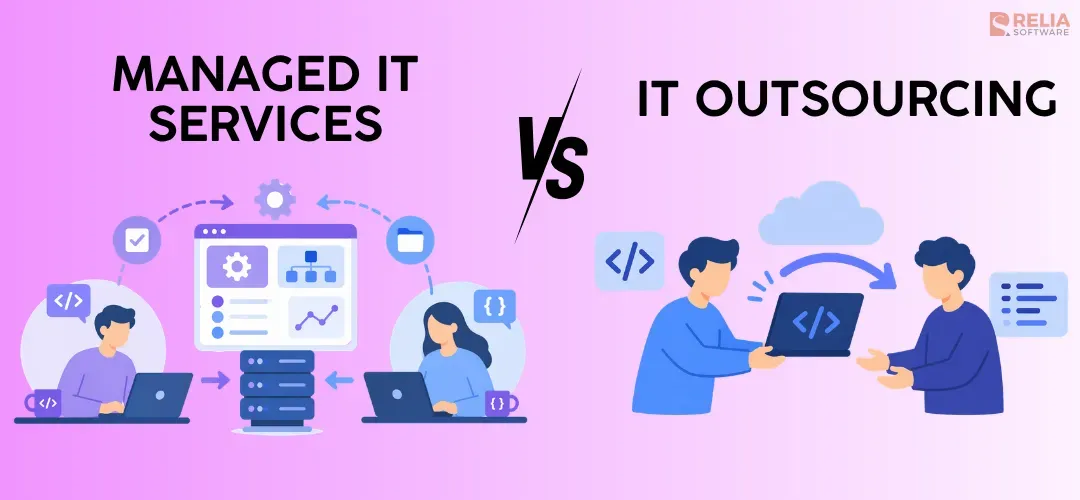
Managed services are usually a proactive, long-term partnership with ongoing support under a regular subscription model. Meanwhile, outsourcing is usually more project-based or task-based, where specific work is handed to an external provider. The two models may look similar at first when they both involve bringing in an external provider, but they serve different purposes and lead to very different ways of working.
In this article, you will see the key differences between managed services and outsourcing, how each model works in real situations, and how to choose the right one based on your needs, budget, and internal capacity.
|
Key Takeaways:
|
Managed Service vs Outsourcing: Comparison Table
Before going deeper into each aspect, it helps to look at both models side by side. The comparison table below provides a quick overview of how they differ in daily operations, cost behavior, and overall role within a business.
|
Aspect | ||
|
Main goal |
Keep systems stable and running smoothly over time |
Complete specific tasks or deliver defined results |
|
Scope |
Clearly defined and ongoing |
Flexible, can change per project or need |
|
Service style |
Proactive, focused on prevention and monitoring |
Often reactive or execution-based |
|
Engagement type |
Long-term partnership |
Short-term or project-based (can also be ongoing) |
|
Pricing model |
Fixed monthly or subscription-based |
Varies: hourly, per project, or per resource |
|
Cost predictability |
High, easier to plan monthly budgets |
Lower, costs can change depending on the scope |
|
Control level |
Shared between client and provider |
Usually handed off to the provider |
|
Responsibility |
Provider is responsible for system performance and outcomes |
Provider is responsible for completing assigned tasks |
|
Integration level |
Deeply integrated into daily operations |
Limited to the scope of work |
|
Tooling & systems |
Often managed and maintained by the provider |
May use client tools or provider tools, depending on agreement |
|
Success measurement |
Based on uptime, performance, and service quality |
Based on task completion, deadlines, or deliverables |
|
Risk ownership |
Shared, often defined by service agreements |
Mostly on the client, unless specified otherwise |
Looking at this table, you can already see that managed services tend to act like an extension of your internal operations for long-term partnership, while outsourcing is more flexible and task-focused, stepping in to handle specific work without always being tied to long-term system performance.
However, to understand each aspect deeper, we need to break it down in more detail.
Key Differences Between Managed Services and Outsourcing
Primary Goal
Managed services are usually chosen when a business wants stability in an ongoing area of work. The IT provider is there to help keep the business systems running well over time, including tasks such as supporting infrastructure, cloud systems, cybersecurity in software development, user devices, or internal IT operations. The goal is not to finish one task and leave, but to keep a business function reliable daily.
Outsourcing usually starts when a company needs outside help to complete tasks that they do not want to handle in-house. These works can be software projects, customizing an app’s function, testing, UI/UX design, or a temporary resource gap. The focus is on getting work completed, not on continuously managing an operational environment.
For example, when a company hires a provider to monitor its cloud servers and handle incidents every day, it is managed services. Meanwhile, outsourcing is when a company hires an external team to build a customer portal over six months. In short, managed services focus on keeping things running well, while outsourcing focuses on getting work done.
Service Approach
Managed services usually take a proactive approach through ongoing subscription-based support. Instead of waiting for problems to happen, the provider stays involved by monitoring systems, applying updates, checking performance, and fixing issues early. Much of the value comes from preventing disruption before it affects users, not just responding after something goes wrong.
Outsourcing is more often reactive and execution-based, which often starts when the client has specific work that needs to be done. The provider works on tasks defined in the agreement, such as building features, handling tickets, migrating data, or supplying technical talent. In this model, the focus is on completing assigned work well, rather than continuously monitoring the environment and preventing future issues.
Generally, managed services stay active in the operation system all the time, while outsourcing moves forward based on tasks and requests.
Scope
Managed services usually have a defined and steady scope. The agreement often lists what systems, users, tools, or service areas need ongoing support. Once defined, the provider continues to manage that scope over time. Therefore, success is often measured by service quality over time, such as uptime, response time, issue resolution, and overall system stability.
Meanwhile, outsourcing has a more flexible scope. A company may outsource one project now, then a different function later, or scale the team up and down as needs change. The boundaries of the work depend more on the business needs at that time. Because the scope is usually tied to delivery, success is often measured by whether the provider completes the work on time, within scope, and at the expected quality level.
For example, if a company uses a managed service provider to handle its cloud infrastructure on AWS, the success is measured by AWS uptime and incident response time. When the company outsources a team to build a new customer portal, success is now measured by whether the portal is delivered on time, meets the required features, and works as expected at launch.
Continuity vs. Flexibility
Managed services are built around continuity, while outsourcing is built around flexibility.
In managed services, the provider becomes part of the day-to-day operating model of the business, and the service continues month after month. This engagement model is built on a long-term relationship where internal teams rely on the provider for continuous support, and the relationship grows over time.
Besides, outsourcing can be a short-term or long-term partnership, but it is usually tied to a project, function, or resource need. A project may last a few months or years. Once the work is done, the engagement may end, pause, or shift into a different form.
For instance, a company can work with the same provider year-round to manage IT support for all office locations, which is called a managed service engagement. Meanwhile, when they hire an external QA team for the final testing stage before a product launch only, they are applying an outsourcing engagement model.
Cost Structure and Pricing
Managed services usually use recurring pricing, where the client pays a regular monthly fee based on the agreed service scope, making costs easier to predict and budget. The managed service cost also covers ongoing support in the operation systems, such as monitoring, maintenance, and issue prevention, even when there are no major visible problems.
In detail, TechTarget notes that some per-device MSP models use fees such as $69 per desktop and $299 per server. Clutch also lists many managed service providers in the $100–$149 per hour range for broader service work. The client is paying not just for fixing issues, but for keeping operations more stable over time.
Outsourcing pricing is a project-based or transactional model because the client is usually paying for work performed, capacity provided, or deliverables completed. If the business needs a larger team, more hours, more features, more revisions, or a longer development timeline, the spend often rises with it. A company does not need to commit to paying for ongoing coverage if what it really needs is project execution or temporary support.
Current market data shows how wide this can be, in which Clutch lists a large number of IT staff augmentation providers in the $25–$49 per hour range, and puts many agencies at $50–$199 per hour, depending on region and expertise. Accelerance also notes that strong software outsourcing companies commonly fall in the $25–$80 per hour range, with some offers going lower or much higher.
>> Read more: (đi link về bài managed IT service pricing)
Control, Responsibility, and Ownership
In managed services, the control level is shared between the client and the provider. The client usually keeps business-level control, but the provider takes on more operational responsibility inside the agreed service area. It means the provider is usually responsible for handling the work and given more ownership over keeping that function running properly over time.
In outsourcing, the provider is usually responsible for completing the tasks or deliverables it has been assigned. However, the client still has to set priorities, review progress, manage dependencies, and make sure the work supports the larger business goal. The provider may own the assigned task, but the client usually keeps more ownership of the wider system, process, or outcome.
As a result, managed services reduce the client’s day-to-day work by letting the provider run an ongoing function, while outsourcing mainly adds outside support to complete tasks and still requires more client oversight.
Strategic Role in the Business
Managed service providers have a deep strategic role because they are often involved daily and work across the same systems. They can gradually build a deeper understanding of the recent working flow of the business. Over time, they can also recommend process changes, identify areas that need investment, suggest tool consolidation, improve service workflows, or flag risks before they become major disruptions.
Outsourcing usually plays a narrower strategic role because the provider is hired to execute specific tasks or projects, but they are less involved in long-term planning unless the engagement is expanded. It still creates strong value, but they are more often brought in to support an existing plan rather than to help shape the business’s operating model over time.
Risk and Compliance
Managed services: The risks include:
- Operational dependency: The business may rely heavily on one provider for critical systems.
- System access risk: The provider often has ongoing access to infrastructure, data, or internal tools.
- Service failure impact: If the provider fails to respond or maintain systems properly, it can affect daily operations immediately.
For compliance, managed services usually require stricter and ongoing controls, including:
- Access control and user permissions;
- Continuous monitoring and logging;
- Incident response processes;
- Audit trails and reporting.
The provider must follow these rules consistently because it is part of the day-to-day system operations.
Outsourcing: Risks are more related to delivery quality, misalignment, and data handling during the project.
- Delivery risk: The work may not meet expectations, timelines, or quality standards
- Misalignment risk: Unclear requirements can lead to rework or incorrect output
- Data handling risk: Sensitive data may be shared during development, testing, or collaboration
For compliance, outsourcing needs:
- Clear requirements for security and data handling;
- Code review and testing standards;
- Approval steps before release;
- Limited and controlled data access.
The client often keeps more responsibility for making sure the final output meets internal policies and legal requirements.
When to Choose Managed Services vs Outsourcing?
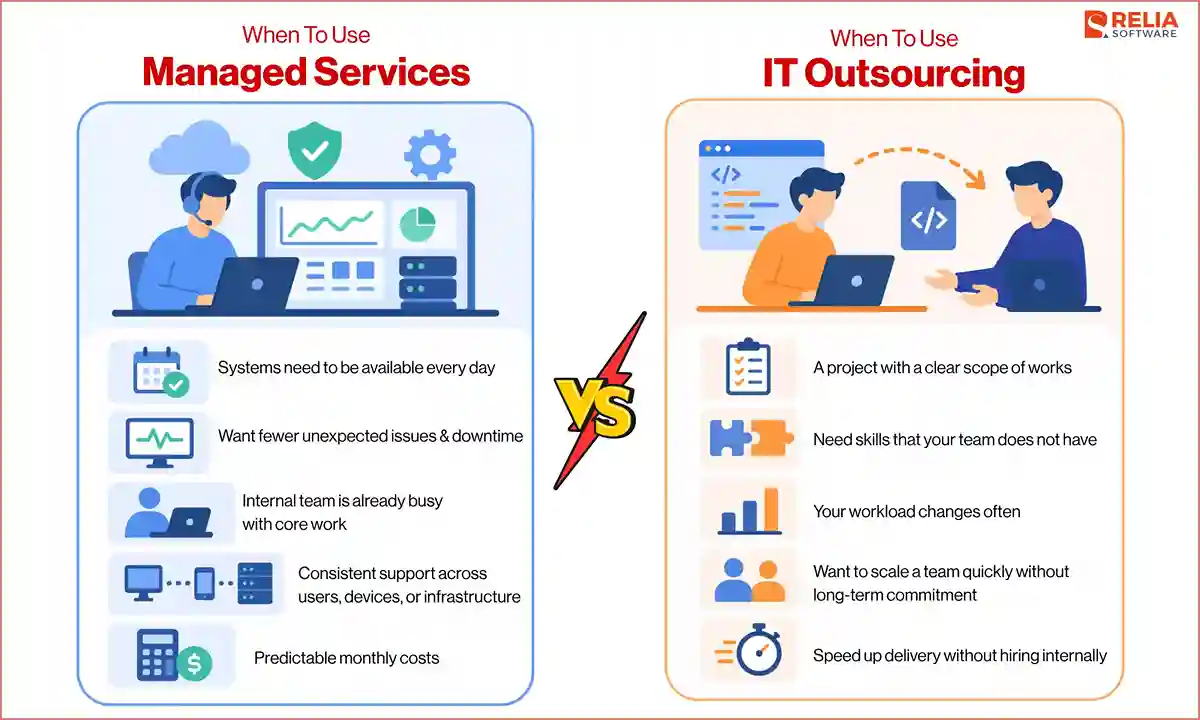
When To Use Managed Services?
You should consider managed services when:
- Your systems need to be available every day
- You want fewer unexpected issues and downtime
- Your internal team is already busy with core work
- You need consistent support across users, devices, or infrastructure
- You prefer predictable monthly costs instead of fluctuating support expenses
In these situations, having a provider continuously monitor and maintain the environment can reduce pressure on your internal team and improve overall reliability.
When To Use Outsourcing?
You should consider outsourcing when:
- You have a project with a clear start and end
- You need skills that your team does not have
- Your workload changes often
- You want to scale a team quickly without long-term commitment
- You need to speed up delivery without hiring internally
In fact, the most suitable choice is not about which model is better overall, but which one fits your current situation. Some businesses need stable, ongoing support. Others need flexibility and fast execution. And in some cases, you can combine both at the same time.
Risks and Challenges to Consider
Both models can work well, but each comes with a different type of risk that businesses should think through before making a decision.
Vendor lock-in
Vendor lock-in is a common risk in managed services because the provider often becomes deeply involved in daily operations, tools, and support processes. This can make switching providers harder later, especially if documentation is weak, internal visibility is low, or too much service knowledge stays with the external partner.
Communication gaps
Communication gaps are more common in outsourcing, especially when the work depends on changing requirements, frequent feedback, or close alignment with internal teams. If the scope is unclear or decisions are delayed, the provider may still complete the work but deliver something that does not fully match what the business actually needs.
Security and compliance differences
Security and compliance need attention in both models, but the risk often comes from unclear responsibility. In managed services, the provider has ongoing access to systems and data, while in outsourcing, risks can appear through delivered code, shared files, or weak handoff practices. In either case, responsibilities need to be clearly defined in the agreement.
How to Choose Between Managed Services and Outsourcing?
Below are some questions that you may need to define to choose the right model for your business.
Is your need an ongoing operation or a defined piece of work?
If the need is ongoing, such as user support, infrastructure management, cloud monitoring, or system maintenance, managed services are often the better fit. If the need is tied to a specific project, a temporary workload increase, or a specific deliverable, outsourcing usually makes more sense.
How stable are our needs over time?
If the work is fairly steady and likely to continue in the same form, managed services are often easier to run and plan. If the scope, workload, or priorities may often change, outsourcing usually gives more flexibility. This question helps you see whether you need consistency or room to adjust.
Do we have enough internal time to manage external work closely?
Outsourcing often needs more day-to-day input from the client side. Someone usually has to guide priorities, review progress, answer questions, and keep the work aligned with business needs. If your team does not have much time for that, managed services may be a better choice because the provider handles many operational tasks on its own within the agreed scope, without needing constant input from the client.
Do we want cost predictability or delivery flexibility?
Managed services are usually easier to budget because they often follow a recurring monthly fee. Outsourcing is usually more flexible because you can scale work up or down based on need, so the cost may change more as the scope changes. This question helps you decide whether budget stability or execution flexibility matters more right now.
How much would problems affect the business in each model?
If problems would affect uptime, employee productivity, customer experience, or daily business operations, managed services are often the safer choice because they are built around continuity and ongoing support. If the main risk is a delayed task, a slower rollout, or a project setback, outsourcing may be enough.
If most of your answers point to stability, continuity, lower day-to-day involvement, and predictable costs, managed services are likely the better fit. If most of your answers point to flexibility, project execution, changing scope, and direct control over delivery, outsourcing is likely the better choice.
>> Read more:
- The Comparison of Staff Augmentation VS Managed Services
- Staff Augmentation VS. Outsourcing: Which Is Better?
FAQs
1. Can a business use both managed services and outsourcing?
Yes, many businesses use both methods at the same time, managed services for ongoing operations and outsourcing for project-based work. In one project, the managed service provider keeps systems stable, while the outsourced team focuses on delivering the project or getting new work done.
2. Which model is more cost-effective?
It depends on your needs. Managed services are usually more cost-effective for ongoing support because costs are predictable over time. Outsourcing can be more cost-effective for short-term projects since you only pay for the work you need.
3. Can small businesses use managed services?
Yes. Managed services can help small businesses handle IT support or operations without hiring a full internal team, making it easier to maintain systems as they grow.
4. Is outsourcing risky for sensitive data?
Yes, it can be if responsibilities are not clearly defined. To reduce risk, businesses should set clear security requirements, limit access, and review how data is handled before starting the work.
Conclusion
Managed services and outsourcing solve different problems: one is for keeping operations stable over time, and the other is for getting specific work done with outside support. Managed services are usually the better fit when you need stability, ongoing support, and predictable costs. Outsourcing works better when you need flexibility, faster execution, or extra capacity for specific work.
Define clearly whether you need to keep something running over time or get something done before making the final decision. Many businesses also use both at the same time, combining stable operations with flexible delivery to support growth more effectively.
>>> Follow and Contact Relia Software for more information!

- outsourcing