


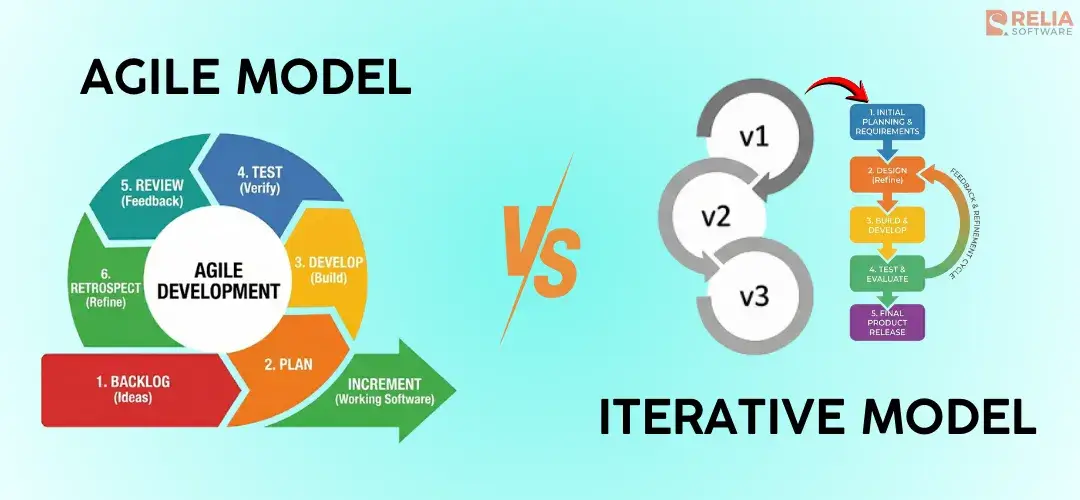
Picking the right development approach can shape the entire success of your software project. When looking at the Agile vs Iterative model, it’s not about which one is “best,” but which one matches how your business wants to move. Agile supports fast releases, quick feedback, and constant change, while the Iterative model takes a steadier, more structured path with a strong focus on technical stability.
In this article, we will break down how each model works, where they overlap, and when your business should choose one over the other. Let’s start!
>> Read more:
- V-Model vs Agile: Key Differences & When to Use Each?
- Lean vs Agile: Choosing the Right Approach for Software Projects
- DevOps vs Agile: What’s the Difference & How They Combine?
Overview of Agile And Iterative Model
Agile model is an iterative and incremental approach to manage projects and build software. Teams work in short sprints, pick tasks from the backlog, and deliver value step by step. Agile stays flexible, keeps close communication with customers, and adjusts quickly to new needs while giving engineers flexibility in how they build the product.
Besides, iterative development model is a software development approach that builds a product through repeated cycles of design, coding, testing, and evaluation, trying to complete everything at once. It’s important to note that “iterative” focuses on improving what already exists, while Agile adds an “incremental” approach to delivering new pieces of the product in every cycle.
A common misconception is that you must choose either Agile or Iterative, but they aren’t mutually exclusive. Agile is actually a specific type of iterative development. It uses the same repeated cycles but focuses each loop on delivering a real, usable product increment, not just improving the system internally.
Agile vs Iterative Model: Key Differences Comparison
So, what are their differences? Below is a comparison table between these two software development methodologies. Let’s have a look!
Aspect | Agile Model | Iterative Model |
Goal | Focus on delivering real-user value step by step | Focus on improving one solution over several cycles |
Requirements | Start with a high-level idea; details grow over time | Start with more detailed specs; changes are added in later iterations |
Planning | Plan often and ship small, usable pieces regularly | Deliver bigger updates at the end of each iteration |
Time Delivery | Short, fixed Sprints (1–3 weeks) | Iterations can be longer and more flexible |
Team structure | Cross-functional teams with high collaboration and communication | Specialized teams for specific phases with less cross-team interaction |
Customer Involvement | Stakeholders join reviews every Sprint and provide feedback | Customer usually reviews work at iteration or milestone checkpoints |
Testing | Happens inside each Sprint | Can be a separate step in or after each iteration |
Risk Management | Market and value risk | Technical and delivery risk |
Documentation | Keep enough documents to support teamwork and future maintenance | More formal documents for requirements, design, and sign-offs |
Purpose
Agile is a product and value-driven mindset with the goal of delivering real business outcomes and useful features at the end of every short cycle. Agile accepts that requirements will change as the team learns more about users and the market. Instead of following a fixed plan, the team adjusts the software to match new insights and needs.
Meanwhile, iterative model focuses on improving a planned solution through repeated cycles. Its main goal is to reduce technical uncertainty and fix issues by refining the same version of the product. This approach assumes the main direction is set from the start. Each cycle is used to polish the design, address defects, and ensure the software meets the original quality goals.
Requirements
In Agile, teams accept that not everything can be predicted upfront, so they avoid heavy specification documents. Instead, they work on a brief with details clarified before each sprint. If a feature is more complex than expected, the team discusses it with the customer, trims low-value parts, and focuses on delivering only what matters.
In contrast, iterative model requires a detailed upfront foundation to ensure the project’s scope stays stable. After that, any further updates are added as planned enhancements for future iterations. Since each cycle focuses on improving the same version of the system, the team uses requirement documents to keep the work aligned with the original design.
Planning
Agile projects run in short, fixed sprints, usually one to three weeks long. At the start of each sprint, the team picks the top backlog items they can finish in that time. If something is too large, the team may reduce the scope instead of changing the deadline. Backlog details are added only when needed, and each sprint ends with a review and a retrospective to improve the next one.
In the iterative model, schedules are flexible and based on the order of work rather than strict time limits. An iteration may take weeks or even months, depending on what needs to be built, and each one builds on the last to reduce technical risk. Planning follows milestones, then the team works until that goal is fully reached.
Stakeholder Involvement
In Agile projects, business stakeholders stay involved throughout the work. They help clarify requirements and give feedback right away, instead of waiting for monthly updates. Each sprint ends with a review where the team presents working software. This quick feedback loop helps the team spot issues early and adjust the plan for the next sprint.
Stakeholder involvement in the iterative model is less frequent. Feedback usually comes at the end of an iteration or after a major milestone, which can be weeks or even months apart. However, the risk is that a misunderstanding early on might not be caught until much later, after the team has already built a lot of code on top of the wrong idea.
Testing
In Agile, testing happens continuously instead of at the end of the project. The goal is to prevent bugs early to prevent overcost. Automated checks run through CI/CD pipelines every time code is saved, catching issues instantly. If something fails, the team fixes it right away. Quality is a shared responsibility, so the product stays in a releasable state at all times.
Testing in the iterative model usually happens after the cycle is finished. A team may spend most of the iteration building features and then test and fix issues at the end. QA is often handled by a separate testing team, so developers hand off their work for review. If a big bug shows up late, the team must either delay the schedule or push the fix to the next iteration, which can create technical debt.
>> Read more:
- What are 4 Levels Of Testing In Software Testing? With Examples
- Mastering Functional Testing for Delivering Bug-Free Software
Risk Management
The biggest risk in Agile development is market and value risk, which means building something users don’t want. Therefore, teams need to release small, working features to gather fast feedback and drop useless ideas before investing too much time. Technical risks are managed through short spikes that test uncertain technologies and through regular refactoring to keep the codebase clean and adaptable.
Iterative model focuses on technical and delivery risks, making sure the system is stable, fast, and well-integrated before adding the rest of the features. However, it often assumes the market need is already clear, so the team might face a risk of spending time on a system that users no longer want. Market risk is usually handled outside the development process.
Documentation
Agile teams don’t avoid documentation; they just keep it lightweight. Instead of long requirement documents, they use flexible tools like the product backlog and user stories that can be updated as things change. Progress is tracked through visible boards and charts, not heavy reports. The real proof of progress is the working software shown at each sprint review.
In the iterative model, documentation guides and approves each step of the work. Teams need to prepare detailed requirements, design documents, and test plans before coding. These documents act as checkpoints before the team can continue. This creates a clear audit trail but also means a lot of time and budget goes into documentation instead of development.
Tracking Metrics
Agile metrics track how quickly value reaches the customer, not how busy people are. Teams watch Cycle Time, Lead Time, and how often they deploy to keep work flowing smoothly. Success is measured by working software and real user impact. If a feature doesn’t help users, the team will need to adjust immediately.
Meanwhile, iterative model uses traditional metrics because the end goal is fixed. Success is measured by delivering the planned scope on time and within budget. Progress is tracked through Gantt charts and milestones, and each iteration aims to reduce bugs. A project is considered successful if it passes UAT with no major issues.
Agile vs Iterative Model Example Case Study
To understand how Agile and the Iterative model affect delivery timelines, imagine you are building a basic version of a food delivery app.
With the Agile approach, teams will finish each feature at a time. In the first sprint, they’ll focus only on creating a working Menu and Cart. At the end of the sprint, the client will get a usable link where they can browse items and add them to the cart. In Sprint 2, the team adds payments. In Sprint 3, they add driver tracking. The client’ll receive a usable feature every two weeks and can even launch an early version right away.
Meanwhile, the iterative model builds the whole app form first. The team creates early versions as prototypes of the Login, Menu, Cart, Payment, and Tracking screens all at once. Next, they’ll focus on fixing issues across the whole system, and then clean up the design to get a final product. The client cannot use or release the app until the last phase, because an unfinished version brings no real value to users.
How Do Agile and Iterative Models Overlap?
Even with their differences, Agile and iterative model still overlap in a few key ways that shape how teams plan and build software.
- Cyclical Work Structure: Both models avoid doing everything in one long sequence. Whether they use sprints or iterations, they break the project into smaller chunks so the team can focus on a manageable amount of work at a time.
- Risk Reduction: Both approaches aim to eliminate the big risk of the Waterfall. By reviewing progress at the end of each cycle, teams can spot misunderstandings and technical issues much earlier than in a linear process.
- Faster Value Delivery: Instead of making users wait until the entire product is finished, both models provide value sooner. Even in the iterative model, early prototypes or beta versions give stakeholders something real to review earlier in the process.
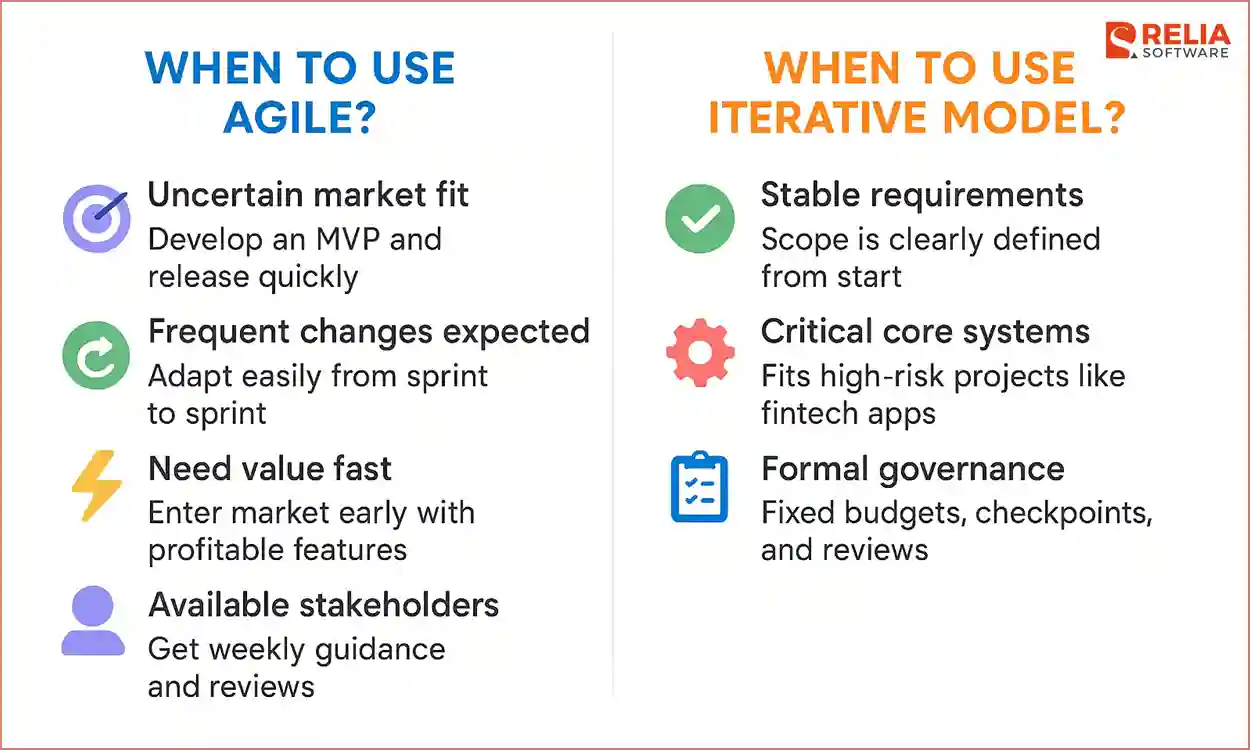
When To Use Agile?
Let’s choose Agile when your project fits these situations:
- Uncertain market fit: If you’re launching a new product and aren’t sure what users will actually pay for, Agile lets you develop an MVP and release it quickly to test real demand before spending the full budget.
- Frequent changes expected: If requirements may shift because of competitors, new tech, or user feedback, Agile frameworks will help you adapt easily from sprint to sprint without wasting months of work.
- Need value fast: If the business needs revenue or traction quickly, Agile focuses on delivering the most important and profitable features first so you can enter the market early.
- Available stakeholders: Agile works best when a business stakeholder can review progress and answer questions every week. If stakeholders are only available once a month, Agile will struggle due to a lack of guidance.
When To Use Iterative Model?
Iterative model is the best fit when your project needs stability and control more than market flexibility, such as:
- Stable requirements: The scope is large but clearly defined from the start. You do not need to figure out what users want during the development process, or be already sure about it from the start. And the project’s goal is to build the app correctly without breaking anything.
- Critical core systems: This approach fits high-risk projects like developing fintech apps, medical software, or complex integrations, where the architecture must be solid long before users interact with the product.
- Formal governance: The iterative model works well in environments with fixed budgets, strict checkpoints, and formal reviews. Teams must meet milestones and get approvals before moving to the next phase.
>> Read more:
- Spiral Model vs Waterfall Model: Which Approach to Choose?
- V-Model vs Waterfall: Differences & Typical Use Cases
Conclusion
In conclusion, choosing between the Agile vs Iterative model depends on what your project needs most. If you want quick learning, fast feedback, and flexibility, Agile helps you adjust and deliver sooner. If your project requires strong architecture, predictable control, and formal checkpoints, the Iterative model provides a steadier, safer path.
By understanding their strengths as well as some weaknesses, you can pick the right model and sometimes the right software development partner that will guide your product forward with more confidence and less risk.
>>> Follow and Contact Relia Software for more information!

- web development
- development