


The healthcare sector’s moving quickly to mobile-first care, which presents a big promise. Specifically, the global mHealth market is expected to grow from $91.4 billion in 2025 to reach $201.1 billion by the end of 2030 (source: businesswire.com).
Yet, with highly sensitive patient data, this growth demands strong security. In fact, healthcare data breaches are the costliest of any industry, costing an average of $7.42 million per incident in 2025. Furthermore, these breaches take a long time to resolve, with an average lifecycle of 279 days to identify and contain (source: hipaajournal.com).
So, to avoid financial and trust risks, you need a clear approach to building apps that protect patient data from the start. This guide will walk you through exactly what HIPAA compliance means for app development and how teams can build healthcare apps that are safe, compliant, and ready for real-world use.
>> Read more: Digital Transformation in Healthcare: Why, When, How to Apply?
What is HIPAA-Compliant App Development?
HIPAA-compliant app development is the process of building mobile or web applications that protect Protected Health Information (PHI) by strictly adhering to the standards set by the Health Insurance Portability and Accountability Act (HIPAA).
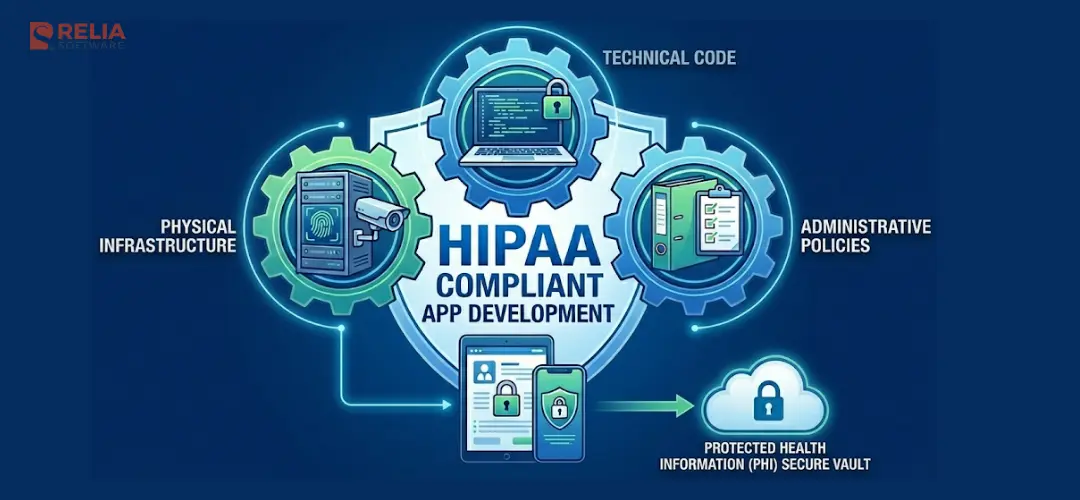
This type of development is not just standard security practices with basic features. HIPAA-compliant apps need a complete solution that includes technical code, physical infrastructure, and administrative policies. They all work together to protect patient data from being accessed without permission.
HIPAA-Compliant App Development Examples
Here are some examples of healthcare apps needing HIPAA compliance:
-
Telemedicine Apps (Spruce, Klara): Patients can communicate with doctors via video, audio, and chat. Compliance emphasizes encrypted data transfer, MFA login, and audit trails for all interactions.
-
EHR/EMR Apps (Salesforce Health Cloud, Epic Systems): Manage full patient records for doctors to view diagnoses, lab results, and treatment history. These systems must strictly control who can access data with RBAC and record every access event.
-
Remote Patient Monitoring Apps (Dexcom G6): Stream real-time health data from connected devices like glucose meters or heart monitors to a smartphone app. These apps’ IoT ecosystem needs device authentication (FaceID/TouchID).
-
Mental Health & Therapy Apps (Talkspace, Amwell): Handle especially sensitive information, including therapy sessions, notes, and communication between patients and clinicians. They need access control, encrypted messaging (often Zero-Knowledge Encryption), and clear rules around data sharing.
-
Prescription Management Apps (DrFirst, SureScripts): Handle medication details, dosages, refill requests, and pharmacy routing. They need data accuracy (using checksums and hashing), unauthorized change control, and secure information transfer.
-
Fitness Apps (Apple Health, Fitbit): Track steps, heart rate, or sleep. Not all of them require HIPAA compliance, but some do. If the app syncs with a hospital system, it needs a secure, encrypted API (often using FHIR standards), not standard open web protocols.
4 HIPAA Rules Developers Must Follow
The HIPAA Privacy Rule
This rule is all about authorization, controlling who can access PHI and how that data can be used. It emphasizes that patients have the right to control their health data. PHI cannot be shared unless the patient gives clear permission or there is a valid medical reason.
Apps must clearly explain how patient data is used during onboarding and require explicit user consent. Patients should be able to view and download their medical records at any time. When an account is deleted, PHI must be removed from active systems while required audit logs are kept.
The HIPAA Security Rule
This rule directly shapes your system architecture. It sets the standards for protecting electronic PHI (ePHI) through three specific safeguards:
-
Administrative Safeguards (The People): Include the policies and procedures used to train the workforce and manage the selection, development, implementation, and maintenance of security measures.
-
Physical Safeguards (The Hardware): Protect the servers and devices where patient data exists from theft, damage, or unauthorized access. Cloud providers manage data centers and server security, but your app is responsible for protecting user devices. This includes features like automatic logoff timers that lock the app after a period of inactivity.
-
Technical Safeguards (The Code): Cover the technologies and policies used to protect electronic PHI, such as access controls, encryption, audit logging, and integrity checks. These automated software controls patient data to stay private, accurate, and protected.
The HIPAA Breach Notification Rule
This rule defines exactly how and when you must sound the alarm. If unsecured PHI is exposed, organizations must notify the affected users, the Secretary of HHS, other regulators, and (in large cases) the media within strict timeframes (usually within 60 days).
Apps should include automated monitoring that alerts administrators to unusual activity, such as large data downloads at odd hours. They must also keep immutable, detailed logs so teams can quickly identify what data was accessed during an incident and avoid reporting a broader breach than necessary.
The HIPAA Omnibus Rule
This updated rule officially makes Business Associates (that's you, the developer, and your vendors) directly liable for compliance. It closed the gaps around third-party vendors.
To stay compliant:
-
Audit every service that handles PHI;
-
Use only vendors that sign a Business Associate Agreement (BAA);
-
Never send PHI to tools without a BAA.
Benefits of HIPAA Compliant App Development
Build Patient Trust
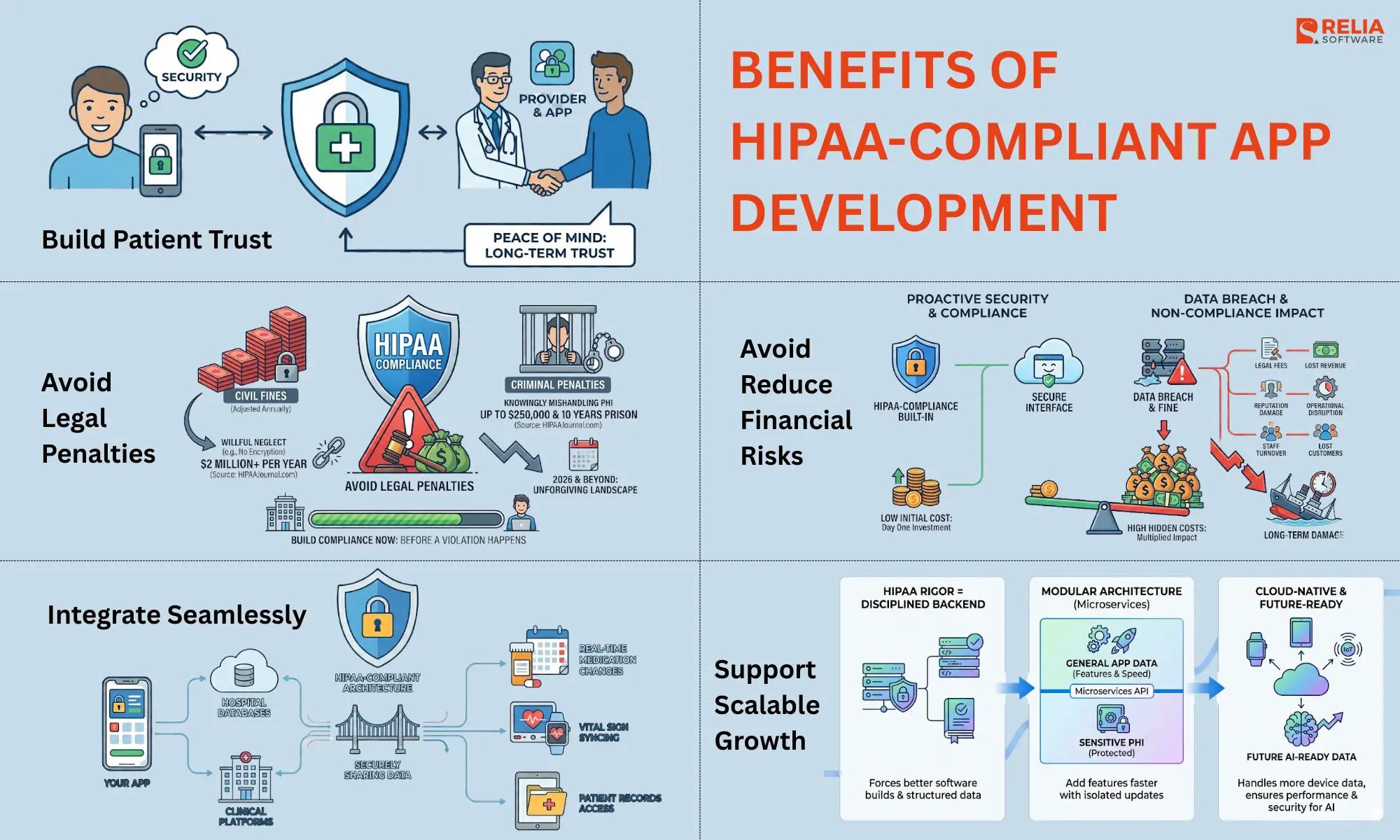
By marketing your app as "HIPAA-Compliant", you directly address the #1 user anxiety that is security. When patients know their health information is handled securely, they are more willing to use and rely on the app. Especially with more frequent cyberattacks, privacy is the primary metric for user retention.
In fact, you aren't just selling an app, you are selling peace of mind to create long-term trust between patients, providers, and the app.
Avoid Legal Penalties
HIPAA compliance is your shield against fines, investigations, or forced shutdowns. Currently, HIPAA violations are tiered based on culpability, with penalties adjusted annually for inflation. For "willful neglect" (e.g., ignoring encryption or audit logs), penalties can reach roughly $2 million per year for each violation category. (source: hipaajournal.com)
Beyond civil fines, there is real personal liability. Criminal penalties for "knowingly" mishandling PHI can include fines up to $250,000 and up to 10 years in prison (source: hipaajournal.com). And the regulatory landscape in 2026 is expected to be even more unforgiving. So, let's build compliance into the app from the start before a serious violation happens.
Reduce Financial Risks
Building security into a healthcare app from day one costs far less than dealing with a single data breach later. A HIPAA-compliant app reduces the risk of incidents that can lead to legal fees, lost revenue, and long-term damage to a company’s reputation.
In many cases, the fine itself is only a small part of the problem. The hidden costs of non-compliance such as operational disruption, legal work, and staff turnover add up quickly. Lost customers and the effort required to rebuild trust can push the total impact to several times the original penalty.
Integrate Seamlessly
In the healthcare sector, your apps cannot operate in isolation. Instead, you need to integrate them smoothly with hospital databases and clinical platforms to create connected systems. You can only connect at this level if there is strong security and compliance in place that doesn't put private data at risk.
Most hospitals and healthcare providers require strict security reviews before allowing any integration. The HIPAA-compliant architecture allows this due to securely sharing data with permission It lets your apps directly access patient records for real-time medication changes and vital sign syncing.
Support Scalable Growth
A compliant backend is a disciplined backend. The rigor required for HIPAA forces you to build better software.
HIPAA compliance supports a modular architecture (like microservices) that makes sensitive PHI separated from general app data. This separation allows teams to add new features more quickly without having to go through a full compliance review for every change.
Also, with cloud-native, these apps can handle more data from wearables and connected devices while keeping performance and security. This method also gets the healthcare system ready for future AI use, which will require safe and clean data processing.
8 Key Steps: How to Create a HIPAA Compliant App?
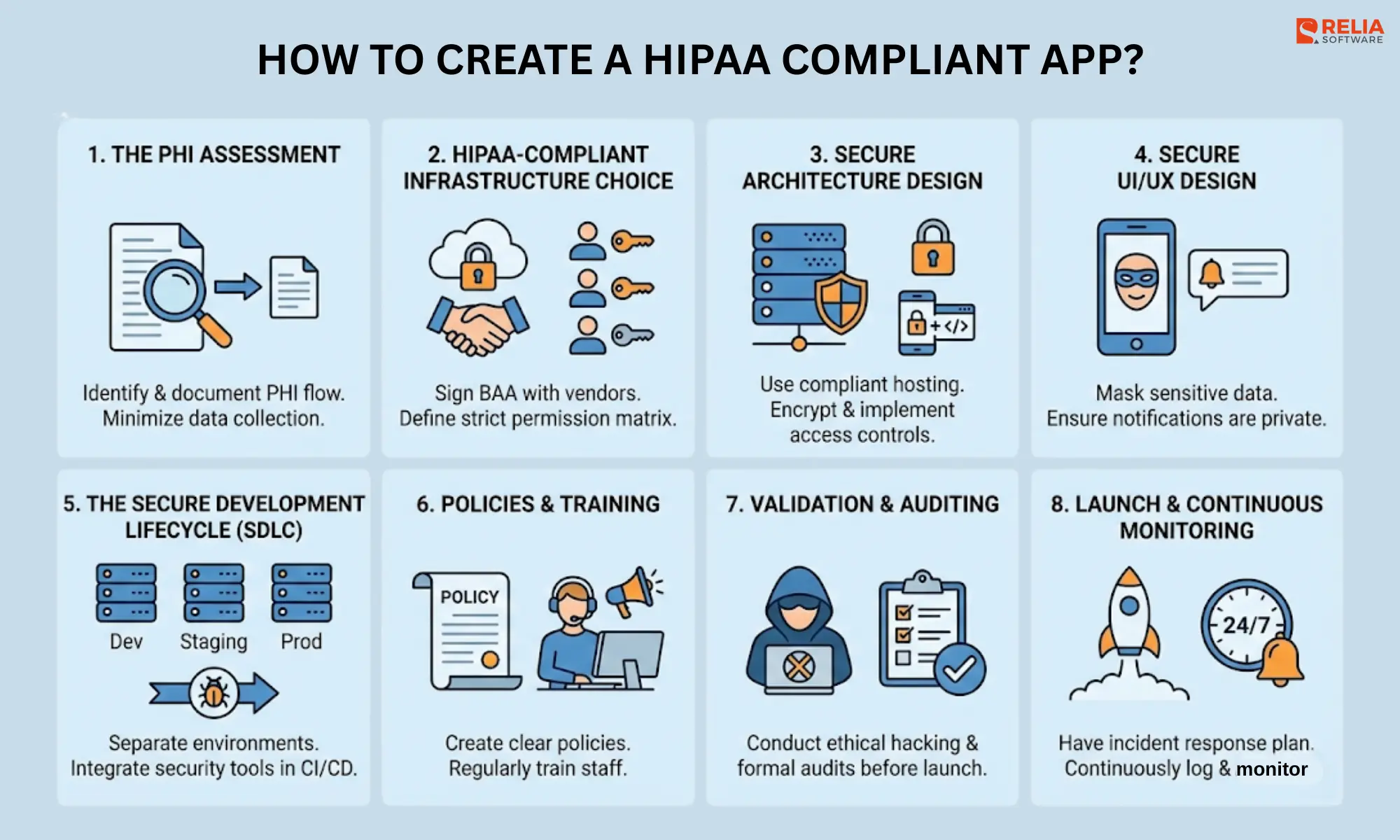
Step 1: The PHI Assessment
Before writing a single line of code, you must identify exactly what data you are handling. Document every point where Protected Health Information (PHI) enters, moves, or rests within your system. This includes intake forms, APIs, databases, and third-party integrations. Knowing these paths helps you spot sensitive areas early.
Next, question what data is truly necessary. If the app can work without storing highly sensitive details, such as Social Security numbers or full identifiers, avoid collecting them. Reducing the amount of PHI you handle lowers both security risk and compliance burden.
Step 2: HIPAA-Compliant Infrastructure Choice
You must sign a Business Associate Agreement (BAA) with every third-party vendor that touches your data (e.g., AWS, Google Cloud, Twilio, SendGrid) before you start development. If a vendor doesn't sign, you can't use them.
Create a strict matrix of who needs to see what. An administrator, a doctor, and a patient should all have distinct permission levels defined in your documentation.
Step 3: Secure Architecture Design
Choose a hosting provider (like HIPAA Vault or specific AWS healthcare tiers) that specializes in compliance. They handle the physical server security, allowing you to focus on the application layer.
Security must be built into the architecture:
-
Encryption: AES-256 for data stored in your database (at rest) and TLS 1.2+ for all data moving between the app and the server (in transit).
-
Access Control: Implement RBAC and multi-factor authentication (MFA).
-
Authentication: Strong user identification and session management.
-
Audit Trails: Log all user activity and data access.
Separate sensitive data from non-sensitive data, limit access by role, and ensure data is encrypted both in transit and at rest.
Step 4: Secure UI/UX Design
Design screens that hide sensitive data by default. For example, mask patient names on dashboard overviews or blur details when the app is in the background.
Ensure push notifications never contain PHI (e.g., "New Message" instead of "Your HIV test results are ready") to protect user privacy on locked screens.
>> You can consider: Tips for Enhancing Healthcare UI Design in Mobile Apps
Step 5: The Secure Development Lifecycle (SDLC)
Create distinct environments for Development, Staging, and Production. Never use real patient data in your testing or staging environments. Use synthetic (dummy) data to test functionality.
Follow secure coding practices to prevent common issues like injection attacks, cross-site scripting, and request forgery.
Integrate tools into your CI/CD pipeline (Static and Dynamic Application Security Testing) that automatically check your code for vulnerabilities every time a developer saves their work. APIs should always be authenticated and protected with rate limits.
Step 6: Policies & Training
HIPAA is not only technical. Create clear internal policies covering data handling, access rules, and incident response. Train developers and staff regularly, and document everything. Human error is one of the most common causes of breaches.
Step 7: Validation & Auditing
Before launch, hire ethical hackers to try and break into your app. This "stress test" reveals vulnerabilities that automated scanners might miss.
Conduct a formal internal or third-party audit to ensure all administrative policies (like training logs) and technical safeguards match HIPAA regulations.
Step 8: Launch & Continuous Monitoring
Have an incident response plan ready so your team knows exactly what to do if something goes wrong. This includes who to contact, how to lock down the system, and how to notify regulators within the legal 60-day window.
Ensure your live app is continuously logging every user action (login, view, edit, delete) to a secure, tamper-proof server. These logs are your primary defense during an audit.
How to Create a HIPAA Compliant App?
Cost Breakdown for Hipaa Compliant App Development Services
HIPAA compliance is an investment, adding approximately 20–40% to the budget of a standard software project due to the rigorous requirements for encryption, audit trails, and specialized infrastructure.
Below is a breakdown of estimated costs for 2026 based on app complexity and lifecycle stages.
|
App Type |
Estimated Cost |
Key Features & Compliance Needs |
|
Basic HIPAA App (MVP) |
$30,000 – $80,000 |
• Secure user login & authentication • PHI encryption (at rest/transit) • Basic dashboard & limited user roles • Essential audit logging. |
|
Mid-Level App |
$80,000 – $160,000 |
• Telehealth features (video/chat) • EHR/EMR integration (HL7/FHIR) • Role-Based Access Control (RBAC) • Secure push notifications & messaging. |
|
Enterprise-Grade Platform |
$160,000+ |
• AI/ML diagnostics & predictive analytics • IoT integration (wearables) • Complex multi-tenant architecture • Advanced interoperability & microservices. |
Also, you also consider the following costs:
-
Infrastructure & Hosting: HIPAA-compliant cloud hosting (e.g., AWS or Azure) is more expensive than standard hosting. Expect to pay $200 – $2,000+ per month depending on data volume and logging retention needs.
-
Security Audits: Independent third-party HIPAA audits typically cost between $5,000 and $50,000, depending on the depth of the assessment.
-
Legal & BAA Fees: Drafting and reviewing Business Associate Agreements (BAAs) and Terms of Service with a specialized healthcare attorney can cost $2,000 – $10,000.
-
Maintenance & Updates: Healthcare apps require constant patching to address new security vulnerabilities. Budget 15–25% of your initial development cost annually for ongoing maintenance.
Common Traps in HIPAA-Compliant App Development
Storing PHI on User Devices
To improve performance, developers often cache API responses on the device using local storage such as UserDefaults, SharedPreferences, or browser storage. If cached data includes PHI and the device is lost or stolen, that data can be exposed. Standard local storage is usually not encrypted to HIPAA standards by default.
Solutions: Avoid storing PHI on the client whenever possible. If offline access is required, use encrypted storage (such as an encrypted database or secure keychain) and ensure all PHI is wiped immediately on logout or session expiry.
Using Non-Compliant Third-Party Tools
Analytics, messaging, push notifications, and logging tools can accidentally expose PHI. If a vendor does not sign a Business Associate Agreement (BAA), it cannot be used for PHI, no matter how common or convenient the tool is.
Solutions: Review every SDK and API in your stack. Disable tools that cannot sign a BAA on any screen that handles PHI, or remove all identifying data before sending it.
Leaky Push Notifications
Sending clinical details directly in a notification payload, such as "Your cardiology appointment is confirmed" or "New test result: Negative."
Push notifications pass through Apple and Google servers, which typically do not sign BAAs for notification content. These messages can also appear on locked screens, exposing PHI to unintended viewers.
Solutions: Send neutral notifications only, such as “You have a new secure message.” Require users to open the app and log in to view sensitive information.
The “HTTPS Is Enough” Assumption
Believing that using HTTPS alone makes an app HIPAA compliant. In fact, HTTPS only protects data while it is being transmitted. It does not secure stored data or control who can access it.
Solutions: HTTPS is the minimum, not the solution. You must layer it with At-Rest Encryption (AES-256), Intrusion Detection Systems (IDS), and strict Firewall rules.
FAQs
Who is responsible for HIPAA compliance in app development?
-
Covered Entities (Clients): Hospitals, clinics, insurers, and clearinghouses are the primary owners of patient data. They must choose compliant vendors, but do not carry all liability.
-
Business Associates (Developers): If your app handles PHI for a covered entity, you are a business associate. Developers are directly responsible for HIPAA compliance and can be penalized independently.
-
Subcontractors (Your Tech Stack): Any third-party service that touches PHI must sign a BAA. If a subcontractor causes a breach without one, liability falls back on developers.
-
Direct-to-Consumer Apps: Apps where users manage their own health data without involving providers or insurers usually fall outside HIPAA, since the user owns the data.
Does HIPAA apply if my app is used outside the USA?
HIPAA is a U.S. law, but it applies whenever an app handles health data for U.S. patients, regardless of where the app or development team is located. If your app also serves users in the EU, you must follow GDPR as well, which has its own rules and requirements.
How long do HIPAA audit logs need to be kept?
HIPAA generally requires logs and records to be retained for at least six years.
What are the future trends in healthcare app development with HIPAA compliance?
-
AI/ML: Healthcare apps are using AI in safer ways by processing data locally or limiting how PHI is used for training. This allows automation and insights without exposing raw patient data.
-
IoMT: IoMT connects medical devices to apps, making secure data transfer and device verification essential. Only trusted devices should be able to send health data into the system. w. Health data should only be sent into the system by gadgets that people trust.
-
Edge Computing Security: Edge computing processes sensitive data on the device before sending results to the cloud. This reduces risk, improves performance, and keeps patient data better protected.
>> Read more: 6 Best Vietnam Healthcare Software Development Companies
Conclusion
HIPAA compliance is not just a legal requirement, it is the foundation of trust in healthcare apps. For developers, it means building with care and discipline. For businesses, it means choosing partners who take data protection seriously.
As healthcare moves toward more connected systems and AI-driven care, the risks of cutting corners continue to grow. Teams that make security a part of the product instead of an afterthought are not only avoiding fines, but they are also making apps that patients and doctors feel safe using.

- Mobile App Development
- Web application Development
- web development