


If your applications rely on querying complex, nested data, especially JSON arrays or multi-valued columns, mastering multi-valued indexes is essential for maximizing database performance and scalability. This post delivers a no-nonsense, clear, and detailed guide to what multi-valued indexes are, why they matter, how to implement them well, and how to avoid common pitfalls. It includes specific, real-world examples and best practices backed by current standards and benchmarks.
>> Read more:
- Mastering Different Types of Indexes in SQL with Examples
- 6 PostgreSQL Index Types Explained: A Complete Guide
What Are Multi-Valued Indexes?
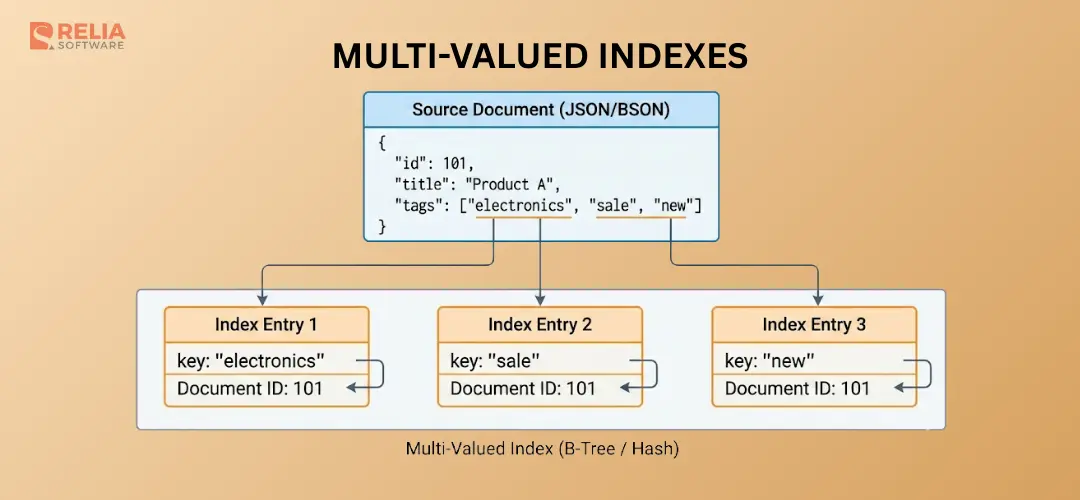
At their core, multi-valued indexes break down a database column that stores arrays or JSON lists so that each individual element inside that array gets its own index entry. Unlike standard indexes which create one entry per row, multi-valued indexes create multiple entries per row, one for each element. This results in a one-to-many mapping from index entries to rows.
Why? Because without it, filtering against array elements inside columns requires expensive full table scans or runtime JSON parsing, killing query speed.
Concrete Example:
Imagine a users table with a JSON column favorite_tags holding a list of tags per user:
{
  "favorite_tags": ["golang", "cloud", "docker"]
}
A multi-valued index creates three separate index entries for this single row, one for each tag. This lets the database jump directly to all users with the tag "docker," for example, instead of scanning every row.
Single-Valued Index vs. Multi-Valued Index: A Quick Comparison
| Feature | Standard Index (Single-Value) | Multi-Valued Index |
| Data Relationship | 1:1 Mapping — One index entry points to exactly one row. | N:1 Mapping — Multiple index entries can point back to the same row. |
| Typical Data Type | Scalar values (INT, VARCHAR, DATE, etc.). | Collection types (JSON Arrays, Sets, nested lists). |
| Primary Use Case | Finding a specific user by email or id. | Finding all products that contain the tag "sale" in a tags array. |
| Query Operators | =, >, LIKE, BETWEEN. | MEMBER OF(), JSON_CONTAINS(), JSON_OVERLAPS(). |
| Storage Impact | Linear Growth. Directly proportional to the number of rows. | Exponential Potential. Grows based on (Number of Rows $\times$ Average Array Length). |
| Write Overhead | Low. One index update per INSERT. | High. If an array has 20 items, one INSERT triggers 20 index updates. |
| Search Logic | Jumps to a specific leaf node and stops (or scans a range). | Scans multiple leaf nodes that may all reference the same record. |
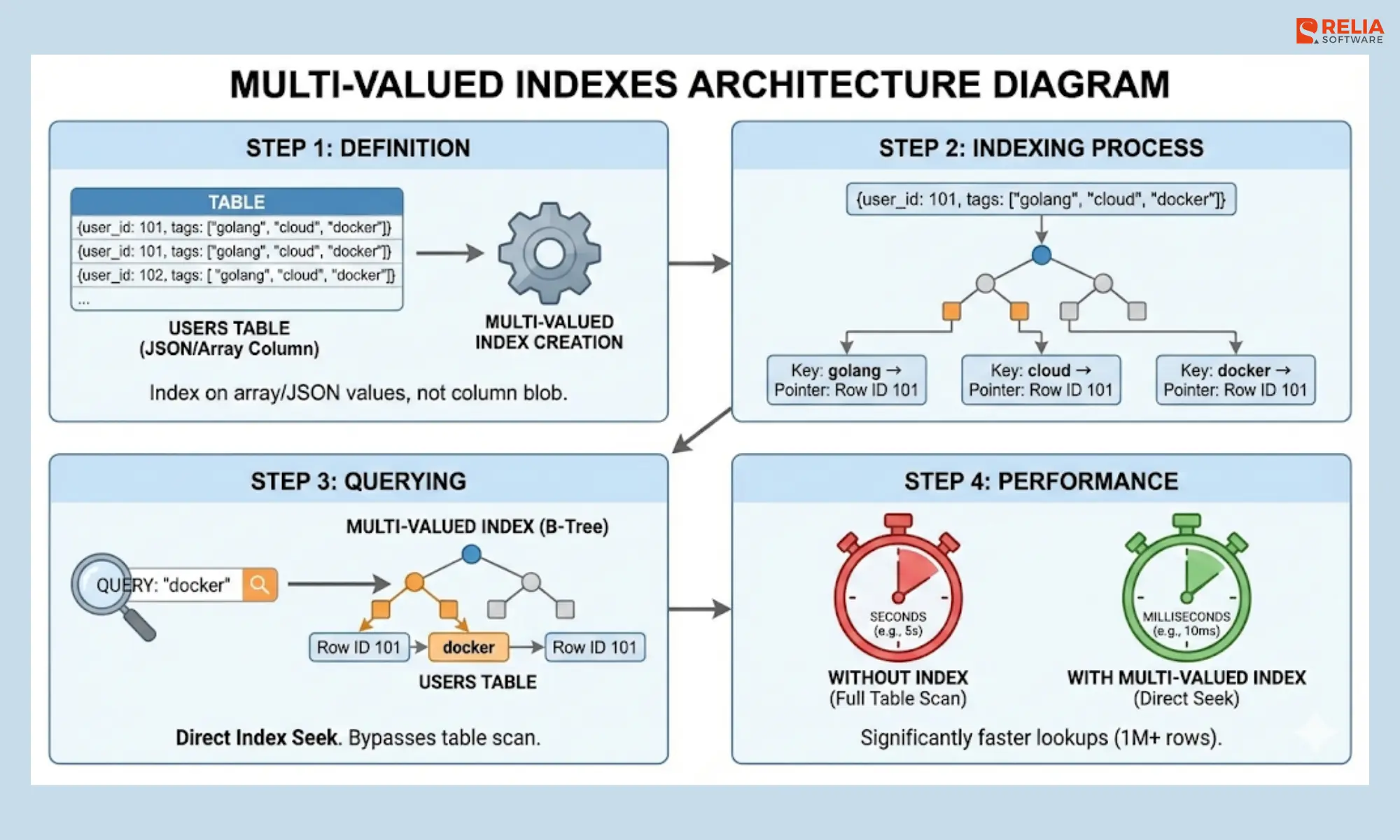
How Multi-Valued Indexes Work?
Step 1: Definition
First, you create a multi-valued index on a column that stores arrays or complex data types, such as a JSON array. This tells the database that the values inside the array should be indexed individually, not as a single blob.
At this point, nothing changes about how your data is stored in the table. Only the index behavior is different.
Key Concept: You aren't indexing the column itself; you are indexing the result of a function that extracts an array from that column.
Step 2: Indexing Process
Consider a row where user_id = 101 and the tags are ["golang", "cloud", "docker"]. Instead of one entry, the database generates three distinct index keys:
-
Key:
golang→ Pointer:Row ID 101 -
Key:
cloud→ Pointer:Row ID 101 -
Key:
docker→ Pointer:Row ID 101
Step 3: Querying
When a user executes a query to find everyone interested in "docker": SELECT * FROM users WHERE JSON_CONTAINS(tags, '"docker"');
The database bypasses the table entirely at first. It goes straight to the index, finds the "docker" leaf node, and immediately retrieves a list of all Row IDs associated with that tag. It doesn't matter if "docker" was the first item in the array or the fiftieth, the lookup time is nearly identical.
Step 4: Performance
With the multi-valued index, the database performs a Direct Seek. Benchmarks in modern environments like MySQL 8.0 or Oracle 23c show that for a table with 1 million rows, a multi-valued index can reduce query time from seconds to milliseconds.
How Multi-Valued Indexes Work?
Key Benefits of Multi-Valued Indexes
- Faster Queries: Benchmarks show query times drop by 5x to 50x when filtering on multi-valued columns using multi-valued indexes.
- Efficient Many-to-Many Relationships: Perfect for tagging, categorization, preference lists, and other array-driven data models.
- Reduced CPU and IO Usage: No need to parse JSON data on the fly or scan large tables.
- Better Resource Allocation: Save server costs by lowering query execution times.
- Supports Complex Queries: You can combine multi-valued indexes with other index types for compound filtering.
But be mindful: multi-valued indexes increase storage use and write overhead because they store multiple entries per row, potentially increasing latency on inserts, updates, and deletes.
Multi-Valued Indexes Example in Practice
MySQL Multi-Valued Indexes
Suppose this table:
CREATE TABLE user_favorites (
  user_id INT PRIMARY KEY,
  tags JSON
);
INSERT INTO user_favorites VALUES
  (1, '["golang", "cloud", "docker"]'),
  (2, '["java", "cloud"]'),
  (3, '["python", "docker"]');
Step 1: Create a Multi-Valued Index on tags
CREATE INDEX idx_tags ON user_favorites
((CAST(JSON_TABLE(tags, '$[*]' COLUMNS(tag VARCHAR(50) PATH '$')) AS CHAR(50) ARRAY)));
This tells MySQL to create index entries for each string inside tags arrays.
Step 2: Query Efficiently with the Index
SELECT user_id FROM user_favorites
WHERE JSON_CONTAINS(tags, '"docker"');
Thanks to the index, MySQL performs an index seek instead of a full table scan.
Multi-Valued Indexing in Oracle
Oracle uses function-based indexes with multi-value JSON support:
CREATE INDEX idx_multi_valued_tags ON user_favorites(
  CAST(JSON_TABLE(tags, '$[*]' COLUMNS(tag VARCHAR2(50) PATH '$')) AS VARCHAR2(50))
);
You combine this with JSON_EXISTS or JSON_TABLE predicates for fast filtering.
Composite Multi-Valued Indexes
Multi-valued indexes can be part of composite indexes combining multiple columns. For instance, index on both user region and JSON tags for geo-filtered tag searches:
CREATE INDEX idx_region_tags ON user_activity(region,
  (CAST(JSON_TABLE(tags, '$[*]' COLUMNS(tag VARCHAR(50) PATH '$')) AS CHAR(50) ARRAY))
);
This accelerates queries like:
SELECT * FROM user_activity
WHERE region = 'US' AND JSON_CONTAINS(tags, '"golang"');
Best Practices for Using Multi-Valued Indexes Right
Multi-valued indexes have nuances. Here’s what you must do to avoid common traps:
Target Only Frequently Queried Columns
Index only the JSON arrays or collection elements that your queries filter, join, or search on regularly. Indexing rarely used fields increases index size and write cost with little benefit.
Confirm Your Database’s Multi-Valued Index Support
Support and syntax vary by database engine:
- MySQL 8.0+: Supports native multi-valued JSON indexing with JSON_TABLE and functional indexes.
- Oracle: Offers function-based multivalue indexes on JSON.
- TiDB: Supports expression-based multi-valued JSON indexes.
- Others: Some NoSQL or NewSQL platforms have unique capabilities.
Always check engine-specific limits and behaviors before designing indexes.
Expect Higher Write Costs
Each array element becomes a separate index entry during writes, increasing maintenance work for the database. In write-heavy workloads, this can slow bulk inserts and updates by 30–50%, so indexing coverage should be chosen carefully. Using batch writes and scheduling heavy updates during off-peak windows helps reduce the impact.
Validate Query Plans
Always verify that queries actually use the multi-valued index:
- Run
EXPLAIN(or equivalent) on critical queries. - Watch for fallback to full table scans or JSON parsing.
- Re-test plans as data volume and query patterns change.
Watch Cardinality and Index Growth
Multi-valued indexes can grow quickly:
- Monitor index size regularly.
- Be cautious with low-cardinality arrays (for example, boolean flags or very small value sets), as they often provide limited filtering power.
- Avoid indexing unbounded or user-generated lists without limits.
Benchmark Everything
Don’t guess. Measure query latency, CPU usage, and I/O before and after adding multi-valued indexes using realistic data and traffic patterns.
Combine Index Types Strategically
Multi-valued indexes work best when paired with other indexed columns. Use composite indexes combining multi-valued and conventional indexed columns to support multi-condition filters.
Use Uniqueness Constraints Carefully
Unique multi-valued indexes enforce uniqueness across all array elements, but allow duplicates within the same record. This can be useful but also surprising, so apply constraints intentionally.
Design Arrays for Index Efficiency
Keep arrays flat and well-structured when possible. Deep nesting, very large arrays, or poorly normalized JSON structures can reduce index efficiency and inflate storage.
Emerging Trends and Future Directions
- Expanding support for indexing nested JSON paths with JSON path expressions.
- Combining multi-valued, bitmap, and inverted indexes for hybrid solutions.
- Cloud services embedding AI-based index optimizers recommending multi-valued indexes dynamically.
- Increasing adoption in distributed SQL/NoSQL platforms enabling scalable JSON querying.
>> You can consider:
- SQL vs NoSQL Databases: What's the Difference & When to Use?
- Mastering Index in SQL to Improve Database Performance
Wrapping Up
Multi-valued indexes are essential in 2026 for applications querying array or JSON data. They unlock massive performance gains but at the cost of higher storage and write overhead. Use them strategically for columns you query often by elements, benchmark rigorously, and combine with other index types for best results.
They’re no longer experimental, they’re a proven feature transforming how we handle complex nested data at scale. Master multi-valued indexes now to future-proof your database skills.
>>> Follow and Contact Relia Software for more information!

- development
- coding