


In JetBrains' State of Python 2025 survey, FastAPI usage climbed from 29% to 38% in a year, the biggest jump among Python web frameworks including Flask. That growth has turned FastAPI into a mainstream choice rather than a niche one, so development teams starting a Python project now weigh it seriously against Flask.
This article compares FastAPI and Flask, explaining what each framework is, how they differ in architecture, performance, validation, and ecosystem, and which one is best suited to use cases such as REST APIs, machine learning, and prototypes. It also covers how to choose between them and how to migrate from Flask to FastAPI when your needs change.
|
Key Takeaways:
|
What Is FastAPI?
FastAPI is a modern Python web framework for building APIs. First released in 2018, it runs on Starlette, which handles the web layer using ASGI (Asynchronous Server Gateway Interface), and Pydantic, which validates data using Python type hints. This foundation is what makes FastAPI asynchronous and type-driven by default.
FastAPI is built for API-first development, so it focuses on the backend logic that powers mobile apps, web clients, and other services, rather than generating web pages itself. You define an endpoint, declare the data it expects with type hints, and FastAPI handles the validation and documentation for you.
Three traits define how FastAPI works:
- Asynchronous by default: It handles many requests at once using /async/ and /await/, which suits high-concurrency and I/O-heavy workloads.
- Automatic validation: Pydantic checks incoming data against your type hints and returns clear errors when the data is wrong.
- Automatic documentation: FastAPI generates interactive API docs (Swagger UI and ReDoc) straight from your code, with no separate step.
A minimal FastAPI app needs only a few lines:
from fastapi import FastAPI

app = FastAPI()

@app.get("/")
async def read_root():
    return {"message": "Hello, World"}
What Is Flask?
First released in 2010, Flask is another lightweight Python web framework for building web applications and APIs. It handles requests synchronously through the WSGI (Web Server Gateway Interface) framework and includes Jinja2 for rendering HTML.
Flask is called a microframework because its core stays small. It provides routing, request handling, and templating, while extra features can be added through extensions, giving developers more control, but it also means they need to set up more tools themselves.
Three traits define how Flask works:
- Synchronous by default: Flask processes requests one at a time per worker, though it added optional async view support in version 2.0.
- Minimal core: It ships without built-in data validation, an ORM, or authentication, so you choose and add those tools.
- Built-in templating: Jinja2 lets Flask generate and return complete HTML pages, which makes it a natural fit for server-rendered web apps.
A minimal Flask app is just as short:
from flask import Flask

app = Flask(__name__)

@app.route("/")
def read_root():
    return "Hello, World"
FastAPI vs Flask: Detailed Comparison
The table below sums up how they compare across the key criteria before diving into details
|
Criteria |
FastAPI |
Flask |
|
Framework type |
API-first framework |
General-purpose microframework |
|
Architecture |
ASGI (asynchronous) |
WSGI (synchronous) |
|
Async support |
Native. async/await are in the ASGI model |
Optional. Available via the Flask[async] extra |
|
Performance |
Higher throughput for I/O-bound work |
Strong for most web apps |
|
Data validation |
Automatic with Pydantic |
Manual or through extensions |
|
API documentation |
Automatic (Swagger UI, ReDoc) |
Added through extensions |
|
HTML templating |
Needs manual setup |
Built in and ready to use through Jinja2 |
|
Type hints |
Required to conduct main tasks |
Optional, ignored by the framework |
|
Learning curve |
Steeper if you are new to async or typing |
Gentle, few concepts to learn |
|
Maturity and ecosystem |
Newer, growing quickly |
Older, larger, more extensions |
|
Best-fit use cases |
REST APIs, microservices, ML serving, real-time apps |
Web apps, dashboards, prototypes, small APIs |
Architecture & Request Handling
The core architectural difference is that FastAPI handles requests asynchronously, while Flask handles them one at a time.
As noted, FastAPI runs on ASGI, and its async model lets one worker start a request, hand off control while that request waits on input or output, and use the wait to make progress on other requests. This design lets a single worker serve many requests at once when the work is I/O-bound, such as database reads or calls to other services.
Flask, on the other hand, runs on WSGI and is built on Werkzeug with Jinja2 for templating. Each worker handles one request from start to finish before it takes the next step. If a request waits on a database query or an external call, that worker has to sit idle until the wait ends. Flask can run async views since version 2.0, but it stays a WSGI application underneath, so it does not reach the concurrency of a native ASGI framework. To handle more traffic, you need to add more workers or server instances.
Performance & Concurrency
FastAPI outperforms Flask on concurrent, I/O-bound workloads. Its async model gives high throughput when requests wait on input or output. On synthetic I/O-bound tests, community benchmarks report FastAPI on Uvicorn handling roughly 15,000 to 20,000 requests per second, and in the TechEmpower Framework Benchmarks Round 22 JSON test it reached about 106,000, as reported by Netguru.
Flask handles requests synchronously, so it usually performs lower in benchmarks compared to FastAPI, at around 2,000 to 5,000 requests per second. In real applications, however, database queries often take up most of the response time, so one production-style test found FastAPI only 25–30% faster. For CPU-heavy tasks, both frameworks are limited by Python’s Global Interpreter Lock (GIL).
Data Validation & Automatic Documentation
FastAPI uses Pydantic to validate incoming data against the type hints you declare. You define the expected data structure once, and FastAPI checks every request against it, rejects bad data with a clear error, and converts values to the right type. It also uses the same information to generate interactive Swagger UI and ReDoc documentation automatically.
The example below validates the request body and documents it at the same time:
from fastapi import FastAPI
from pydantic import BaseModel

app = FastAPI()

class Item(BaseModel):
    name: str
    price: float

@app.post("/items")
async def create_item(item: Item):
    return item
Meanwhile, Flask does not validate request data by default. Developers must write the checks themselves or add a library such as Marshmallow or Flask-Pydantic. It also does not generate API documentation automatically, so teams often use tools like Flask-RESTX or Flasgger and need to keep the documentation updated manually.
As a result, the same endpoint requires more validation code:
from flask import Flask, request, jsonify

app = Flask(__name__)

@app.route("/items", methods=["POST"])
def create_item():
    data = request.get_json()
    if not isinstance(data.get("name"), str) or not isinstance(data.get("price"), (int, float)):
        return jsonify({"error": "Invalid input"}), 400
    return jsonify(data)
The practical effect is less boilerplate in FastAPI for data-heavy APIs, and more control but more setup in Flask.
Routing & Built-in Features
Both frameworks use simple decorator-based routing, but FastAPI builds more into the route while Flask keeps the core minimal.
FastAPI includes decorators to specify the HTTP method, while typed function parameters handle request parsing, validation, and documentation automatically. These features reduce repeated code and catch type errors earlier, but developers need to be comfortable with type hints, and ideally with async programming to get the most out of it. FastAPI also includes built-in features such as dependency injection and background tasks.
Flask keeps routing and its core simple. You will define paths with @app.route and set the HTTP methods you need. It is flexible and easy to learn, but features like validation, authentication, and database access must be added through extensions or separate libraries.
Neither framework enforces security defaults such as CSRF protection, so that responsibility falls to the developer in both cases.
Ecosystem, Community & Maturity
FastAPI is the fastest-growing Python web framework since 2020. It also passed Flask in GitHub stars, with about 79,000 compared with Flask’s 68,000. Much of that growth comes from teams building APIs and machine learning services, so its libraries and community lean toward async, API-first work. However, FastAPI is newer, which means some extensions are less proven and the pool of developers with deep FastAPI experience is smaller.
Flask has been around since 2010, giving it a mature and well-established ecosystem. It offers more extensions, tutorials, Stack Overflow answers, and experienced developers, which makes it easier to find both developers and ready-made solutions when you get stuck. Its ecosystem is also broad rather than API-specific, covering everything from small web apps to dashboards and internal tools.
For a team, Flask's maturity helps when long-term support and easy hiring matter most, while FastAPI's momentum favors new async and API projects.
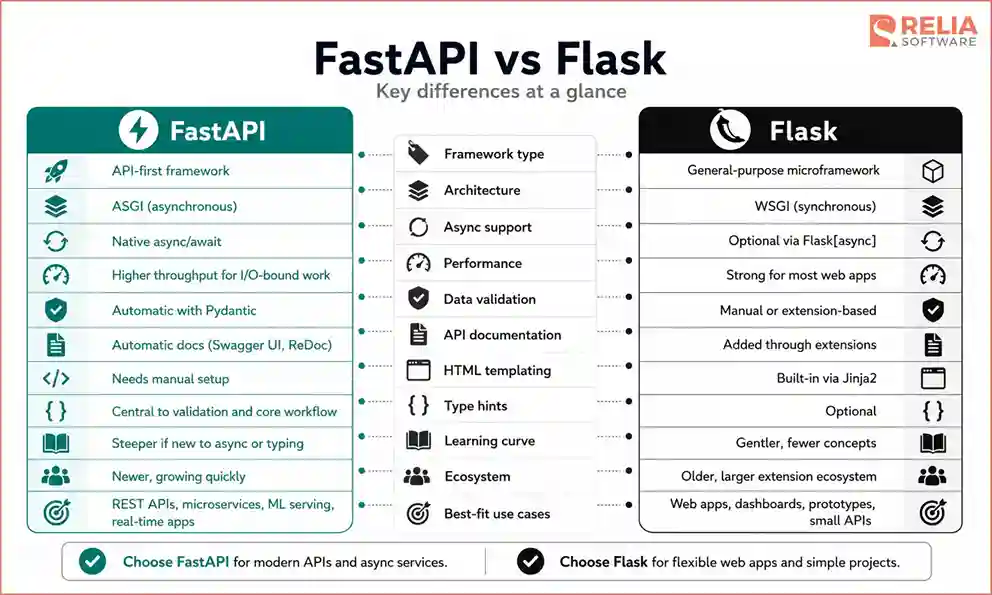
FastAPI vs Flask by Use Case
REST APIs & Microservices
FastAPI is the better fit for REST APIs and microservices. These systems often break work into many small services that handle heavy request volumes and need a clear, shared contract so teams can build against each other's endpoints. FastAPI matches well, since it serves high traffic and documents automatically. Flask is less suited because building the same contract and handling the same load takes extra tools and more manual setup.
Web Apps & Server-Rendered Pages
Server-rendered web apps lean toward Flask. This kind of app fills a page template with data and returns full HTML for the browser to display, often across many pages. Flask comes with a built-in template engine that does exactly that flow, turning data into a ready-to-send page in one step.
Meanwhile, FastAPI is built to serve data rather than pages, so a page-heavy site means adding a templating setup it leaves out by default.
Machine Learning & Model Serving
FastAPI is the first choice for serving machine learning models through an API. Model requests tend to wait on slow, variable inference and arrive many at once, so the service has to stay responsive under load and check inputs before they reach the model.
FastAPI handles that pattern smoothly, while Flask can struggle once traffic climbs, though it still works fine for a single prediction endpoint or a small internal tool.
Real-Time Apps (WebSockets and Streaming)
FastAPI supports real-time features natively, while Flask needs extra tooling. Live chat, notifications, and streamed output rely on open connections that push data continuously instead of answering one request and closing. FastAPI supports this kind of ongoing, two-way communication out of the box.
Flask, built around the standard request-and-response cycle, has to fight its own design to do the same and needs extra tools to run it reliably.
Prototypes & MVPs
Flask shines for early prototypes and developing MVPs. At this stage, you want to test an idea quickly with little traffic and few requirements, so a fast, no-friction start is more important than scale. Flask lets a small team stand up a working version with barely any setup.
Meanwhile, FastAPI earns its keep mainly once a product grows, which is effort a throwaway prototype rarely calls for.
>> Read more: Prototyping in Software Engineering: Types, Phases, Benefits, Uses
How to Choose Between FastAPI and Flask?
You should choose FastAPI when your team can work with async, and the project needs to scale, while choosing Flask when you need to ship fast, keep things simple, or build on an existing Flask codebase.
The conditions below help you decide once you know the project type.
Choose FastAPI when:
- Your team is comfortable with async and type hints: Your developers should be able to work with async and await and Python typing without a long ramp-up.
- You expect the service to scale: Your system traffic and concurrency are likely to grow, so the async model pays off over time.
- You are starting fresh: Your project requires a new codebase that lets you adopt FastAPI's patterns without working around legacy code.
- Long-term maintainability matters: You need typed and self-documenting endpoints to help a growing team onboard and reduce bugs.
- You can invest a little more setup upfront: The team accepts a steeper start in exchange for less friction as the project grows.
Choose Flask when:
- Your team is newer to Python or prefers minimal structure: You prefer fewer concepts and more freedom to assemble your own stack.
- You have a large existing Flask codebase: Your code is staying with Flask and avoids a rewrite that rarely pays for itself.
- You are on a tight timeline: You prefer fewer moving parts to help your small team ship quickly.
- Fast hiring and support matter: The larger talent pool and deeper library of answers make problems easier to solve.
- The workload is modest: Your project has steady traffic and is unlikely to need heavy concurrency, so raw throughput is not the deciding factor.
How to Migrate from Flask to FastAPI?
Migration from Flask to FastAPI is worth doing when your Flask app needs async performance, built-in validation, or automatic docs, and it is best avoided when the app is stable and none of those pressures apply.
You can follow the steps below to migrate your app from Flask to FastAPI safely.
Step 1: Set up FastAPI alongside Flask.
Add FastAPI and an ASGI server such as Uvicorn to your project, and keep the Flask app running. You can mount the existing Flask app inside FastAPI with a WSGI-to-ASGI adapter like a2wsgi, so both serve traffic while you migrate.
Step 2: Route new endpoints to FastAPI.
Send new routes to the FastAPI service and leave stable Flask routes untouched. A reverse proxy or API gateway can split traffic by path, which lets you adopt FastAPI without disturbing current features.
Step 3: Move shared logic first.
Your Python business logic, database models, and ORM code (such as SQLAlchemy) transfer with few changes. Move these into the FastAPI service early, since endpoints on both sides can reuse them.
Step 4: Convert routes one at a time.
Rewrite each Flask route as a FastAPI endpoint. Flask blueprints map onto FastAPI's APIRouter, and the request object and manual checks become typed parameters and Pydantic models. Convert I/O-bound functions to async def where async helps.
Step 5: Replace Flask extensions.
Swap Flask-specific extensions for FastAPI's built-in features or async equivalents. Validation and documentation often need no extension, since Pydantic and automatic OpenAPI docs are built in.
Step 6: Test each endpoint, then retire the Flask route.
Confirm the FastAPI version returns the same results, then move traffic off the old route. Migrate the highest-value endpoints first, and stop whenever the remaining Flask routes are fine as they are.
FAQs
1. Is FastAPI faster than Flask?
Yes, for concurrent, I/O-bound work, FastAPI handles more requests per second because of its async model. The gap is large in synthetic benchmarks but much smaller in real apps, where a database query dominates the response time.
2. Is Flask still worth using in 2026?
Yes. Flask is still a strong choice for server-rendered web apps, simple APIs, and quick prototypes. In JetBrains' State of Python 2025 survey, 34% of developers reported using Flask, and its maturity, large ecosystem, and big hiring pool keep it relevant, especially for teams that value simplicity over async performance.
3. Can Flask handle async now?
Yes, Flask has supported async view functions since version 2.0, but the support is limited. Async views run on top of Flask's synchronous WSGI model, so they do not reach the concurrency of a native ASGI framework like FastAPI.
4. Which is better for beginners?
Flask is usually easier to start with, since it has fewer concepts and does not require async or type hints. FastAPI is still approachable, and its automatic docs and validation help once you are building APIs, though it asks a little more upfront. Beginners building a simple web app often start with Flask, while those building an API often prefers FastAPI.
5. Is FastAPI production-ready?
Yes. FastAPI runs in production at large companies including Microsoft, Uber, and Netflix. It is stable, well-documented, and widely adopted for API and machine learning services.
>> Read more: Django vs. Flask: A Comprehensive Comparison Across 10 Aspects
Conclusion
In conclusion, FastAPI fits API-first, async, and machine learning workloads where concurrency and validation matter, while Flask fits server-rendered web apps, simple APIs, and fast prototypes where a small, flexible core is enough. The framework is one decision inside a larger build, and it depends on your product goals, your team's experience, and how the service needs to scale.
Relia Software builds Python backends and APIs with both FastAPI and Flask, choosing the framework to match each project rather than defaulting to one. Our team covers the full process, from planning and architecture through development, testing, and ongoing maintenance. If you are weighing the two for a new product or planning a migration, contact us to talk through the right fit.
>>> Follow and Contact Relia Software for more information!

- development