


Your team just landed a greenfield project. The CTO asks: "What architecture?" Someone says microservices. Someone says serverless. The senior engineer quietly suggests starting with a monolith.
They're all right, and all wrong. The answer depends on your team size, traffic patterns, budget, and where you expect to be in 18 months. This guide gives you a structured framework to make that decision with real cost numbers, migration case studies, and team-size heuristics, so you walk out of that architecture meeting with a reasonable choice.
|
Key Takeaways:
|
Key Differences at a Glance:
| Dimension | Monolithic | Microservices | Serverless |
|---|---|---|---|
| Deployment unit | Single artifact | Independent services | Individual functions |
| Scaling | Vertical (scale up) | Horizontal (per service) | Automatic (per function) |
| Team coupling | High | Low | Low |
| Startup cost | Low | High | Low |
| Operational cost at scale | Medium | High | Low-Medium |
| Complexity | Low initially | High | Medium |
| Vendor lock-in | Low | Low | High |
| Cold starts | N/A | N/A | Yes (100ms-10s) |
| Max execution time | Unlimited | Unlimited | 15 min (AWS Lambda) |
| Best for | MVPs, small teams | Large orgs, complex domains | Event-driven, bursty workloads |
Want the quick answer? Jump to the decision framework for team-size and budget matrices you can take straight into your next architecture review.
What Are Monolithic, Microservices, and Serverless Architectures?
Before comparing trade-offs, let's nail down what each pattern actually means in practice.
Monolithic Architecture
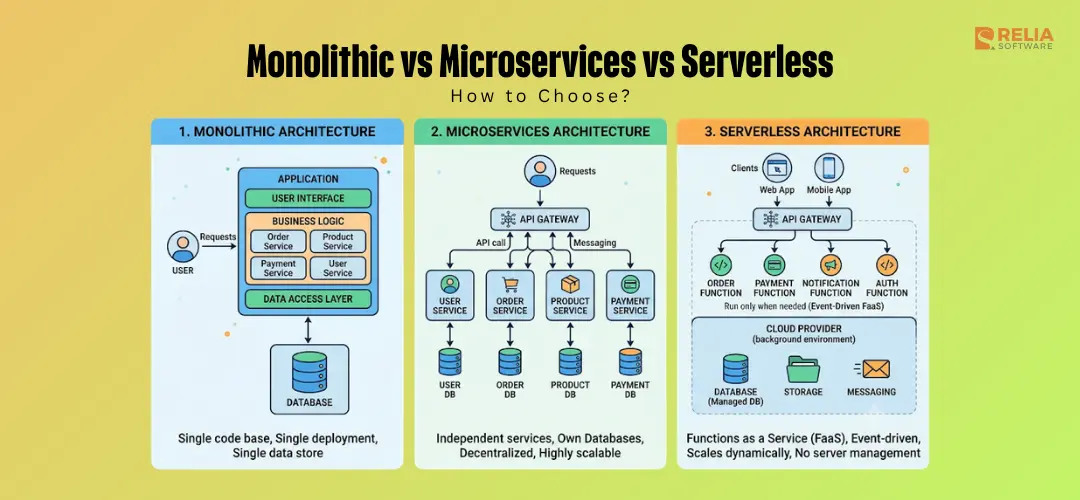
A monolithic architecture packages the entire application, including UI, business logic, data access into a single deployable unit. The main characteristics of monolithic architecture are one codebase, one build pipeline, one deployment artifact.
[Client] → [Single Application Server] → [Database]
              ├── Auth Module
              ├── Order Module
              ├── Payment Module
              └── Notification Module
All modules share the same process, memory space, and database. A change to the payment module means redeploying the entire application.
Who uses monolith: Basecamp (deliberately chose monolith at scale), Stack Overflow (serves 1.3 billion monthly page views from a monolith), Shopify (modular monolith serving millions of merchants).
Microservices Architecture
A microservices architecture decomposes the application into small, independently deployable services. Each service owns its data, runs in its own process, and communicates over the network via APIs or message queues.
[Client] → [API Gateway]
              ├── Auth Service → [Auth DB]
              ├── Order Service → [Order DB]
              ├── Payment Service → [Payment DB]
              └── Notification Service → [Message Queue]
Each service can be built in a different language, deployed on a different schedule, and scaled independently. But every service boundary introduces a network call, and network calls fail.
Who uses microservices: Netflix (1,000+ microservices), Uber (2,200+ services at peak), Amazon (pioneered the pattern from 2001 onward), Spotify (autonomous squads each owning services).
>> You may need: Top 10 Microservices Design Patterns Developers Should Know
Serverless Architecture
A serverless architecture abstracts away all infrastructure. You write functions that execute in response to events like HTTP requests, queue messages, database changes, scheduled triggers. The cloud provider handles provisioning, scaling, and patching.
[Client] → [API Gateway]
              ├── POST /order → Lambda Function → DynamoDB
              ├── Payment Webhook → Lambda Function → SQS
              └── Scheduled Report → Lambda Function → S3
With serverless architecture, you don't manage servers and provision capacity. You pay per execution, billed in milliseconds. But you give up control over the runtime environment and accept vendor-specific constraints.
Who uses serverless: Coca-Cola (vending machine backend on AWS Lambda), iRobot (IoT event processing), Liberty Mutual (insurance claims processing), T-Mobile (customer-facing APIs).
>> Read more:
- A Developer Guide to Serverless Architecture With Azure Functions
- AWS Lambda vs Azure Functions: Pricing, Performance, and Uses
Scalability Comparison
Scalability is the first argument in every architecture debate. But "scalability" means different things for each pattern.
Scaling a Monolith
A monolith usually scales in two ways: vertically by using bigger machines, or horizontally by running multiple copies behind a load balancer. This is simple and can work well for a long time.
Stack Overflow, for example, runs on 9 web servers and 4 SQL servers for 1.3 billion page views per month. The monolith isn't the bottleneck, poorly written queries are.
Where it breaks: When different modules have vastly different resource needs. If your image processing module needs 10x the CPU of your user authentication module, you're paying for 10x CPU on every instance just to satisfy one module.
Scaling Microservices
Microservices scale per service. The payment service getting hammered during a flash sale? Scale it to 50 instances while keeping everything else at 3.
This granularity is powerful but expensive to operate. Each service needs its own CI/CD pipeline, health checks and monitoring, service discovery and load balancing, and circuit breakers for fault tolerance.
Netflix runs 1,000+ microservices on hundreds of thousands of instances. That requires a dedicated platform engineering team of 100+ people just to keep the infrastructure running.
Scaling Serverless
Serverless scales automatically and instantly based on demand. A function can scale from zero to thousands of executions when traffic spikes, then return to zero when traffic stops.
AWS Lambda can burst to 3,000 concurrent executions immediately, then add 500 per minute. For bursty, unpredictable workloads, this is unmatched.
Where it breaks: Sustained high-throughput workloads. If your function runs constantly at high concurrency, you'll pay more than a reserved EC2 instance. AWS themselves acknowledge this, it's why they built AWS Fargate as a middle ground.
>> Explore: How to Migrate Your AWS Workloads from EC2 to ECS?
Cost and Operational Overhead
Development Cost
| Architecture | Initial Dev Cost | Ongoing Dev Cost |
| Monolithic | Low. One codebase, one build. A solo dev can ship v1 in weeks. | Increases as codebase grows. Changes become riskier. |
| Microservices | High. Service boundaries, API contracts, infrastructure-as-code before writing business logic. | Moderate per service, but multiplied by N services. |
| Serverless | Low. Write a function, deploy. Minimal infrastructure setup. | Low per function. But debugging distributed functions is painful. |
Infrastructure Cost
Here's where the real differences emerge. Consider a SaaS app handling 10 million API requests per month:
Monolithic (EC2/VPS):
- 2x t3.large instances: ~$120/month
- RDS database: ~$150/month
- Total: ~$270/month (predictable)
Microservices (EKS/Kubernetes):
- Kubernetes cluster: ~$73/month (control plane)
- 6x t3.medium nodes: ~$240/month
- Multiple RDS instances: ~$400/month
- Load balancer: ~$20/month
- Total: ~$733/month (higher baseline)
Serverless (Lambda + DynamoDB):
- Lambda: ~$20/month (10M invocations at 200ms avg)
- API Gateway: ~$35/month
- DynamoDB: ~$50/month
- Total: ~$105/month (pay-per-use)
Serverless wins on cost at this scale. But at 100M requests/month, the Lambda bill climbs to ~$200 while the monolith stays at ~$270 with a bigger instance. At 1B requests/month, serverless can exceed $2,000 while a well-optimized monolith on dedicated hardware might cost $500.
The crossover point matters. Estimate your steady-state traffic before choosing based on cost alone.
Maintenance Burden
This is the hidden cost nobody talks about until month 6.
- Monolith: One thing to monitor, one thing to deploy, one thing to debug. But the blast radius of a bug is the entire application.
- Microservices: N things to monitor, N pipelines to maintain, distributed traces to correlate. Netflix built an entire observability platform (Atlas, Zuul, Eureka) just to manage this.
- Serverless: Zero server maintenance, but you're debugging across dozens of ephemeral function invocations. CloudWatch logs become your best friend and worst enemy.
Performance and Latency
Monolith Performance Characteristics
In-process function calls have near-zero overhead with no serialization, no network hops, no retry logic. A monolith is the fastest architecture for request handling until it becomes I/O bound on a single database.
This is why performance alone is rarely the deciding factor. All three architectures can serve millions of users when designed properly.
Inter-Service Communication in Microservices
Every microservice call crosses a network boundary. A single user request that touches 5 services adds 5 network round trips, each with serialization, DNS resolution, TLS handshake, and potential failure.
A page load that takes 50ms in a monolith can take 200ms+ in a microservices architecture simply due to cascading service calls. This is why Netflix, despite having 1,000+ microservices, aggressively caches and uses async communication wherever possible.
The solution: Async messaging (Kafka, RabbitMQ), caching layers (Redis), and accepting eventual consistency where possible.
Cold Starts in Serverless
Cold starts is the most discussed serverless drawback. When a function hasn't been invoked recently, the provider must:
- Allocate a container
- Download your code
- Initialize the runtime
- Execute your function
This adds 100ms to 10 seconds of latency depending on runtime and package size:
| Runtime | Typical Cold Start |
| Python | 200-500ms |
| Node.js | 100-300ms |
| Java | 3-10 seconds |
| .NET | 1-3 seconds |
| Go/Rust | 50-100ms |
In practice, fewer than 1% of Lambda invocations experience cold starts. AWS Lambda SnapStart 2.0 (2025) reduces Java cold starts by 90% using pre-initialized snapshots. The cold start problem is shrinking fast, but hasn't disappeared.
Mitigations: Provisioned concurrency (AWS), min instances (GCP), always-on (Azure), but these add cost and reduce the "serverless" benefit.
Note: as of August 2025, AWS bills for the Lambda INIT phase, increasing cold start costs 10-50% for functions with heavy startup logic.
When to Use Monolithic vs Microservices vs Serverless?
Choose Monolithic When:
- Your team is small (1-10 developers). Microservices require at least 2-3 teams to justify the coordination overhead.
- You're building an MVP or prototype. Ship fast, validate the idea, refactor later. Instagram launched as a monolith with 2 engineers and scaled to 30 million users before considering decomposition.
- Your domain isn't well understood yet. Getting service boundaries wrong is expensive. A monolith lets you refactor freely until boundaries become clear.
- You need strong consistency. ACID transactions across modules are trivial in a monolith, complex in microservices (sagas, compensating transactions).
- You want simple debugging. One stack trace, one log stream, one debugger session.
Choose Microservices When:
- Multiple teams need to deploy independently. This is the #1 reason. Microservices are an organizational pattern as much as a technical one. Conway's Law is real.
- Different components have different scaling needs. Your search service needs 50 instances during peak, but your admin panel needs 1.
- Different components need different tech stacks. ML pipeline in Python, real-time API in Go, admin dashboard in Node.js.
- You need fault isolation. A bug in the notification service shouldn't take down payment processing.
- Your domain has clear bounded contexts. If you can draw clean lines between order management, inventory, shipping, and billing, microservices map naturally.
Choose Serverless When:
- Your traffic is bursty and unpredictable. Webhooks, IoT events, periodic batch jobs are workloads that spike and idle.
- You want zero operational overhead. No patching, no capacity planning, no 3 AM pager alerts for a server running out of disk.
- You're building event-driven pipelines. File upload triggers image processing triggers notification triggers analytics update. Each step is a function.
- Your functions are short-lived. Under 15 minutes, ideally under 30 seconds. Long-running processes are a poor fit.
- You want to minimize time to market. Deploy a function in minutes, not weeks of infrastructure setup.
Real-World Migration Stories
Theory is useful. Reality is instructive.
Netflix: Monolith to Microservices (2009-2016)
Netflix started as a monolithic Java application. In 2008, a database corruption took down the entire service for 3 days. That incident triggered a 7-year migration to microservices and AWS.
What worked:
- Gradual, service-by-service migration (Strangler Fig pattern)
- Building internal platforms (Zuul, Eureka, Hystrix) to manage complexity
- Chaos engineering (Chaos Monkey) to build resilience
What was hard:
- Took 7 years, not 7 months
- Required building an entire platform engineering discipline
- Cost hundreds of millions in engineering investment
Key lesson: Netflix didn't adopt microservices because they're "better." They adopted them because they had 2,000+ engineers who needed to deploy independently. If you have 20 engineers, you don't have Netflix's problem.
Segment: Microservices Back to Monolith (2017)
Segment decomposed their data pipeline into 140+ microservices. The result is every new destination integration required changes across dozens of services. Onboarding a new API destination took weeks instead of hours.
They consolidated back into a single service called Centrifuge, a monolith that handled all destinations through a shared abstraction layer.
Result:
- New destination onboarding dropped from weeks to hours
- Operational incidents decreased by 80%
- Team velocity increased 5x
Key lesson: Microservices have a coordination cost. If your services aren't truly independent, you're paying the cost of distribution without the benefits.
Amazon Prime Video: Microservices to Monolith (2023)
Amazon's Prime Video monitoring team moved from a distributed microservices architecture (using Step Functions and Lambda) to a monolith. The result is 90% cost reduction.
Their distributed architecture was passing video frames between Lambda functions via S3, creating massive data transfer costs. Consolidating into a single process eliminated inter-service data transfer entirely.
Key lesson: Serverless per-invocation pricing can explode when functions pass large payloads between each other. Architecture decisions must account for data flow patterns, not just compute patterns.
Decision Framework: Picking the Right Architecture
Stop thinking about which architecture is "best." Start thinking about which constraints matter most for your specific situation.
Team Size
| Team Size | Recommended Start |
| 1-5 developers | Monolith (or serverless for simple APIs) |
| 5-20 developers | Modular monolith, selective microservices |
| 20-100 developers | Microservices with platform team |
| 100+ developers | Microservices (you probably already have them) |
Application Complexity
| Complexity | Pattern |
| CRUD app, simple business logic | Monolith or Serverless |
| Complex domain, many entities | Modular Monolith |
| Multiple domains, independent lifecycles | Microservices |
| Event pipelines, data processing | Serverless |
Traffic Patterns
| Traffic Pattern | Best Fit |
| Steady, predictable | Monolith (cheapest) |
| Bursty, unpredictable | Serverless (auto-scales, pay-per-use) |
| Mixed (some steady, some bursty) | Hybrid: monolith core + serverless for spikes |
| Very high sustained throughput | Monolith or microservices on dedicated infra |
Budget Constraints
| Budget | Approach |
| Bootstrap / indie hacker | Monolith on a $10/month VPS |
| Startup (seed-Series A) | Monolith or serverless |
| Growth (Series B+) | Begin selective decomposition |
| Enterprise | Microservices with dedicated platform team |
The Hybrid Approach: Best of All Worlds
Most production systems in 2026 don't use a single pattern. They combine them:
- Monolith core handling primary business logic
- Serverless functions for webhooks, image processing, scheduled jobs
- Microservices extracted only where independent scaling or deployment is needed
For example: Shopify runs a modular monolith but uses serverless for edge computing (Shopify Functions). Amazon runs thousands of microservices but individual teams often build monoliths within their service boundary.
The best architecture is the one you can operate successfully with your current team.
FAQ
Can we combine microservices and serverless?
Yes, and many teams do. Individual microservices can be implemented as serverless functions. AWS Lambda behind API Gateway is essentially a serverless microservice.
The key difference is operational: traditional microservices run on containers you manage; serverless microservices run on infrastructure the provider manages.
Is monolithic architecture dead?
No. Monolithic architecture is still widely used, especially when teams need simple deployment, easier debugging, and lower operational complexity.
Companies like Shopify have shown that a modular monolith can still work at scale, while the Prime Video case shows that even large engineering teams may move specific services back into a monolithic design when distributed architecture adds unnecessary cost or complexity.
What is a modular monolith?
A monolith with strictly enforced internal boundaries between modules. Each module has its own domain logic and database schema but deploys as a single unit. It offers the organizational benefits of microservices (clear ownership, defined interfaces) without the operational complexity (no network calls, no distributed transactions).
How do I migrate from monolith to microservices?
Use the Strangler Fig pattern: build new features as microservices while gradually extracting modules from the monolith. Route traffic through an API gateway that directs requests to either the monolith or the new service. This approach lets you migrate incrementally without a risky big-bang rewrite.
What's the biggest mistake teams make with architecture decisions?
Choosing microservices before they need them. Martin Fowler calls this "microservice premium", the upfront cost of distributed systems that only pays off at a certain organizational scale. If you're a team of 5 building an MVP, a monolith will get you to market 3-5x faster.
Conclusion
The monolithic vs microservices vs serverless debate isn't about finding the "best" architecture. It's about matching your architecture to your constraints.
Here's the decision in three sentences:
- Start with a monolith unless you have a proven reason not to. It's faster to build, easier to debug, and cheaper to run.
- Adopt microservices when your organization outgrows a single deployment or when multiple teams need to ship independently and different components have genuinely different scaling needs.
- Use serverless for event-driven workloads, bursty traffic, and anywhere you want to eliminate operational overhead — but watch for vendor lock-in and cold start latency.
The most successful engineering teams in 2026 aren't dogmatic about architecture. They're pragmatic. They start simple, measure what actually hurts, and evolve their architecture in response to real problems, not hypothetical ones.
Your users don't care about your architecture. They care about whether your product works.

- Designing an application
- coding
- development