Challenges
The client’s legacy platform was built on ASP.NET MVC (.NET Framework 4.7.2), which created several critical bottlenecks:
Performance at Scale: The monolithic system struggled to process payroll for 150,000 workers monthly, leading to significant delays.
Fragmented Workflows: Data consistency was lacking across the chain of timesheets, payroll, invoicing, and banking.
Lack of Self-Service: Workers did not have access to a self-service portal to view payslips, submit timesheets, or manage expenses.
Compliance Complexity: Difficulties in providing real-time integration with UK compliance services like HMRC and Right to Work verification.
Weak Multi-tenancy: Multi-tenant support was insufficient, making it difficult to manage multiple companies or agencies on a single system.
Technical Debt: Lack of automated CI/CD, tight coupling between UI and logic, and a total absence of modern caching or message queuing.
Legacy UI/UX: The system utilized server-rendered views and jQuery rather than a modern Single Page Application (SPA) architecture.
Scope Of Work
Relia Software re-engineered the platform from the ground up, moving to a modern architecture based on .NET 8 and React.
Core Platforms Developed:
- PayrollBackOffice (Core Platform)
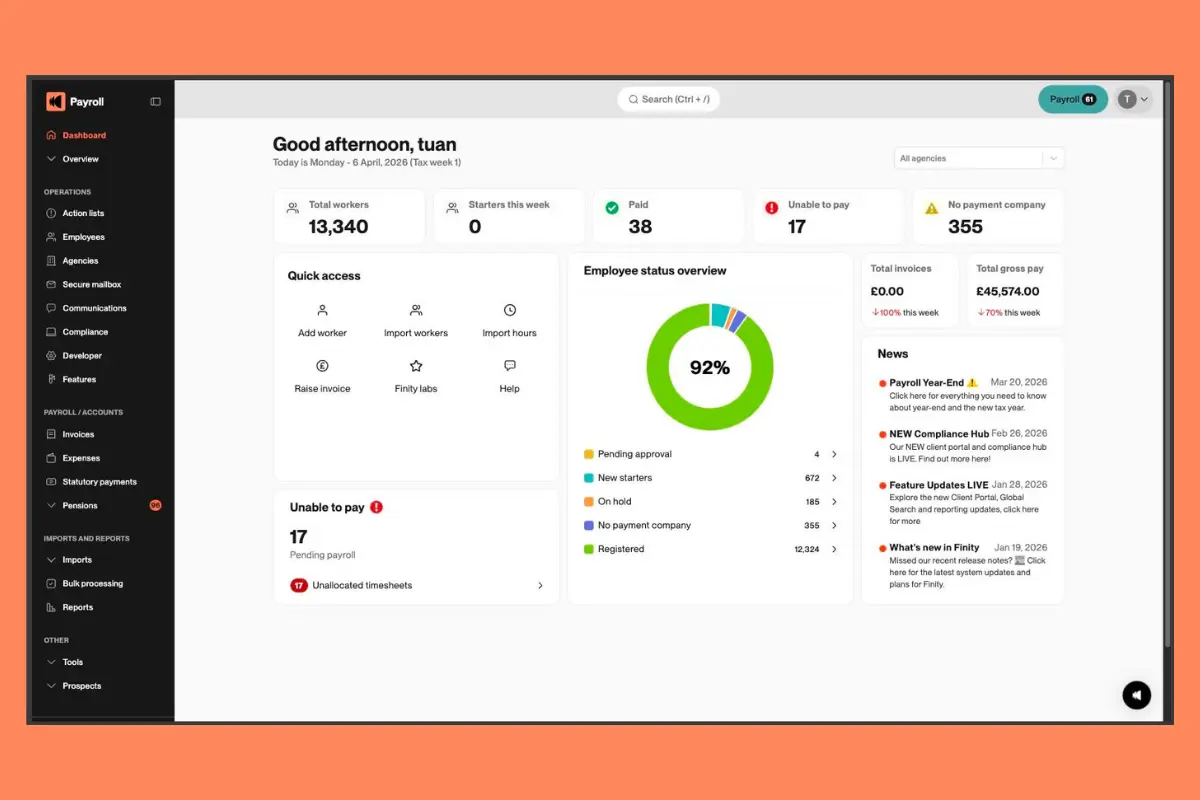
A central hub managing agency onboarding, employee contracts, and automated payroll (PAYE, NI, pensions, and statutory payments). It integrates bulk timesheet processing, automated invoicing, bank reconciliation, and a React-based Worker Portal for self-service payslip and expense management.
- Codabill (Staffing & Recruitment)
A recruitment module that manages candidates and placements while orchestrating multi-step timesheet approval workflows. It automates sales/purchase invoicing, supplier document storage on Azure, and holiday tracking, supported by background jobs for automated reminders.
- Coda.Payroll (Calculation Engine)
A specialized NuGet library supporting UK, Scottish, and Welsh tax regimes from 2012 to 2024+. It utilizes a regex-based tax code parser and embedded JSON configurations to handle complex deductions for National Insurance, Student Loans, and Statutory Payments across varied pay cycles.
- Vanguard.Scb (Supplier Contact Book API)
A secure API for managing supplier data with MD5 change detection and comprehensive audit trails. It ensures high throughput via semaphore-controlled concurrency for batch operations and enforces security through API-key authentication and IP whitelisting.
- SubstitutionMarketplace (Shift Substitution Portal)
An automated portal managing the full lifecycle of shift requests and contractor onboarding. It features an automated matching engine to connect drivers with available shifts and sends real-time notifications via email and SMS.
Solution
Technical Innovations
-
Legacy Migration: Successfully converted a .NET Framework 4.7.2 monolith into a modern .NET 7.0/8.0 microservices architecture while maintaining continuous service availability.
-
Performance Optimization: Designed a high-performance infrastructure using a Redis caching layer and Azure Service Bus messaging to handle payroll for 150,000 workers per month.
-
Multi-tenancy: Developed a robust multi-tenant system featuring automatic query filtering and strict tenant-scoped data isolation.
-
HMRC Compliance: Built an HMRC-compliant calculation engine that accurately processes tax codes, National Insurance categories, and statutory payments, even handling mid-year regulatory changes like the three updates seen in 2022.
-
Distributed Tracing: Integrated OpenTelemetry across all APIs, SQL databases, Redis instances, and HTTP calls to provide full system observability.
-
Concurrent Batch Processing: Implemented semaphore-controlled concurrency for large-scale operations to prevent database overload during peak processing.
-
Real-time Data Consistency: Ensured strict data integrity across multiple services throughout the entire workflow, from timesheets and payroll to invoicing and banking.
Tech Stack
Frontend
-
Frameworks: React 17/18, TypeScript.
-
Build Tools: Vite 4.3 (Worker Portal), Webpack 5 (Codabill).
-
Styling: TailwindCSS 3.x, @awsm/react-tailwindui (Custom UI Library).
-
State & Routing: React Query (@tanstack/react-query), React Router v5/v6.
-
Data Visualization: Recharts.
-
Legacy Support: Alpine.js, jQuery (SubstitutionMarketplace).
-
Development Utilities: Swagger TypeScript API codegen.
Backend
-
Frameworks: .NET 8 / 7.0 / 6.0 / 5.0 (Progressive upgrade), ASP.NET Core Web API.
-
Legacy Core: .NET Framework 4.7.2 (Legacy - Zop.Web).
-
Architecture & Logic: MediatR (CQRS pattern), FluentValidation, AutoMapper.
-
ORM & Data: Entity Framework Core 5/6/7, Dapper (Micro-ORM for performance).
-
Security: OpenIddict (OAuth2/OpenID Connect), JWT Bearer Authentication, ASP.NET Identity.
-
Services: Serilog (Logging), Quartz.NET (Job scheduling), FluentEmail, Flurl (HTTP client).
-
Document Processing: Wkhtmltopdf / Rotativa (PDF), CsvHelper (CSV).
Database & Infrastructure
-
Database: Microsoft SQL Server (MSSQL), EF Core Migrations, In-memory database (testing).
-
Cloud (Azure): App Service, Blob Storage, Service Bus, CDN, Application Insights.
-
Performance & Monitoring: Redis (Distributed caching), Seq (Log aggregation), OpenTelemetry (Tracing).
-
CI/CD: Azure Pipelines, Octopus Deploy, Azure DevOps Private Package Registry (NuGet/npm).
Third-party Integrations
-
Compliance: HMRC (Tax compliance), Credas API (Right to Work verification).
-
Utilities: Loqate API (Address validation), Google Maps API (Location), Companies House (Verification).
-
Communication: SendGrid, Mailgun, Mailtrap (Email), Cedita PureSMS (SMS).
-
Finance & HR: NEST (Pension), Awsm Document Storage.
Results & Impact
Processing Efficiency: Achieved bulk processing of 10,000+ timesheets/payslips in under 5 seconds.
Massive Throughput: Successfully supports a payroll scale of ~150,000 workers per month.
Code Quality: Implemented CQRS with 78 Commands and 58 Queries in the back office alone to ensure high maintainability.
System Reliability: Resolved legacy bottlenecks through Semaphore-controlled concurrency and Redis caching.
Market Coverage: The system now accurately covers UK/Scottish/Welsh tax regimes across over a decade of historical tax data.
Between 2021 and 2024, Relia Software served as the core engineering partner to modernize their legacy .NET infrastructure into a high-performance, scalable fintech platform.